
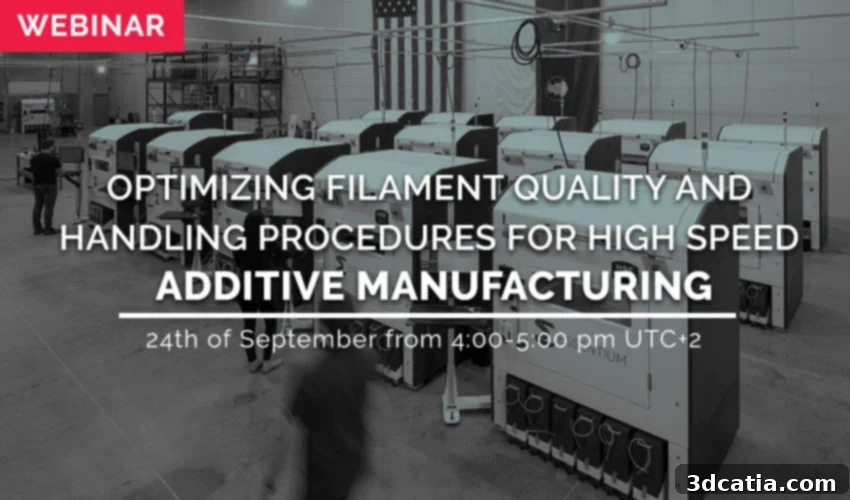
Mastering Industrial FFF: Essential Material Handling for Engineering-Grade 3D Prints
Material extrusion, widely recognized by its popular brand name Fused Filament Fabrication (FFF), continues to dominate the additive manufacturing (AM) market. This foundational 3D printing technology has witnessed significant transformation in recent years, particularly with the introduction of more sophisticated industrial machines and a broader array of compatible, high-performance materials. These advancements are propelling FFF beyond its traditional role in rapid prototyping towards full-scale serial and even industrial production.
Evidence of this shift is clear: a study released by Essentium on the state of industrial 3D printing revealed a remarkable surge in full-scale 3D printing adoption. Between 2018 and 2019, industrial-scale additive manufacturing doubled, climbing from 21% to 40%. This exponential growth underscores the increasing reliance on FFF for critical manufacturing applications, demanding unparalleled precision and reliability.
The Imperative of Repeatability and Quality in Industrial Additive Manufacturing
For these demanding industrial applications, manufacturers face a critical challenge: ensuring absolute repeatability in the production process. Every single part produced must consistently meet the same stringent standards, without deviation. This consistency is not merely a preference but a necessity for components used in aerospace, automotive, medical, and consumer electronics industries, where safety, performance, and regulatory compliance are paramount.
Achieving high-quality parts through material extrusion additive manufacturing hinges on several factors. Primarily, it requires the use of superior quality feedstock materials. However, even the best materials can be compromised without proper material handling procedures. When combined with a capable 3D printer and optimized process parameters, these elements create the foundation for reliable, repeatable, and high-performance industrial 3D printing.
Unlocking Engineering-Grade Performance: A Deep Dive into Material Handling
To address these vital concerns, Essentium and SABIC recently collaborated on a webinar designed to educate manufacturers on the critical specifications and material handling requirements necessary for producing engineering-grade parts on material extrusion platforms. This comprehensive session provided invaluable insights into the science behind polymer behavior and best practices for ensuring material integrity.
Understanding Polymer Classes: Hygroscopic vs. Hydrophobic Materials
The webinar began by reviewing fundamental polymer classes, distinguishing between hygroscopic and hydrophobic materials. Hygroscopic polymers, such as nylons, polycarbonates (PC), PETG, ABS, and high-performance resins like SABIC’s ULTEM™ 9085, readily absorb moisture from the surrounding atmosphere. This absorbed moisture can significantly impact their processing and the mechanical properties of the final printed part.
In contrast, hydrophobic materials, such as polypropylene (PP) and polyethylene (PE), exhibit a much lower affinity for water absorption. While less susceptible to moisture-related issues, they still require careful handling to prevent other forms of contamination. Understanding these distinctions is the first step towards implementing effective material management strategies.
The Detrimental Effects of Moisture on Thermoplastics During Melt Processing
The impact of moisture on hygroscopic thermoplastics during melt processing cannot be overstated. When moist filament enters the hot melt zone of an extruder, the absorbed water rapidly turns into steam. This process can lead to several critical problems, compromising both print quality and part performance:
- Hydrolysis: Water molecules react with the polymer chains, leading to chain scission and a reduction in the polymer’s molecular weight. This molecular degradation directly translates to a significant loss in mechanical properties, including tensile strength, impact resistance, and elongation at break.
- Voids and Bubbles: The formation of steam within the molten polymer creates internal voids and bubbles. These defects weaken the internal structure of the printed part, reducing its density, compromising layer adhesion, and leading to a porous, brittle final product.
- Poor Surface Finish: Bubbles escaping during extrusion can cause an inconsistent and rough surface finish, detracting from the aesthetic appeal and potentially affecting dimensional accuracy.
- Nozzle Clogging and Splattering: Inconsistent steam release can disrupt the smooth flow of material through the nozzle, leading to inconsistent extrusion, nozzle clogging, and material splattering, which results in print failures and wasted material.
- Dimensional Instability: The presence of moisture can contribute to warping, shrinkage, and other dimensional inaccuracies, making it difficult to achieve tight tolerances required for engineering applications.
Sources of Material Contamination and Their Impact
Beyond moisture, the webinar also highlighted other common sources of material contamination and their serious consequences. Dust, dirt, oils from human touch, and airborne particles can all adhere to filament spools. When these contaminants enter the extruder, they can cause:
- Print Defects: Visible flaws on the part surface, discoloration, and inclusions that compromise aesthetic quality.
- Reduced Mechanical Properties: Contaminants can act as stress concentrators within the part, creating weak points that lead to premature failure under load.
- Equipment Damage: Abrasive particles can cause wear and tear on extruder components, particularly the nozzle, leading to costly maintenance and downtime.
- Clogging: Fine particles can obstruct the nozzle, disrupting the print process and requiring manual intervention.
The Critical Role of Filament Specifications: Diameter, Ovality, and Flaws
The physical characteristics of the filament itself play a pivotal role in print consistency and part quality. The webinar meticulously examined how filament specifications, including diameter, ovality, and inherent flaws, can dramatically affect the outcome of a print, with a specific focus on Essentium 9085 filament made with SABIC’s ULTEM™ 9085 resin.
- Diameter Consistency: An ideal filament maintains a precise and uniform diameter throughout its entire length. Any significant deviation in diameter leads to inconsistent material flow through the nozzle. This can result in either under-extrusion (too little material, creating gaps and weak layers) or over-extrusion (too much material, causing blobs and dimensional inaccuracies). Both scenarios compromise part strength, dimensional accuracy, and surface finish.
- Ovality: Ovality refers to a filament’s cross-section not being perfectly circular. Even if the average diameter is within tolerance, an oval shape can lead to inconsistent feeding into the extruder and variable melt flow, producing effects similar to diameter variations. For industrial applications requiring high precision, strict control over ovality is non-negotiable.
- Internal and Surface Flaws: Microscopic voids, impurities, air bubbles, or surface inconsistencies within the filament can act as critical defect points. These flaws, often invisible to the naked eye, can propagate during the printing process, leading to internal weaknesses, poor layer adhesion, and ultimately, part failure. For high-performance materials like ULTEM™ 9085, which are often used in demanding environments, such flaws can have catastrophic consequences.
The webinar emphasized that for engineering-grade materials like Essentium 9085, these specifications are not merely guidelines but absolute requirements. Manufacturers must ensure their filament suppliers adhere to the strictest quality control standards to guarantee optimal performance.
Advanced Equipment for Optimal Material Handling: Introducing the Essentium DryBox™
Recognizing the critical importance of material conditioning, the webinar presented several cutting-edge equipment options for feeding, storing, and drying filament spools. These solutions are vital for maintaining material integrity from storage to extrusion, especially for sensitive engineering polymers. Options included industrial filament drying cabinets that use heated desiccant air to actively remove moisture, and sealed, humidity-controlled storage solutions.
A highlight of the presentation was the introduction of the new Essentium DryBox™. This innovative system is designed to provide an actively controlled environment for filament spools, ensuring they remain in optimal condition throughout the printing process. The DryBox™ offers real-time monitoring of humidity and temperature, actively drying and maintaining the material at ideal levels right up to the print head. This proactive approach significantly mitigates the risks associated with moisture absorption, contributing directly to enhanced print quality, consistency, and reliability for industrial applications.
Insights from Industry Leaders: Our Esteemed Speakers
The webinar benefited immensely from the expertise of its distinguished speakers, who brought a wealth of knowledge from both the material science and additive manufacturing fields.
Speakers

Brandon Sweeney is the Head of Research and Development for Materials and Co-Founder at Essentium, Inc. Brandon spearheads the research and development of the groundbreaking materials Essentium is creating to revolutionize industrial additive manufacturing. He earned his Ph.D. from the Department of Materials Science and Engineering at Texas A&M University, where he played a pivotal role in developing a specialized printer. His doctoral research focused on studying the heating effect of carbon nanotubes when exposed to microwave irradiation, a technique used to weld 3D printed parts at the nanoscale. Prior to his graduate studies at Texas A&M, Brandon served as a research scientist at the Army Research Labs at the Aberdeen Proving Grounds in Maryland. During this tenure, he gained extensive experience in nanotechnology development and 3D printing applications for robotic vehicles, laying the foundation for his innovative work at Essentium.

Constantin Donea currently serves as Senior Product Manager for Additive Manufacturing within SABIC’s Specialties business unit. He holds an M.Sc. in Statistical Physics from Ecole Normale Superieure de Lyon, France, and an MBA from the University of Southern Indiana, showcasing a strong blend of scientific and business acumen. Constantin is also recognized as an inventor on 5 patents, underscoring his innovative contributions to the field. His career commenced with Luxten Lighting in Romania before he joined GE Plastics and subsequently SABIC in 2001. Throughout his tenure, he has held a variety of influential roles in both product development and product management, contributing significantly to SABIC’s advancements in polymer technologies and additive manufacturing solutions.
 Carlota Valdivieso is the Editor-in-Chief of 3Dnatives’ English website. 3Dnatives stands as the largest international online magazine dedicated to 3D printing and its diverse applications. In her role, Carlota is responsible for defining the content that 3Dnatives covers for its English-speaking audience, ensuring readers receive the latest news, insightful analyses, and critical developments concerning the additive manufacturing sector and its far-reaching implications.
The Future of Industrial FFF: A Focus on Integrated Solutions
As the industrial additive manufacturing landscape continues to evolve, the insights shared by Essentium and SABIC highlight a crucial truth: the path to widespread adoption of FFF for engineering-grade parts lies in a holistic approach. This encompasses not only advanced printer technology and high-performance materials but also intelligent, integrated solutions for material handling and quality assurance.
By meticulously managing factors such as moisture content, contamination, and filament specifications, manufacturers can unlock the full potential of materials like ULTEM™ 9085, enabling the consistent production of reliable, high-quality end-use parts. The Essentium DryBox™ exemplifies this commitment to integrated solutions, bridging the gap between material science and practical application. This collaborative effort between material suppliers and equipment manufacturers is vital for pushing the boundaries of what is possible with industrial 3D printing, ensuring that FFF continues its trajectory as a cornerstone of modern manufacturing.