
Revolutionizing Electric Motorcycle Design: Honda and WASP’s Sustainable Clay 3D Printing Approach
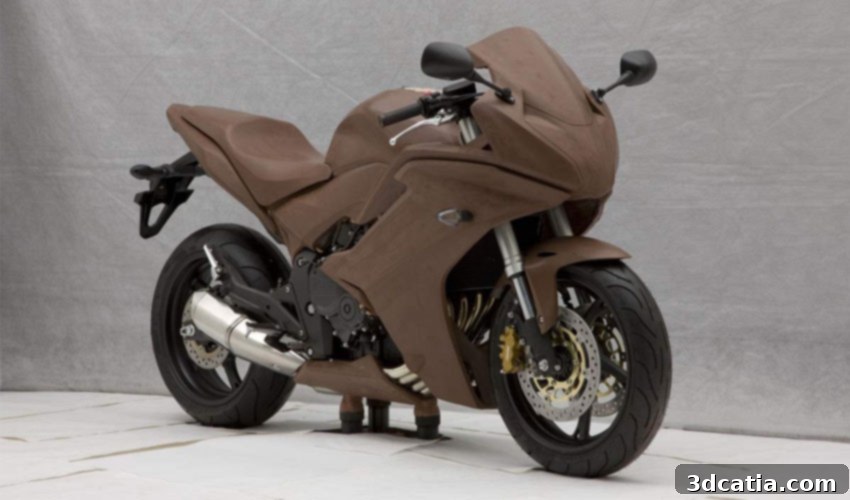
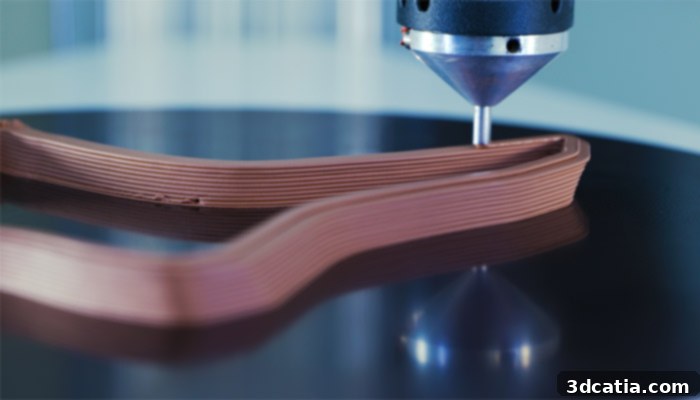
In a significant stride towards future mobility and sustainable design, the renowned car manufacturer Honda has forged an innovative partnership with the Italian 3D printer manufacturer WASP. This collaboration aims to redefine the design process for Honda’s upcoming generation of electric motorcycles, leveraging WASP’s advanced clay extrusion technology. The Japanese automotive giant is utilizing this cutting-edge additive manufacturing method to envision and create futuristic vehicle designs that boast a significantly reduced environmental footprint – a critical objective for a brand committed to ecological responsibility. The immediate goal of this pioneering project is to develop functional prototypes, rigorously evaluate their compliance with Honda’s stringent standards, and assess their potential to meet evolving market demands. A key advantage of this approach lies in its inherent sustainability: should a design not meet the required specifications, the clay material used for 3D printing can be effortlessly recycled and reused. This commitment to circularity perfectly aligns with both Honda’s and WASP’s shared dedication to economic viability and environmental stewardship, setting a new benchmark for sustainable product development in the automotive industry. The specific machine instrumental in this project is the Delta WASP 40100 Clay, a sophisticated printer renowned for its capability to extrude successive, precise layers of industrial clay, bringing complex designs to life with remarkable accuracy and efficiency.
The automotive sector has long embraced additive manufacturing (AM) for a multitude of applications, continually expanding its utility beyond initial expectations. While initially popularized for rapid prototyping, which dramatically accelerated development cycles, AM has progressively become an indispensable tool in the production of finished parts. This evolution is largely due to its unparalleled ability to create components that are significantly lighter yet maintain or even surpass conventional strength levels. This benefit is particularly pronounced with the integration of advanced composite materials and complex lattice structures that are otherwise impossible to achieve with traditional manufacturing methods. Moreover, additive manufacturing has cemented its position as a preferred method throughout the entire design process, empowering engineers and designers to conceive more intricate geometries, optimize existing parts, and swiftly test novel concepts. The iterative design process, crucial for refining products, becomes not only faster but also considerably more cost-effective thanks to AM. These compelling advantages, among others, were pivotal in Honda’s decision to adopt WASP’s innovative technology. Beyond the broad benefits offered by 3D printing, WASP’s specific clay-based technology introduces an additional layer of sustainability, utilizing a more environmentally friendly material. It is worth recalling that the Italian company, WASP, has a distinguished history of pioneering multiple sustainable constructions, often utilizing natural and locally sourced materials, showcasing their expertise in eco-conscious manufacturing and design.
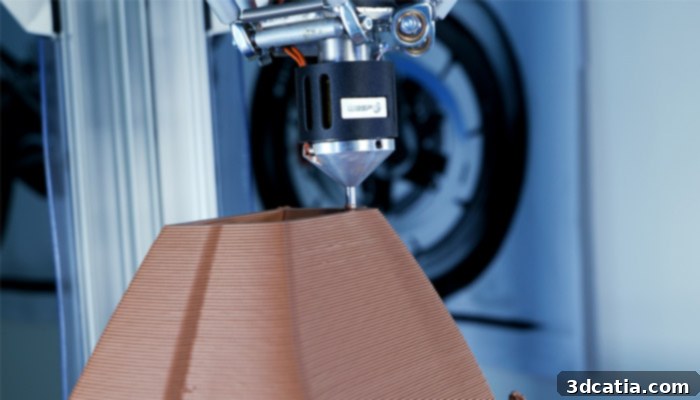
Photo Credits: Honda/WASP
Integrating Clay 3D Printing into Honda’s Design Workflow
At its core, this collaboration sees Honda Europe’s R&D department actively striving to develop truly innovative and groundbreaking designs for its future motorcycle lineup. The deployment of WASP’s advanced 3D printing technology enables them to fabricate intricate clay parts, which can then be seamlessly superimposed onto existing motorcycle frames or prototypes. This allows designers to immediately visualize and critically evaluate the final aesthetic and ergonomic rendering of new components in a tangible, three-dimensional form. This process, in many ways, closely mirrors and enhances traditional clay modeling techniques that have been a cornerstone of automotive design for decades. Essentially, a specific part or design element is first 3D printed in clay, after which Honda’s highly skilled design teams engage in hands-on manual refinement. They meticulously rework the printed clay, sculpting and adjusting it by hand to achieve the precise desired result. This unique hybrid approach represents a sophisticated technological evolution of traditional clay modeling. Crucially, it does not aim to eliminate the invaluable intervention of human modelers; quite the contrary, it empowers them, offering a dynamic tool that streamlines initial iterations while preserving the crucial human element of touch, intuition, and artistic refinement in the creative process.
The Symbiotic Relationship: Technology and Human Craftsmanship
Antonio Arcadu, the discerning design modeling coordinator for Honda R&D Europe, eloquently articulated the philosophy underpinning this innovative methodology. He emphasized, “In order to preserve the creative process, we cannot rely on technology alone, but we need modelers not to interrupt their connection with matter in its most direct form: the hands.” This statement underscores a profound understanding that while technology can accelerate and enhance design, the intuitive connection between a designer’s hands and the material remains irreplaceable for true creative expression and nuance. Arcadu further elaborated on the transformative potential of this new workflow, stating, “Although this is a newly introduced process it can be considered disruptive in the automotive sector because it introduces a new flow, mostly additive, able to optimize processing times and reduce the amount of material used in the traditional and subtractive processes.” This highlights the dual benefits of efficiency and sustainability. By transitioning from traditional subtractive methods, which generate significant material waste through carving, to an additive process, Honda dramatically reduces material consumption. The ability to reuse the 3D-printed clay for subsequent iterations or entirely new prints further amplifies the environmental advantages, making the entire design lifecycle more resource-efficient and economically sensible. This blend of digital precision and artisanal craftsmanship represents a forward-thinking approach that redefines design paradigms in the automotive realm.
The 3D-printed clay can be reused (photo credits: Honda/WASP)
The Broader Impact of Sustainable Additive Manufacturing in Automotive Design
The collaboration between Honda and WASP transcends mere prototyping; it represents a significant leap towards more sustainable and efficient design practices within the entire automotive industry. The capacity to rapidly iterate designs using an eco-friendly, reusable material like clay offers unprecedented advantages. Designers can experiment with bolder, more complex forms and functional geometries without the typical constraints of material cost or waste. This freedom fosters innovation, allowing for radical concepts in electric motorcycle design that might otherwise be deemed too risky or expensive to explore. The environmental benefits are substantial: by adopting a circular economy model for their design materials, Honda significantly reduces its ecological footprint, aligning with global efforts to combat climate change and resource depletion. This move sets a powerful precedent for other manufacturers, demonstrating that high-performance vehicle design can coexist with robust environmental responsibility. WASP’s expertise in large-scale clay 3D printing, honed through its work in sustainable architecture, proves invaluable here, translating robust construction methodologies to intricate automotive design challenges.
Furthermore, the integration of additive manufacturing into the early stages of design has profound implications for product development timelines. What once took weeks or months for physical models can now be achieved in days, allowing for a far more agile and responsive design cycle. This speed not only reduces time-to-market for new models but also enables more comprehensive testing and refinement before committing to costly production tooling. The ability to directly overlay 3D printed clay parts onto existing motorcycle structures provides immediate, tangible feedback, bridging the gap between digital renderings and physical reality. This tactile interaction is crucial for designers who rely on sensory input to make critical judgments about form, balance, and user experience. The partnership showcases how traditional craft skills can be augmented, not replaced, by advanced manufacturing technologies, fostering a richer and more intuitive design environment.
Looking Ahead: The Future of Design and Mobility
The success of this groundbreaking initiative with electric motorcycles holds immense promise for wider applications within Honda’s portfolio and potentially across the entire automotive landscape. It remains an exciting prospect to witness whether this innovative concept, currently proving its worth in motorcycle design, can be effectively scaled and applied to future car models, revolutionizing the design process for entire vehicle lineups. Regardless of its broader implementation, this technique is undoubtedly full of promise, signaling a paradigm shift in how vehicles are conceived, designed, and brought to life. The synergy between Honda’s engineering prowess and WASP’s pioneering 3D printing technology demonstrates a powerful commitment to innovation, sustainability, and human-centric design. This collaboration is not just about manufacturing parts; it’s about shaping the future of mobility with a conscientious approach to resources and environmental impact, while simultaneously enhancing the creative capabilities of designers. It’s a testament to how forward-thinking partnerships can drive significant advancements in both technology and ecological responsibility.
What are your thoughts on this innovative partnership between Honda and WASP, and the potential impact of clay 3D printing on the future of vehicle design? We invite you to share your insights in a comment below or join the discussion on our social media channels, including LinkedIn, Facebook, and Twitter! Don’t miss out on the latest advancements and news in the additive manufacturing world – remember to sign up for our free weekly Newsletter here, delivering the freshest 3D printing updates straight to your inbox! Additionally, you can explore all our engaging videos and content on our dedicated YouTube channel, where we delve deeper into the fascinating realm of 3D printing innovation.