
Solar Gate: Revolutionizing Building Energy Efficiency with 4D Printed Biomimetic Adaptive Facades
The pursuit of indoor comfort, whether heating during winter or cooling in summer, places an immense demand on global energy resources. Consequently, buildings are major contributors to worldwide carbon emissions, significantly impacting climate change. For instance, data from 2020 revealed that single-family homes alone consumed an average of 864 petajoules of heating energy – a staggering figure that underscores the urgent need for more sustainable architectural solutions. Addressing this critical challenge, researchers at the esteemed Universities of Stuttgart and Freiburg have unveiled a groundbreaking innovation: a self-sufficient façade system known as Solar Gate. This pioneering system autonomously adapts to fluctuating weather conditions, leveraging the transformative power of 4D printing and the principles of biomimicry, drawing profound inspiration from nature’s elegant designs.
Solar Gate represents a monumental leap in architectural design, emerging as the world’s premier adaptive shading system capable of operating entirely independent of external electrical power. Its remarkable ability to respond dynamically to environmental cues without consuming metabolic energy is directly inspired by one of nature’s most ingenious mechanisms: the pine cone. Pine cones possess an innate ability to open and close their scales in response to changes in humidity or temperature. This natural, energy-free actuation provided the fundamental blueprint for the Solar Gate project. By studying the intricate, direction-dependent structure of cellulose in plant tissues, the interdisciplinary research team successfully replicated this phenomenon using advanced 3D printing technologies. This approach highlights the potential for bio-inspired design to significantly enhance building performance and sustainability.
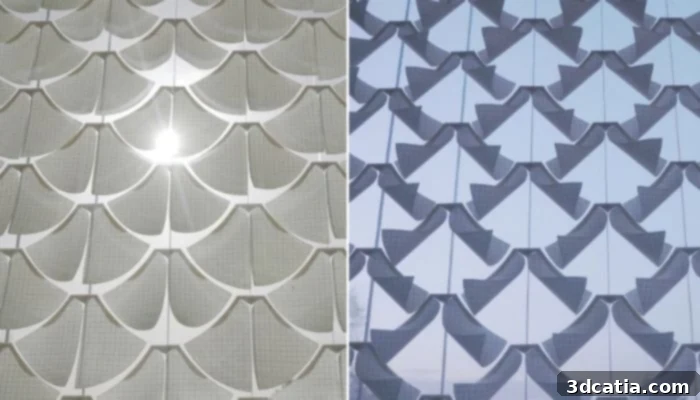
Thanks to bio-inspired 4D printing and cellulose materials made from renewable raw materials, the team has developed a system that automatically adapts to changes in the weather. (Photo credit: ICD/IntCDC University of Stuttgart)
Professor Achim Menges, a leading figure in the project and Head of the Institute for Computer-Based Design and Construction at the University of Stuttgart, eloquently explains the core philosophy: “Weather-responsive architectural façade systems usually rely on complex technical devices. Our research investigates how we can harness the responsiveness of the material itself through computer-based design methods and additive manufacturing. We have developed a shading system that opens and closes independently depending on weather conditions, without the need for any operating energy or mechatronic elements. The biomaterial structure itself is the machine.” This statement perfectly encapsulates the paradigm shift offered by Solar Gate – moving away from energy-intensive mechanical systems towards intelligent, self-actuating materials that inherently possess the desired functionality. This innovative concept holds profound implications for the future of sustainable architecture, promising to drastically reduce the operational energy demands of buildings globally.
The selection of cellulose as the primary material for Solar Gate was a deliberate and strategic choice. Cellulose is not only an exceptionally abundant and renewable resource, making it highly sustainable, but it also possesses a remarkable property known as hydromorphism. This characteristic enables cellulose to react dynamically to changes in humidity by either swelling or shrinking. This natural responsiveness is widely observed throughout the plant kingdom, from the opening and closing of pine cone scales to the movements of various seed pods. The research team ingeniously harnessed this inherent property, fabricating bio-based cellulose fibers into a sophisticated two-layer structure. This structure, meticulously designed to mimic the scales of a pine cone, was then realized through advanced 4D printing techniques. The result is a material system that can autonomously alter its shape in direct response to environmental influences, such as changes in moisture levels in the air, without any external energy input. This passive actuation mechanism is key to the system’s self-sufficiency and low environmental footprint.
To ensure the precise and predictable behavior of Solar Gate, the researchers developed an advanced computer-controlled manufacturing method. This method allows for the meticulous control of cellulose material extrusion using standard 3D printers, transforming them into tools for 4D printing. This innovative approach capitalizes on the intrinsic self-forming behavior of 4D-printed material systems. The specially engineered cellulose elements are designed to curl or open in a controlled manner. When humidity levels are high, the cellulosic materials absorb moisture, causing them to swell and expand, leading to a specific shape change. Conversely, at low humidity, these materials release their absorbed moisture and contract, causing the printed elements to flatten and close. This elegant interplay of material science and digital fabrication allows for the creation of intricate, responsive structures that are precisely tuned to their environment. The ability to program material behavior directly into the manufacturing process opens new avenues for creating truly adaptive and sustainable building components, moving beyond static designs to dynamic, living architectures.
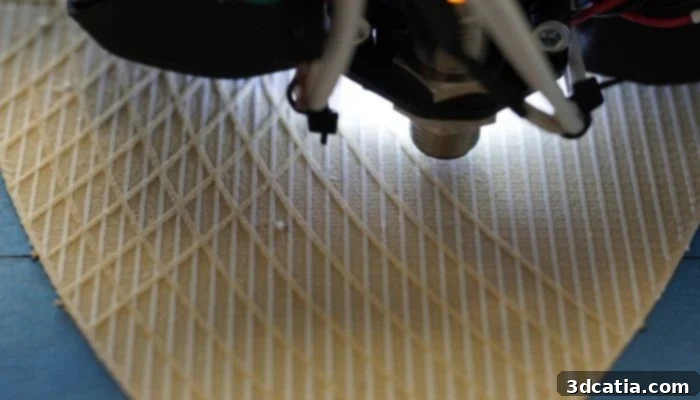
The two-layer structure is produced from cellulose-containing materials (Image: ICD/IntCDC University of Stuttgart)
Professor Thomas Speck, head of the Plant Biomechanics Group Freiburg and spokesperson for the Cluster of Excellence Living, Adaptive and Energy-autonomous Materials Systems (livMatS) at the University of Freiburg, underscores the project’s exceptional achievement: “Inspired by the hygroscopic movements of pine cone scales and the bracts of the silver thistle, the Solar Gate has succeeded in transferring not only the high functionality and robustness of the biological models into a bio-inspired shading system but also the aesthetics of plant movements. This can be regarded as the ‘royal road of bionics’, as everything that fascinates us about the biological source of ideas has also been realized in the bio-inspired architectural product.” This profound statement highlights that Solar Gate is not merely a functional replica but a holistic embodiment of nature’s principles, seamlessly blending performance with the inherent beauty of biological forms. It demonstrates how biomimicry can elevate architectural design beyond pure utility, creating structures that are both highly efficient and aesthetically engaging, fostering a deeper connection between buildings and their natural surroundings.
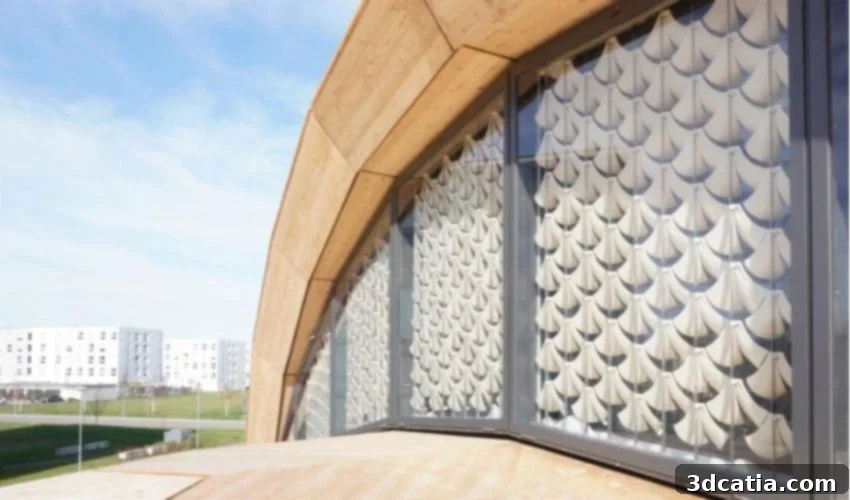
The practical integration of Solar Gate into contemporary architecture has been rigorously tested. The system’s functionality and durability underwent a full year of evaluation under authentic weather conditions, demonstrating its robust performance and resilience. Following this successful testing phase, Solar Gate was strategically installed on the livMatS Biomimetic Shell. This structure serves as the building demonstrator for the Cluster of Excellence IntCDC and the Cluster of Excellence livMatS, acting as a cutting-edge research building for the University of Freiburg. Specifically, the 4D-printed shading system was positioned on a south-facing skylight, where it actively contributes to the building’s climate regulation. This real-world application not only validates the system’s design but also provides invaluable data for future development and broader implementation in diverse architectural contexts. The successful deployment underscores the potential for such adaptive systems to move from theoretical concepts to practical, impactful solutions in building design.
The operational logic of Solar Gate is elegantly simple yet incredibly effective for optimizing indoor climate control. During the colder winter months, the façade elements are designed to open, allowing maximum sunlight to penetrate the building. This passive solar gain significantly contributes to warming the interior, reducing the need for conventional heating systems and thereby saving energy. Conversely, as temperatures rise in the summer, the elements automatically close, creating shade and preventing excessive solar radiation from entering the building. This crucial mechanism helps to mitigate overheating, minimizing the reliance on energy-intensive air conditioning. What makes this system truly revolutionary is that the entire process of opening and closing is governed solely by natural changes in weather conditions, eliminating the need for complex electronics, sensors, or power sources. This passive, self-regulating design represents a huge advancement for future architecture, demonstrating the immense potential of additive manufacturing techniques and renewable materials like cellulose to create truly sustainable and energy-efficient building skins. Such innovations pave the way for a future where buildings actively collaborate with their environment, rather than constantly fighting against it, leading to significant reductions in global energy consumption and carbon footprints. Find out more about Solar Gate by exploring the detailed scientific publication HERE.
What are your thoughts on the groundbreaking Solar Gate system and its potential to reshape sustainable architecture? We invite you to share your insights in a comment below or join the discussion on our LinkedIn, Facebook, and Twitter pages. To stay updated with the very latest in 3D printing news and innovations, don’t forget to sign up for our free weekly Newsletter here, delivered straight to your inbox. You can also discover more about the fascinating world of additive manufacturing by exploring all our videos on our dedicated YouTube channel.
*Cover Photo: ICD/IntCDC University of Stuttgart