
Prvok: Pioneering the Future with the Czech Republic’s First 3D Printed Floating Home
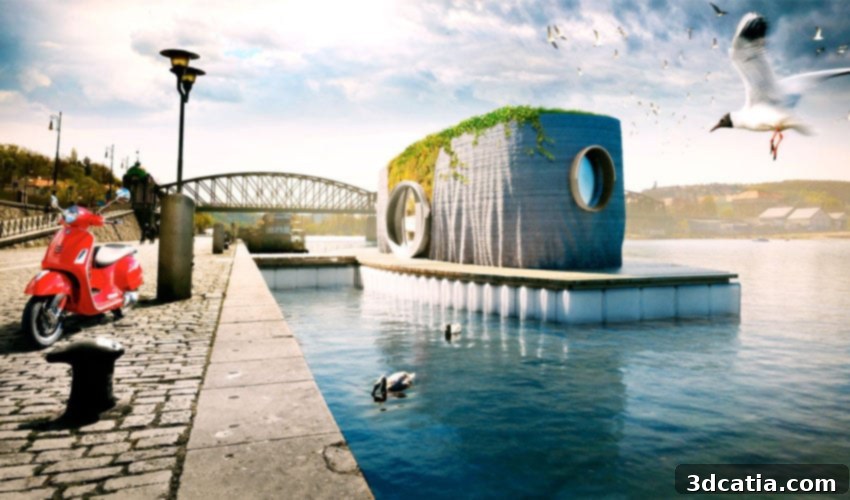
Imagine a home that defies conventional boundaries, not only gracefully floating on water but also ingeniously constructed through the marvel of additive manufacturing. This vision is rapidly becoming a reality in the Czech Republic with the groundbreaking project known as Prvok. This innovative small structure is set to revolutionize sustainable living, boasting not only 3D printed walls but also the distinction of being built directly on water – a pioneering achievement for the nation. Conceived by the visionary architect Michal Trpak of the esteemed Scoolpt architecture studio, this extraordinary 3D printed floating house, measuring a comfortable 43 square meters, is slated for erection in the coming months, marking a significant milestone in architectural innovation and eco-conscious design.
The construction sector has witnessed a profound transformation thanks to the advent of 3D printing technology. This revolutionary approach is already delivering remarkable results, notably in the rapid fabrication of entire homes. Reports frequently highlight how 3D printing drastically cuts down construction timelines, often saving significant costs on both materials and labor. While many contemporary 3D printed structures primarily feature printed walls and serve as conceptual proofs, these initiatives are crucial. They represent encouraging steps forward, continually demonstrating how additive manufacturing is not merely a tool but a force fundamentally rethinking and reshaping our traditional value chains in construction. The Prvok project, therefore, signifies a monumental first for the Czech Republic – not only introducing a 3D printed house to its landscape but one that also embraces the unique challenge and opportunity of floating architecture.
Visual Concept: The innovative 3D printed floating house, Prvok, destined for the Czech Republic.
Unveiling Prvok: Design and Structural Superiority
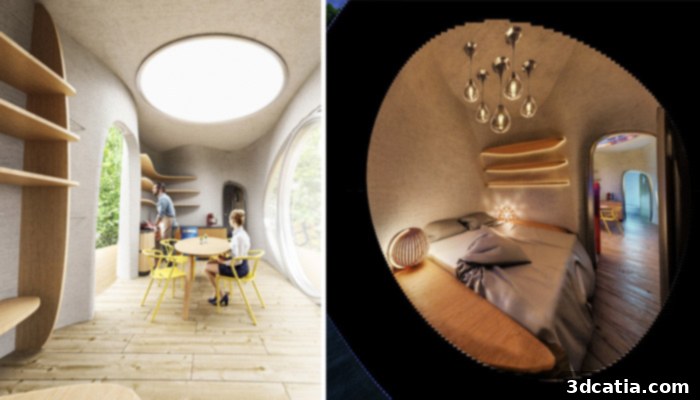
At the heart of the Prvok project is the innovative Scoolpt studio, collaborating strategically with the renowned construction firm Stavebni sporitelna Ceske sporitelny. Together, they have conceptualized a compact yet highly functional 43-square-meter structure, thoughtfully designed to maximize living space and comfort. The layout includes three distinct areas: a welcoming living room seamlessly integrated with a modern kitchen, a tranquil bedroom, and a well-appointed bathroom, ensuring all essential amenities are within a small footprint. A cornerstone of Prvok’s design philosophy is its commitment to structural integrity and efficiency. According to the studio’s extensive research and development, the 3D printed walls of Prvok are engineered to possess an impressive strength, reportedly three times greater than those constructed using conventional concrete methods. This remarkable durability doesn’t come at the cost of speed; the entire wall structure is anticipated to be erected in an astonishing 48 hours. This rapid construction significantly contributes to reducing overall building costs by up to 50%, while simultaneously making a substantial positive impact on the environment by minimizing CO2 emissions. Following the swift erection of the primary structure, an additional two months will be allocated for the meticulous interior finishing and installation of various systems before the dwelling is ready for its first inhabitants.
The unprecedented strength and efficiency achieved in Prvok’s walls are directly attributable to the advanced materials and printing techniques employed. Unlike standard concrete, the specialized concrete mix used for 3D printing is enriched with nano-polypropylene fibres and plasticizers. Nano-polypropylene fibres serve to significantly enhance the tensile strength and crack resistance of the concrete, making the walls incredibly robust and less prone to damage from stress or environmental factors. Plasticizers, on the other hand, improve the workability and flow of the concrete mix during the printing process, allowing for precise layering and faster deposition without compromising structural integrity. This combination results in a highly durable, resilient, and energy-efficient building envelope, a testament to the advantages of integrating material science with additive manufacturing in architecture. The ability to customize the concrete mix for specific performance requirements truly sets 3D printed construction apart, offering superior material properties compared to traditional cast-in-place concrete.
A Symphony of Sustainability: Eco-Technologies at Prvok’s Core
Beyond its innovative construction method, the Czech floating house, Prvok, stands as a beacon of ecological responsibility, meticulously designed to integrate a suite of advanced eco-technologies aimed at minimizing its environmental footprint and maximizing self-sufficiency. Anchored securely to a pontoon, this sustainable dwelling incorporates sophisticated water management systems, including highly efficient water recovery mechanisms that capture and treat rainwater for various uses, significantly reducing reliance on external water sources. A cutting-edge recirculation shower system further conserves water by filtering and reusing shower water, offering a sustainable bathing experience without compromise. The roof of Prvok will be adorned with a vibrant green roof, providing natural insulation, enhancing biodiversity, and absorbing rainwater, contributing to a cooler interior in summer and warmer in winter. Furthermore, the house will be equipped with multiple tanks for drinking water, utilities, and careful wastewater management, ensuring a closed-loop system that champions responsible resource utilization. These integrated systems collectively underscore Prvok’s commitment to a truly sustainable lifestyle, setting a new benchmark for eco-friendly housing solutions.
The thoughtful inclusion of these green building technologies transforms Prvok into more than just a house; it becomes a living laboratory for future sustainable urban planning. The water recovery system, for instance, can drastically cut down municipal water consumption, especially in regions prone to water scarcity. The green roof not only insulates but also acts as a natural air purifier and a habitat for local flora and fauna, mitigating the urban heat island effect often seen in densely populated areas. By efficiently managing its own water resources and generating minimal waste, Prvok embodies the principles of a circular economy, where resources are kept in use for as long as possible, extracting the maximum value from them whilst in use, then recovering and regenerating products and materials at the end of their service life. This holistic approach to sustainability is critical for addressing global environmental challenges and inspires future developments in residential construction.
The Robotic Revolution: Precision in Printing
Delving into the specifics of the construction process, the Scoolpt studio details the sophisticated printing technology that brings Prvok to life. The core of this innovative construction method lies in the deployment of a highly advanced robotic arm. This robotic arm is not just fast but incredibly precise, capable of depositing the specially formulated concrete mix at an impressive speed of 15 centimeters per second. This rapid deposition rate is crucial for achieving the project’s ambitious construction timeline of just 48 hours for the main structure. The concrete itself is a proprietary blend, meticulously developed to optimize both printability and structural performance. As previously mentioned, it is generously enriched with nano-polypropylene fibres, which enhance its tensile strength and resistance to cracking, and plasticizers, which ensure optimal flow and adhesion between layers. This combination allows for the creation of seamless, robust walls that outperform traditional concrete in durability and structural integrity. The robotic arm’s programmed precision ensures that each layer is laid down with exacting accuracy, contributing to the overall stability and aesthetic quality of the final structure, pushing the boundaries of what is possible in automated construction.
The integration of robotic arms in construction signifies a major leap forward, promising higher quality, greater efficiency, and enhanced safety on construction sites. For Prvok, this means reduced human error, consistent material application, and the ability to execute complex geometries that would be challenging or impossible with manual labor. The rapid deposition rate of 15 cm per second highlights the scalability of this technology, indicating that larger structures could be printed just as efficiently. Furthermore, the ability to precisely control the material composition and layer thickness ensures that the structural performance is optimized for the unique demands of a floating house. This level of automation not only accelerates the building process but also reduces waste, as the robot only deposits material where it is needed, minimizing off-cuts and excess. This efficiency in material usage directly translates into reduced environmental impact and lower project costs, further cementing the case for additive manufacturing in sustainable architecture.
Longevity and the Circular Economy: A 100-Year Vision
A cornerstone of Prvok’s philosophy is its commitment to long-term sustainability and resource stewardship. Michal Trpak, the visionary architect behind the project, proudly asserts that the 3D printed structure is designed for an impressive lifespan of 100 years. This century-long durability is a testament to the advanced material science and engineering principles applied in its construction, ensuring that Prvok will serve generations. But the ambition doesn’t end there. In a truly forward-thinking approach, Trpak also emphasizes the concept of material reuse. Once Prvok reaches the end of its remarkable 100-year service life, the materials used in its construction are not destined for landfill. Instead, they are engineered to be reprocessed and repurposed, enabling the creation of entirely new structures. This commitment to a circular economy model represents a significant departure from traditional linear construction practices, where materials are often used once and then discarded. By allowing for the reclamation and reuse of building components, Prvok offers a compelling blueprint for reducing waste, conserving natural resources, and fostering a more sustainable future for the construction industry.
The implications of designing a building with a 100-year lifespan and built-in recyclability are profound. Such an approach significantly reduces the overall carbon footprint of a structure over its entire lifecycle. The ability to reuse materials minimizes the demand for virgin resources, lowers energy consumption associated with manufacturing new materials, and drastically cuts down on construction and demolition waste. This vision aligns perfectly with the principles of the circular economy, which advocates for keeping resources in use for as long as possible, extracting maximum value from them, and then recovering and regenerating products and materials at the end of their service life. For Prvok, this means that the investment in innovative 3D printing and advanced materials pays dividends not just in immediate construction efficiency but also in long-term environmental benefits, inspiring a new paradigm for responsible building and living.
Setting Sail: Project Timeline and Impact
The construction of Prvok is an eagerly anticipated event, with the project expected to commence its printing phase in June. Following the rapid two-day erection of its robust 3D printed walls and an additional two months for interior outfitting and system integration, the first fortunate inhabitants are projected to move in by August, provided all aspects of the ambitious timeline proceed as planned. This swift turnaround from groundbreaking to inhabitation underscores the transformative potential of 3D printing in significantly accelerating housing delivery. The successful realization of Prvok will not only mark a proud moment for the Czech Republic but also serve as a powerful proof-of-concept for the global construction industry. It demonstrates the viability and advantages of integrating additive manufacturing with sustainable design principles to create highly efficient, environmentally friendly, and unique living spaces. This pioneering project opens doors for broader adoption of 3D printing in both conventional and unconventional architectural contexts, potentially paving the way for more affordable, customizable, and sustainable housing solutions worldwide. Further details and updates on this remarkable project can be found directly from the source HERE.
What are your thoughts on this groundbreaking project, Prvok? Do you envision 3D printed floating houses as the future of sustainable living? Share your insights and opinions in a comment below. Engage with us and stay updated on the latest innovations in 3D printing by joining our vibrant communities on our Facebook and Twitter pages! For a direct dose of all the cutting-edge news in additive manufacturing delivered straight to your inbox, don’t forget to sign up for our free weekly Newsletter.