
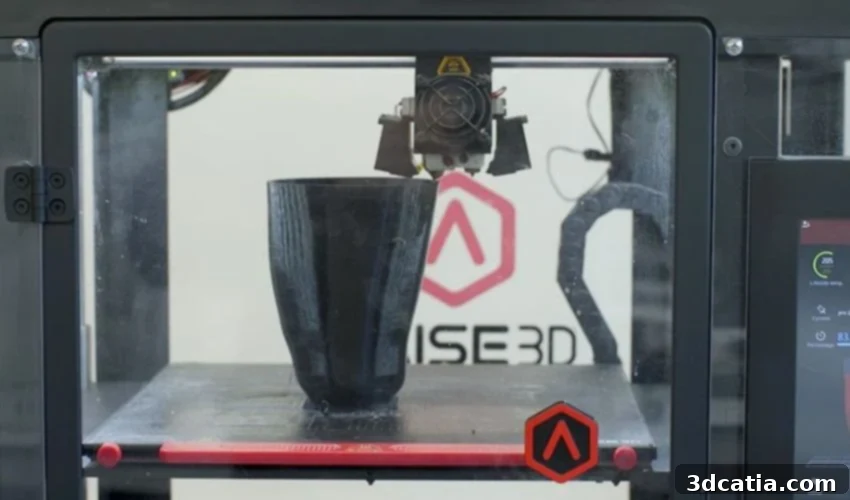
Revolutionizing Prosthetics: 3D Printing Enables Decentralized Manufacturing of Limb Sockets
The rapid advancements in 3D printing technology have firmly established it as one of the most transformative forces in the medical sector. Its unparalleled ability to create highly customizable and patient-specific solutions has made it particularly impactful in the realm of prosthetics and orthotics. These devices, by their very nature, demand precise individual tailoring to ensure comfort, functionality, and optimal patient outcomes. Despite the clear benefits, widespread adoption has faced significant hurdles, primarily due to the current necessity for these advanced 3D printed prosthetics to be manufactured within specialized hospital settings. This centralized production model limits accessibility, especially for individuals in remote or underserved areas. However, groundbreaking new research from Loughborough University promises to dismantle these barriers. Researchers there have announced a significant breakthrough in the creation of 3D printed prosthetic sockets, introducing a fully digital design-to-manufacturing process. This innovation holds the potential to allow lower limb prosthetic sockets to be printed not only in local community centers but even directly in users’ homes, marking a pivotal shift towards decentralized healthcare.
Understanding the Critical Role of Prosthetic Sockets
For those outside the medical field, the concept of a “prosthetic socket” might seem abstract. Essentially, it is the crucial interface that connects a person’s residual limb – often referred to as a stump – to the prosthetic device itself. Its design and fit are paramount, serving as the foundation for the entire prosthetic system. A well-fitting socket is indispensable for ensuring stability, comfort, and the overall functional success of the prosthesis. Conversely, a poorly fitted socket can lead to a cascade of debilitating issues, including severe skin irritation, painful pressure sores, instability during movement, and ultimately, a significant reduction in the user’s quality of life and mobility.
The traditional manufacturing process for prosthetic sockets is notoriously complex, time-consuming, and labor-intensive. Each socket requires a high level of specialized expertise from skilled prosthetists, involving intricate casting, molding, and fabrication steps. This bespoke process typically takes a considerable amount of time, often ranging from three to six weeks for a single socket. Beyond the initial creation, prosthetic sockets also have a limited lifespan. They are subject to wear and tear, and more critically, residual limbs can change in size and shape due to muscle atrophy, fluid retention, or weight fluctuations. Consequently, sockets must be replaced regularly – typically every three to six months for adults, and even more frequently for growing children. This ongoing need for replacement further exacerbates the logistical and financial burdens associated with prosthetic care.
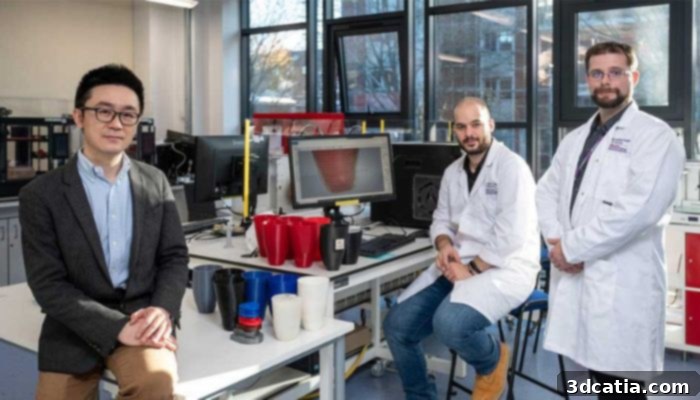
Dr. Simin Li and his team are working on creating 3D printed prosthetic limb sockets
The Loughborough University Breakthrough: Democratizing Prosthetic Access
The challenges of prosthetic socket production are amplified in areas with limited healthcare infrastructure, such as remote geographical regions or economically disadvantaged communities. These populations often face immense difficulties accessing the specialized facilities and expert professionals required for traditional socket fabrication. This is precisely where the pioneering research from Loughborough University, spearheaded by Dr. Simin Li, a Senior Lecturer in Mechanics of Biomaterials within the School of Mechanical, Electrical and Manufacturing Engineering, offers a transformative solution. Dr. Li and his dedicated team have engineered a fully digital process that enables the production of limb sockets using 3D printing technology, critically, even outside conventional hospital environments. This shift promises to dramatically enhance access to life-changing prosthetic care, regardless of location.
Dr. Li’s Vision: A Future of On-Demand, Personalized Prosthetics
Dr. Li articulated the profound advantages of this “groundbreaking” process, emphasizing its potential to reshape prosthetic care. He stated, “By using a fully digital design-to-manufacturing workflow and additive manufacturing – or ‘3D printing’ as it’s commonly known – our entire process for creating a socket is quantitative and iterative, therefore, highly customizable, repeatable, and efficient.” This means that every step, from initial assessment to final production, is data-driven and can be refined continuously, ensuring unparalleled precision and personalization. The quantitative nature of the process allows for exact measurements and material properties to be applied, while its iterative capability means designs can be quickly adjusted and re-printed to achieve a perfect fit without extensive manual rework.
The long-term vision for this project is equally ambitious and patient-centric. Dr. Li continued, “The ultimate goal for this project is to make the design and manufacturing process easier and more accessible for both the healthcare professions and user so that one day the prosthetic socket can be manufactured in local community areas, hospitals and even in users’ homes on demand.” This vision moves beyond mere convenience; it speaks to a future where geographical location no longer dictates access to essential medical devices. By enabling local and even in-home manufacturing, wait times would be drastically reduced, costs potentially lowered, and the overall experience for prosthetic users significantly improved. This decentralized model also empowers healthcare professionals by streamlining their workflow, allowing them to focus more on patient care rather than laborious fabrication processes.
Making Prosthetic Limb Sockets With 3D Printing: A Digital Workflow
To bring this vision to fruition, Dr. Li’s team has seamlessly integrated various advanced technologies and sophisticated coding into a cohesive, fully digital workflow for prosthetic socket production. The process begins with precise digital data acquisition:
-
3D Scanning the Limb: The initial and critical step involves accurately scanning the residual limb. Unlike traditional plaster casting, which can be messy and imprecise, 3D scanning captures the exact geometry of the limb with high resolution. This digital model serves as the foundation for the personalized design.
-
Personalized Design with CAD Software: Once the limb is scanned, a personalized design profile for the socket is meticulously crafted using advanced CAD (Computer-Aided Design) software. This phase allows for highly customized adjustments, taking into account pressure points, bony prominences, and other critical anatomical features to ensure optimal comfort and fit. The design can be iterated quickly based on specific patient needs and preferences.
-
3D Printing the Socket: The finalized CAD file is then imported into a 3D printer for fabrication. The researchers suggest that even accessible solutions like a desktop FFF (Fused Filament Fabrication) printer could be utilized for this purpose. This opens up possibilities for using a range of materials, including lightweight, durable thermoplastics that can be tailored for specific strength and flexibility requirements.
-
Remote Expert Consultation: Recognizing that not all users or local communities will have expert designers on hand, the process includes a crucial remote consultation feature. Users can scan their limb, securely send the digital scan data to a healthcare expert located anywhere in the world, who can then process the information, refine the design, and return a customized design file. This file can then be used for local printing, effectively decentralizing expert medical advice and manufacturing capabilities.
This innovative workflow dramatically overcomes numerous geographical and logistical barriers. It makes personalized medical devices significantly more accessible, bringing high-quality prosthetic care closer to the individuals who need it most, whether they are in urban centers or remote villages.
Impressive Performance and Real-World Impact
While the concept might sound like something from science fiction, Dr. Li’s team has achieved remarkable and tangible success. Their extensive research and development have demonstrated not only the feasibility but also the superior performance of these 3D printed prosthetic sockets. A key achievement has been the ability to customize designs to vary the mechanical properties of the socket – making them harder or softer – depending on the user’s specific activities and requirements. This flexibility opens up the use of 3D printed prosthetics for a much broader range of applications, from everyday walking and casual activities to high-intensity sports and demanding physical occupations.
Furthermore, rigorous testing has yielded exceptionally promising results regarding the structural integrity and durability of the prototypes. These 3D printed sockets have demonstrated the capacity to bear substantial loads, ranging from 6,000 to 16,000 Newtons. To put this into perspective, this is equivalent to supporting anywhere from seven to twenty times a person’s average body weight. This impressive feat underscores the robustness and reliability of the digitally manufactured sockets, confirming their ability to withstand the strenuous demands of daily use and strenuous activities, ensuring user safety and confidence. Such performance validation is critical for clinical acceptance and demonstrates the potential for these advanced sockets to match or even surpass the performance of traditionally manufactured counterparts, while offering unprecedented customization and accessibility.
Paving the Way for a Future of Accessible Medical Devices
Dr. Li concluded his insights with an inspiring vision for the future, stating, “I hope to see this research one day benefiting lower limb prosthetic users worldwide and kick-start broader discussions about using 3D printing for medical devices and beyond. Currently, the entry barriers for accessing healthcare facilities, medical professionals, and 3D printing techniques in remote locations is too high. We believe our research will not only break down these barriers, but act as a catalyst for other exciting innovations that utilize 3D printing.” His words resonate with the core mission of this research: to address inequities in healthcare access and to leverage advanced manufacturing for global good.
The implications of this breakthrough extend far beyond prosthetic sockets. By demonstrating a viable model for decentralized, expert-guided 3D printing of complex medical devices, Loughborough University’s work could serve as a blueprint for numerous other applications. From custom orthotics and assistive devices to surgical guides and patient-specific implants, the ability to manufacture on-demand, closer to the point of need, could fundamentally alter healthcare delivery globally. It promises a future where access to essential medical technologies is no longer dictated by geographic location or economic status, but by individual need and innovative solutions. This research truly acts as a powerful catalyst, inviting wider discussion and investment in the transformative potential of 3D printing in medicine.
You can find out more on the dedicated website HERE.
What are your thoughts on Dr. Li’s innovative research and the potential for 3D printed prosthetic sockets to be manufactured anywhere in the world? We invite you to share your perspectives in a comment below or join the conversation on our LinkedIn, Facebook, and Twitter pages! Don’t forget to sign up for our free weekly Newsletter here, to get the latest 3D printing news delivered straight to your inbox! You can also find all our compelling videos on our YouTube channel.
*All Photo Credits: Loughborough University