
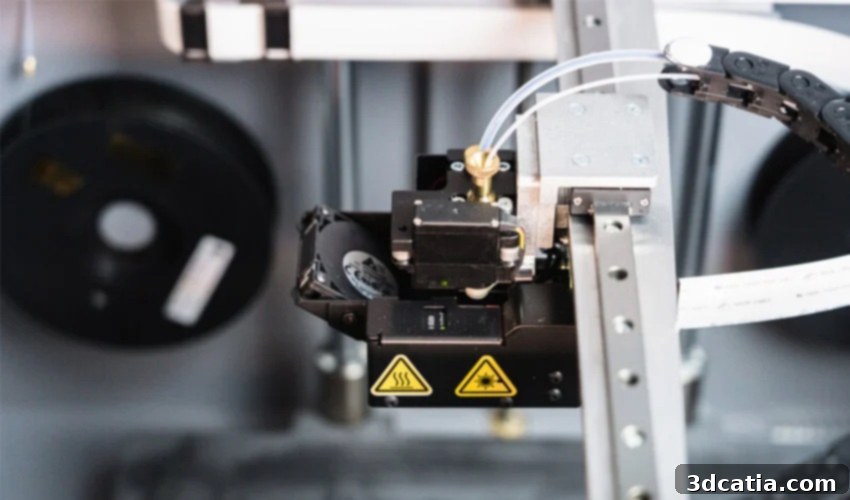
Pioneering Algorithm Optimizes FDM 3D Printing for Flawless Continuous Fiber Composites
The rapid advancements in additive manufacturing continue to redefine possibilities in material science and engineering. A significant breakthrough has recently emerged in the realm of Fused Deposition Modeling (FDM) 3D printing, specifically targeting the complex challenge of incorporating continuous fiber composites. Scientists have developed an innovative algorithm designed to meticulously plan the path of the FDM print head, aiming to eliminate a critical flaw: intersection points on the same print layer. These intersections are detrimental, as they can cause breaks in the crucial fiber bundles embedded within the polymer matrix, severely compromising the structural integrity of the final part. With this intelligent new algorithm, users gain unparalleled control over composite prints, enabling the production of substantially more resistant, durable, and high-performance components. The research team behind this project ingeniously utilized principles from graph theory, specifically an Eulerian graph model, and Hierholzer’s algorithm, to generate an optimized, continuous printing path that adeptly integrates and adapts to various printing constraints.
The Growing Demand for Composite Materials in Additive Manufacturing
Composite materials have become increasingly popular among additive manufacturing users due to their exceptional properties. These materials offer a superior weight-to-strength ratio, often outperforming traditional metals in applications requiring high specific stiffness and strength, all without sacrificing the geometric complexity that is a hallmark of 3D printing. This powerful combination of lightweight performance and design freedom has spurred an impressive expansion in the sector, with the composite 3D printing market growing rapidly as more manufacturers introduce sophisticated continuous fiber 3D printing solutions. It’s crucial to distinguish between the two primary methods of incorporating fibers in 3D printing: short fiber reinforcement and continuous fiber reinforcement.
Short fibers are typically mixed directly into the base polymer filament, which is then extruded by a standard FDM machine. While this improves the mechanical properties compared to unreinforced plastics, the short, discontinuous nature and often random orientation of the fibers provide limited structural enhancement. Conversely, continuous fiber 3D printing involves depositing unbroken strands of fiber simultaneously with the thermoplastic matrix. This process requires a specialized 3D printer capable of co-extruding both materials, enabling strategic placement of fibers along anticipated stress lines. While continuous fiber composites offer significantly higher strength, stiffness, and fatigue resistance, their precise deposition introduces considerable complexity in terms of nozzle trajectory and slicing. A critical issue arises when too much material is deposited on the same layer, especially at points where fiber paths are designed to cross. These intersection points create localized stress concentrations that can lead to catastrophic breaks in the continuous fiber bundle, thereby undermining the intended mechanical performance of the component. Consequently, limiting or completely avoiding areas where fibers can intersect on a single layer is paramount for achieving reliable and strong continuous fiber 3D prints.
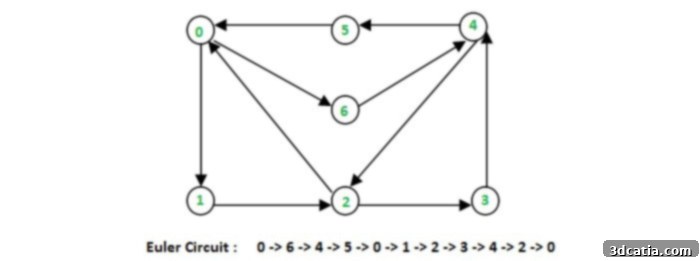
The team relied on an Eulerian path, as conceptually illustrated above, to ensure continuous, unbroken fiber deposition.
Engineering Flawless Paths: The Algorithmic Breakthrough
It was precisely this challenge of fiber intersection that became the focal point of the scientists’ innovative research. The core idea was to generate a ‘single-stroke’ printing path – a continuous trajectory that would deposit all the fiber material for a given layer without ever lifting or cutting the filament. This approach inherently prevents the formation of destructive intersection points. This concept naturally led the team to model the printing process using an Eulerian graph, a fundamental concept in graph theory. An Eulerian graph (or path) is one in which it is possible to traverse every edge exactly once, much like drawing a figure without lifting your pen or retracing any line. By mapping the fiber deposition lines as edges in a graph, the goal was to find a continuous route that covered all required fiber segments for an entire layer, ensuring an uninterrupted flow of material.
To translate this theoretical framework into a practical solution, the researchers employed Hierholzer’s algorithm, a renowned method for efficiently finding Eulerian paths and cycles within a graph. By adapting Hierholzer’s algorithm, the team successfully developed a precise and optimal printing path for the FDM 3D printer head. Each calculated step within the algorithm’s output corresponds to a segment of this continuous, single-stroke path, guaranteeing that the fiber is deposited smoothly and without breaks. Beyond its fundamental ability to generate a continuous path, a key advantage of this algorithm is its capacity to integrate and adapt to various complex constraints. These might include intricate part geometries, specific desired fiber orientations for anisotropic performance, hardware limitations such as nozzle diameter or print speed, and even the rheological properties of the matrix material. This adaptability ensures that the algorithm can be customized for a diverse range of applications and material combinations, providing unprecedented control over the fiber deposition process. To rigorously validate their findings, the team proceeded to 3D print three distinct structures using their optimized path, subsequently analyzing the internal fiber architecture with a high-resolution X-ray scanner, the ScanXmate-L080TT.
Experimental Validation and Future Refinements
While the initial experimental results unequivocally demonstrated the algorithm’s significant potential, the team did observe some minor imperfections, primarily concentrated on the curved sections of the printed vertices. These slight deficiencies are likely attributed to the inherent challenges of precisely maintaining fiber alignment and consistent material flow when navigating sharp curvatures. However, these observations provide valuable feedback for further refinement. The research team is now actively engaged in fine-tuning the algorithm’s parameters to mitigate these defects. This ongoing optimization effort focuses on enhancing fiber alignment accuracy and ensuring the exceptional reproducibility of complex shapes, particularly where intricate curves and contours are involved. Achieving perfect fiber alignment in these challenging regions is crucial, as even minor misalignments can lead to localized stress concentrations, thereby diminishing the intended benefits of continuous fiber reinforcement and affecting the overall strength and durability of the printed part.
Despite these initial areas for improvement, the researchers emphasize that this calculated trajectory planning algorithm has been fundamentally designed for complex geometries, specifically highlighting its effectiveness with intricate lattice structures. These types of structures, known for their exceptional strength-to-weight characteristics, typically pose significant challenges for continuous fiber printing due to their inherent complexity and the multitude of potential fiber crossovers. The algorithm’s ability to effectively manage and optimize paths for such geometries represents a monumental step forward. Furthermore, one can readily envision the powerful synergies between this path-planning algorithm and advanced design methodologies such as topological optimization. Topological optimization is a generative design technique that, based on defined load cases and constraints, determines the optimal distribution of material within a given design space. By combining this algorithm with topologically optimized designs—which often result in highly organic, non-intuitive, and extremely efficient forms—the manufacturing of continuous fiber composite parts could achieve unprecedented levels of performance and lightweighting across various industries.
Unlocking New Possibilities for High-Performance FDM Composites
The broader implications of this groundbreaking research are substantial, extending far beyond the laboratory. This algorithm provides a critical tool for advancing FDM 3D printing of continuous fiber composites, paving the way for a new generation of high-performance parts. These components will boast superior mechanical properties, including enhanced tensile strength, increased stiffness, and significantly improved fatigue resistance, addressing critical needs across a multitude of industries. Imagine aerospace components that are not only considerably lighter than their metallic counterparts but also possess superior strength and stiffness, directly contributing to greater fuel efficiency and increased payload capacities. In the automotive sector, structural parts could be produced with improved crashworthiness and contribute to overall vehicle lightweighting, enhancing performance and reducing emissions. For the medical field, custom prosthetics or implants could be fabricated with precisely tailored fiber architectures, leading to better biomechanical compatibility and superior long-term durability. Even in industrial tooling, manufacturing highly durable fixtures, jigs, and molds with precisely oriented continuous fibers could dramatically extend their operational lifespan and performance under demanding conditions. This research represents a pivotal moment, making continuous fiber FDM 3D printing a more robust, reliable, and versatile manufacturing technique capable of producing truly functional, end-use parts and profoundly reshaping the landscape of additive manufacturing.
For those interested in a deeper dive into the technical specifics, methodology, and detailed results of this innovative project, the full study is publicly available. We encourage you to read the comprehensive publication, which can be accessed HERE.
What are your thoughts on this groundbreaking new method for optimizing print paths for carbon fiber-reinforced thermoplastics? We’d love to hear your perspective and insights! Please share your comments below or join the ongoing conversation on our LinkedIn, Facebook, and Twitter pages! To stay informed about the latest advancements and news in the world of additive manufacturing, don’t forget to sign up for our free weekly Newsletter here, delivering critical updates directly to your inbox! Additionally, you can explore our extensive library of videos and in-depth content on our YouTube channel.
*Cover Photo Credits: Markforged