

Revolutionizing Additive Manufacturing: Multi Material Jetting for High-Performance, Multi-Functional Components
In the rapidly evolving landscape of Additive Manufacturing (AM), the ability to produce components with intricate geometries and customized properties has become a cornerstone of innovation. However, a significant frontier remains in the seamless integration of multiple materials within a single manufacturing process. Addressing this challenge head-on, researchers at the esteemed Fraunhofer Institute for Ceramic Technologies and Systems (IKTS) in Germany have achieved a breakthrough with their Multi Material Jetting (MMJ) system. This cutting-edge technology is engineered to additively manufacture parts that intricately combine diverse materials, including highly advanced and demanding substances such as ceramics and metals. The purpose of such sophisticated technology is clear: to meet the ever-increasing demand for components that possess a harmonious blend of multiple, often contrasting, properties. Imagine a single part that needs to be both thermally insulating in one area and highly conductive in another, or electrically isolating yet structurally robust. Traditional manufacturing methods struggle immensely with these requirements, often necessitating complex assembly of disparate parts. Fraunhofer IKTS’s Multi Material Jetting technology stands poised to unlock unprecedented possibilities for creating parts that integrate a spectrum of multiple properties or functions, fundamentally altering product design and performance across various industries.
Manufacturing with multiple materials, whether through conventional techniques or additive manufacturing processes, has historically presented formidable challenges. Achieving strong interfacial bonding, managing different material shrinkage rates, and maintaining geometric precision across varying materials are complex hurdles. The innovative Multi Material Jetting process developed at Fraunhofer IKTS is specifically designed to overcome these limitations by enabling the precise deposition of different materials at an incredibly fine nanoliter scale. This level of control is crucial for integrating dissimilar materials effectively. The core of this advanced technology lies in its sophisticated drop-by-drop deposition mechanism. It utilizes high-precision microdispensing systems (MDS) to selectively deposit a thermoplastic binder substance, which is meticulously filled with either metal or ceramic powder. Each droplet’s diameter is exceptionally small, typically ranging between 300 and 1000 micrometers (µm), ensuring fine resolution and material placement. As the printing process unfolds, these minuscule droplets are precisely overlapped after each deposition, gradually building up layers with heights between 100 to 200 µm. This precise layering facilitates the creation of complex three-dimensional structures. The solidification mechanism employed by MMJ is based on rapid cooling, which is a significant advantage. This cooling-based approach allows for the processing of a wide array of high-performance materials, including various metals, hardmetals, as well as an extensive range of ceramic materials such as oxides, nitrides, and carbides. This broad material compatibility opens up vast potential for diverse applications. The final, critical steps in the MMJ process involve debinding and sintering. Debinding removes the thermoplastic binder, leaving behind a “green” part composed solely of the tightly packed powder. Sintering then consolidates these powder particles through heat, transforming the green part into a dense, fully functional component with the desired mechanical and physical properties. These post-processing steps are essential to achieve the final material strength and integrity, characteristic of conventionally manufactured high-performance parts.
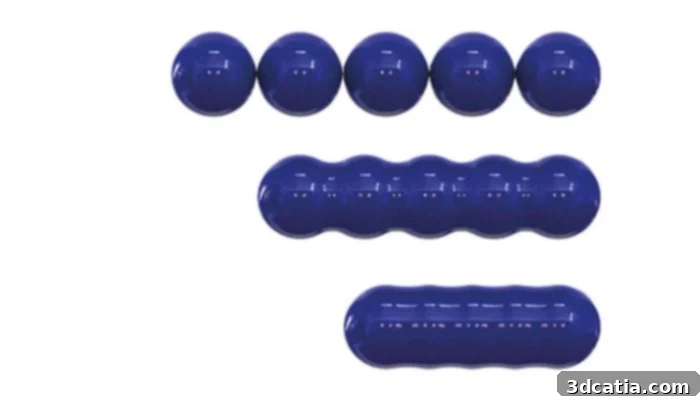
The micro-dosing systems enable precise droplet deposition at a rate of 1,000 drops per second, ensuring high-speed and accurate material placement | Image via Fraunhofer IKTS
Multi Material Jetting: Unlocking a New Era of Multi-Functional Component Applications
The versatility and precision inherent in the Multi Material Jetting system are truly transformative, opening the door to an unprecedented range of innovative applications across various high-tech sectors. Uwe Scheithauer, a leading researcher at Fraunhofer IKTS, highlights this capability, stating, “Right now, we can process up to four different materials at a time.” This ability to simultaneously integrate multiple materials in a single printing process represents a paradigm shift, enabling companies to design and produce highly integrated, multi-functional components with precisely defined and localized properties. The implications for product design and performance are profound, moving beyond simple geometric complexity to functional complexity. A compelling example of MMJ’s potential lies in the manufacturing of highly complex parts such as the ignition system for a satellite propulsion engine. Traditionally, components for such demanding environments, especially those experiencing extremely high temperatures, pose significant manufacturing challenges. Satellite engine combustion chambers, for instance, operate under intense thermal stress. Here, ceramics excel due to their exceptional heat resistance, making them an ideal choice for such high-temperature applications. However, an ignition system also requires electrically conductive elements. With MMJ, it becomes possible to directly integrate an entire ignition system within the engine structure, creating a single, extremely robust component that seamlessly combines both electrically conductive and insulating areas. This level of functional integration, previously unachievable with conventional methods or even other AM techniques, drastically reduces part count, simplifies assembly, improves reliability, and optimizes performance in critical aerospace applications. Beyond aerospace, this capability extends to medical devices requiring biocompatible materials with integrated sensors, advanced tooling with localized wear resistance and impact strength, or customized electronic components that manage heat dissipation and electrical conductivity within the same complex structure.
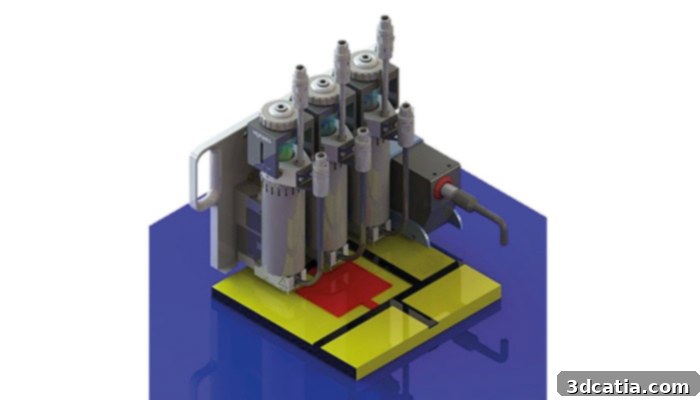
Detailed schematic illustration of the micro-dosing systems, showcasing the intricate precision required for Multi Material Jetting | Image via Fraunhofer IKTS
The applications of the MMJ system extend far beyond just the creation of novel multi-functional components. Its unparalleled high precision and inherent flexibility make it exceptionally suitable for optimizing existing manufacturing processes, leading to significant efficiencies and cost reductions. Uwe Scheithauer elaborates on another compelling use case: “We could also use it to make blanks for carbide parts, for example. Thanks to the tremendous precision of the dosing systems, the contours of the blanks would already be very close to those of the end product. They would therefore require very little subsequent grinding as compared to conventional methods. That’s a big advantage when you are working with carbide.” This capability addresses a long-standing challenge in working with extremely hard materials like carbides, which are essential for tools and wear parts due to their exceptional hardness and abrasion resistance. Conventionally, shaping carbide parts involves extensive and costly grinding processes, which are time-consuming, consume significant energy, and require specialized, wear-resistant tooling. The precision afforded by MMJ means that the “green” parts (blanks) produced are much closer to the final desired geometry. This near-net-shape capability drastically reduces the amount of material that needs to be removed during post-processing grinding, thereby cutting down manufacturing time, reducing material waste, extending the life of grinding tools, and lowering overall production costs. For industries heavily reliant on carbide components, such as tooling, mining, and aerospace, this represents a substantial leap forward in manufacturing efficiency and economic viability. The ability to precisely control material deposition ensures that intricate details and tight tolerances can be achieved even before final sintering, further enhancing the quality and performance of the end product.
The development cycle at Fraunhofer IKTS has moved beyond theoretical concepts, with the project successfully demonstrating that the Multi Material Jetting technology is not only effective in principle but also remarkably scalable for future industrial adoption. This practical validation is a critical milestone, signifying its readiness for broader implementation. The immediate next step involves rigorously validating the technology for extensive industrial use, ensuring its robustness, reliability, and cost-effectiveness in real-world production environments. Fraunhofer IKTS envisions playing a pivotal role in this industrial transition. Beyond merely supplying the advanced MMJ hardware, the institute is committed to forming strategic partnerships with industrial customers, offering comprehensive support in developing the specific materials and sophisticated software required for seamless monitoring and automation of the MMJ process. This holistic approach, encompassing hardware, materials science, and advanced software solutions, is essential for successful integration into diverse manufacturing workflows. Automation and real-time monitoring are particularly crucial for maintaining consistent quality and maximizing throughput in an industrial setting, ensuring that complex multi-material parts can be produced efficiently and reliably at scale. To further disseminate knowledge and foster collaboration around this groundbreaking technology, Fraunhofer IKTS is hosting an important online conference: the AM Ceramics meets CERAMITEC Conference, scheduled for September 16 and 17. This event will provide an invaluable platform for industry leaders, researchers, and potential adopters to delve deeper into the capabilities of MMJ, discuss its industrial implications, and explore future innovations in advanced ceramic additive manufacturing. More comprehensive information about this highly anticipated conference can be found HERE, offering a prime opportunity to engage with the pioneers of this transformative technology.
The Multi Material Jetting system developed by the Fraunhofer Institute represents a significant leap forward in additive manufacturing, pushing the boundaries of what is possible in component design and functionality. Its ability to integrate diverse high-performance materials like ceramics and metals with extreme precision opens up new avenues for innovation across aerospace, medical, tooling, and electronics industries. What are your thoughts on this revolutionary Multi Material Jetting system and its potential impact on industrial production and product development? We encourage you to share your insights and feedback in a comment below. You can also join the ongoing discussions on our Facebook and Twitter pages. Stay ahead of the curve by remembering to sign up for our free weekly Newsletter. It’s your direct source for all the latest news, groundbreaking research, and exciting entrepreneurial ventures in the world of 3D printing, delivered straight to your inbox every week!