
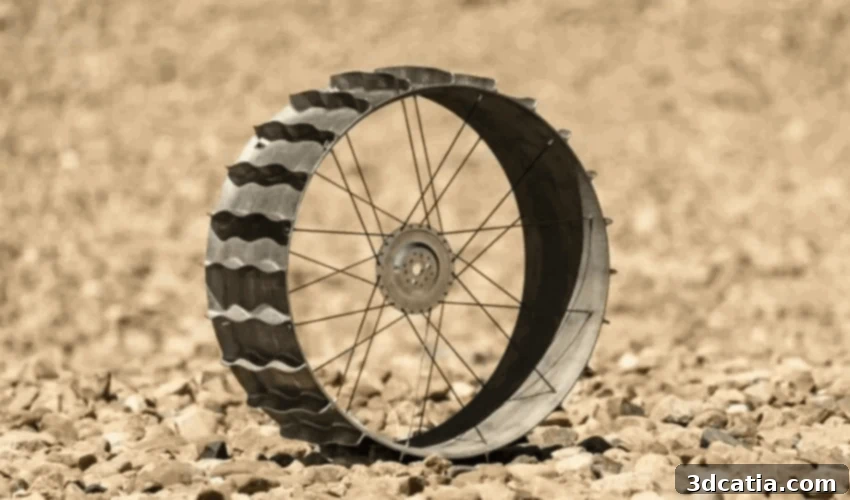
Revolutionizing Lunar Exploration: NASA’s VIPER Rover Wheels Get a 3D Printed Upgrade
In a significant stride towards advanced space exploration, Oak Ridge National Laboratory (ORNL) has successfully leveraged cutting-edge additive manufacturing technology to produce a lunar rover wheel prototype. This groundbreaking achievement, based on a meticulous NASA design, marks a pivotal moment in how components for extraterrestrial missions could be fabricated in the future. Utilizing a newly developed, specialized 3D printer, ORNL has created parts specifically engineered for the rigorous demands of space exploration, demonstrating the immense potential of additive manufacturing beyond Earth’s atmosphere. This innovative wheel prototype is slated for rigorous testing by NASA, where its performance will be critically evaluated against the traditionally manufactured wheels currently designated for their next-generation lunar rover, paving the way for a new era of space vehicle development.
NASA has been meticulously preparing for an ambitious operation: a mission to comprehensively map the mysterious south pole of the Moon. While perhaps not as overtly dramatic as other space ventures, this mapping endeavor holds profound implications. It is a determining factor in understanding the distribution of water ice on the lunar surface, a crucial resource that could make or break plans for future human habitation. The presence of sufficient water ice would allow for in-situ resource utilization (ISRU), enabling astronauts to extract and process water for drinking, breathable air, and even rocket fuel, thereby significantly reducing the cost and logistical challenges of lunar outposts. The vehicle central to this critical mission is the Volatiles Investigating Polar Exploration Rover, aptly named VIPER. This state-of-the-art rover will be equipped with a cutting-edge wheel design, which is precisely what ORNL has reproduced using advanced 3D printing techniques. By adhering to the exact design specifications, the project aims to directly assess the viability and advantages of additive manufacturing for such critical space components, providing invaluable insights for future mission planning and spacecraft construction.
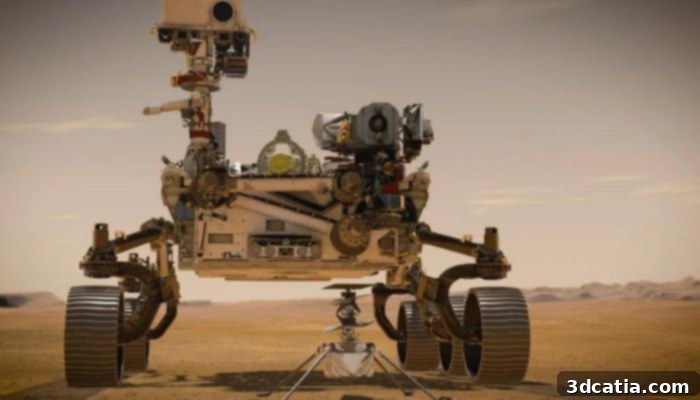
The VIPER rover that NASA plans to send to the Moon, featuring new wheel designs.
The 3D printed prototype wheels represent a significant engineering feat. Fabricated from a robust nickel alloy, these wheels boast a diameter exceeding 50 cm. This dimension is notably large for a component produced via metal powder bed fusion, a process known for its precision and ability to create intricate geometries. The use of additive manufacturing not only enables the creation of complex designs but also offers unprecedented speed and flexibility. Remarkably, ORNL was able to produce a wheel even more intricate than the original concept in as little as 40 hours. This rapid turnaround comes with no additional costs or manufacturing difficulties, showcasing the efficiency of the advanced 3D printing process. However, the innovation is not without its challenges; the current prototype weighs 50% more than its traditionally manufactured counterpart. Despite this weight increase, if NASA’s rigorous testing confirms that the 3D printed prototype meets or exceeds the robustness and durability of the original, it could signal a transformative shift. The next generation of these lunar rovers could potentially be outfitted with these advanced, additively manufactured rims, opening doors for optimized designs and on-demand production for future lunar and Martian missions.
The Advanced Technology Driving Space Exploration: ORNL’s Revolutionary 3D Printer
The Future of the 3D Printers Used to Make the Lunar Rover Wheel
At the heart of this groundbreaking achievement lies a truly unique additive manufacturing system. Peter Wang, who spearheads the development of new laser powder bed fusion systems at ORNL, firmly asserts that the printer employed in this project stands alone in its capacity to print large objects simultaneously and continuously. This advanced system utilizes two lasers, meticulously coordinated to work in tandem, coupled with an innovative rotating printing plate. Wang elaborates on its efficiency, noting, “This dramatically increases the production rate with the same amount of laser power. We’re only scratching the surface of what the system can do. I really think this is going to be the future of laser powder bed printing, especially at large scale and in mass production.” This statement underscores the profound impact this technology is poised to have, not just in niche applications like space components, but across various industries requiring high-volume, large-scale additive manufacturing. The printer’s ability to minimize build time for complex, large-format parts makes it an invaluable asset for industries where rapid prototyping and production are critical, further solidifying the role of 3D printing in the evolution of modern manufacturing.
The choice of nickel alloy for the lunar wheel prototype is also strategic. Nickel alloys are renowned for their exceptional strength, high-temperature resistance, and corrosion resistance, properties that are paramount for components operating in the harsh, vacuum-filled, and thermally extreme environment of the lunar surface. The successful printing of a 50cm diameter wheel from this material using powder bed fusion is a testament to the printer’s precision and control, ensuring material integrity and optimal mechanical properties. This breakthrough demonstrates that even with challenging materials and large dimensions, additive manufacturing can produce robust, flight-worthy components, thereby expanding the material palette available for space hardware.
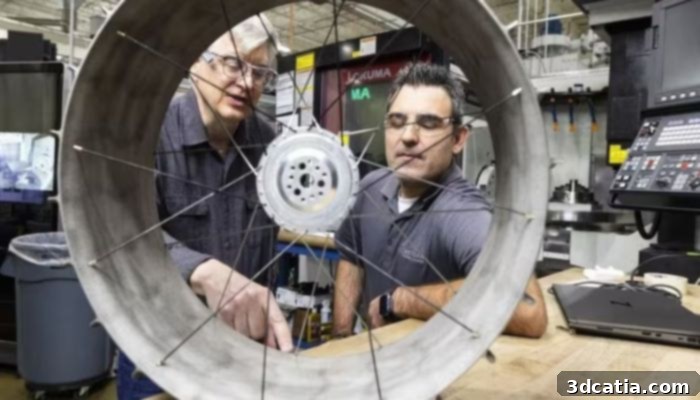
Prototype of a 3D printed wheel for the NASA VIPER rover, showcasing advanced additive manufacturing capabilities.
Paving the Way for On-Demand Manufacturing in Space
Moreover, this remarkable achievement has ignited significant interest in 3D printing a wide array of other essential parts for space missions. Brian Gibson, the lead researcher for this pioneering project, emphasized the inherent flexibility of the technology: “Additive manufacturing offers the flexibility that if you have the feedstock, you could make any replacement part you need, whether in space or on Earth.” This powerful statement not only confirms long-standing speculations about the future role of 3D printers on the Moon or Mars but also highlights the potential for unprecedented self-sufficiency in extraterrestrial outposts. The vision is clear: imagine astronauts being able to print a critical replacement part for a habitat or a rover using local raw materials – lunar regolith or Martian soil – transformed into feedstock. This concept of In-Situ Resource Utilization (ISRU), empowered by additive manufacturing, could dramatically reduce mission costs, decrease reliance on Earth-based supply chains, and enable longer, more ambitious deep-space missions by providing immediate access to tools, parts, and infrastructure on demand. The ability to print on-site minimizes launch mass, a major cost driver in space exploration, and allows for greater adaptability to unforeseen challenges in remote environments.
The success of the 3D printed lunar rover wheel prototype is more than just a technical milestone; it’s a philosophical shift in how we approach space exploration. It moves us closer to a future where humanity is not just visiting other celestial bodies but living and working on them sustainably. The capability to manufacture complex components quickly and efficiently, potentially even from local extraterrestrial resources, addresses many of the logistical and engineering hurdles that have historically limited deep space endeavors. As researchers continue to refine the processes and expand the material capabilities of advanced 3D printers, the possibilities for lunar bases, Martian settlements, and even asteroid mining become increasingly tangible. This project by ORNL and NASA is a critical step in building the foundational technologies necessary for such an expansive future.
Conclusion: A New Horizon for Space Mobility and Sustainability
The successful 3D printing of a lunar rover wheel prototype by Oak Ridge National Laboratory for NASA’s VIPER mission represents a monumental leap forward for additive manufacturing in space exploration. This endeavor not only validates the capabilities of specialized, multi-laser powder bed fusion systems but also highlights the critical role such technologies will play in future lunar and Martian missions. While challenges like managing the weight of 3D printed components persist, the benefits of rapid prototyping, design complexity, and the potential for on-demand manufacturing using local resources far outweigh these hurdles. The collaboration between ORNL and NASA exemplifies the innovative spirit required to push the boundaries of human presence beyond Earth. As this 3D printed wheel undergoes rigorous testing, the insights gained will undoubtedly shape the development of more durable, efficient, and adaptable vehicles for exploring the cosmos, propelling us closer to a future where space travel and habitation are not just dreams, but realities forged by advanced manufacturing.
You can find out more about the project HERE.
What do you think of this 3D printed wheel prototype for NASA’s lunar rover? Share your thoughts and join the conversation in a comment below or on ourLinkedIn,Facebook, andTwitter pages! Don’t forget to sign up for our free weeklyNewsletter here, and receive the latest 3D printing news straight to your inbox! You can also find all our videos on ourYouTube channel for more insights into the world of additive manufacturing.
*All Photo Credits: Carlos Jones/ORNL, U.S. Dept. of Energy