
Origin and BASF: Spearheading Mass Production 3D Printing with Open Additive Production
In a significant stride towards revolutionizing the manufacturing landscape, Origin, a dynamic Californian startup founded in 2015, has successfully secured $10 million in funding to propel its groundbreaking approach: Open Additive Production. This innovative methodology represents a paradigm shift in industrial manufacturing, blending the power of open materials, adaptable software, and modular hardware. Its primary goal is to address the ever-growing demands from manufacturing partners for superior quality materials and unparalleled customization capabilities, ultimately paving the way for true mass production 3D printing. This forward-thinking US startup has further amplified its industry presence by announcing a pivotal new partnership with chemical giant BASF, setting the stage for accelerated innovation in additive manufacturing.
The additive manufacturing sector has long grappled with the limitations imposed by closed ecosystems, where access to specific materials is often restricted solely to the original equipment manufacturer (OEM). This proprietary model can be a significant bottleneck for users who aspire to push the boundaries of their application cases, limiting their ability to innovate and optimize. As industries evolve, there’s an undeniable and rapidly increasing demand for more advanced and technical materials that can meet stringent performance requirements. Recognizing this critical challenge, Origin has ingeniously crafted its platform as a truly open ecosystem. This design philosophy empowers manufacturers with access to a broader spectrum of custom-made materials, fostering an environment of innovation and flexibility that was previously unattainable in many closed additive manufacturing systems.
Origin’s core technology leverages a sophisticated light-curing printing process, a method renowned for its precision and capability to produce highly detailed parts. The materials currently available through its open platform are meticulously selected to meet diverse industrial needs, including high resilience elastomers that offer exceptional flexibility and durability, heat-resistant polymers engineered for demanding thermal environments, and biocompatible formulations suitable for medical and consumer applications. The strength of Origin’s approach lies not only in its technology but also in its expansive network of partners. This collaborative ecosystem is crucial for continuously broadening its range of available materials, ensuring that manufacturers always have access to the latest and most suitable options for their specific projects. Furthermore, Origin emphasizes that its system delivers not only impressive printing speeds but also significantly streamlines the post-processing phase. This efficiency is critical for mass production, as it dramatically reduces overall lead times. For instance, post-processing can involve a brief 2 to 3-minute steep bath, followed by an additional 5 to 10 minutes of exposure to light at specific wavelengths, making the entire workflow remarkably efficient compared to traditional methods.
The Vision: Accelerating Additive Manufacturing Through Openness
Chris Prucha, the visionary CEO of Origin, articulates a profound understanding of how open additive production is poised to transform manufacturing. He explains that this approach will empower manufacturers to achieve unprecedented levels of customization and scale in additive manufacturing. By creating a ‘virtuous circle’—a self-reinforcing loop where advancements in materials, software, and machinery collectively drive progress—Origin aims to unlock the full potential of 3D printing for industrial applications. This innovative model is not just about producing parts; it’s about optimizing the entire production lifecycle. Prucha envisions a future where manufacturers benefit from enhanced performance, significantly lower costs per part, and the ability to produce larger volumes than ever before. This integrated approach, he believes, will ultimately accelerate the widespread adoption of additive manufacturing across all sectors of production, moving it beyond prototyping and into the realm of true industrial-scale manufacturing.
The ‘virtuous circle’ concept is central to Origin’s philosophy. It posits that by making materials, software, and hardware more accessible and interoperable, each component enhances the others. Open materials invite broader participation from chemical companies and developers, leading to a richer variety of innovative formulations. Expandable software allows for greater flexibility in process control and optimization, enabling manufacturers to fine-tune their operations for specific material properties or part geometries. Modular hardware ensures that machines can be easily adapted, upgraded, and scaled to meet evolving production needs, preventing obsolescence and maximizing investment. Together, these elements reduce barriers to entry, foster continuous improvement, and drive down overall production costs, making additive manufacturing a viable and attractive option for even the most demanding mass production scenarios.
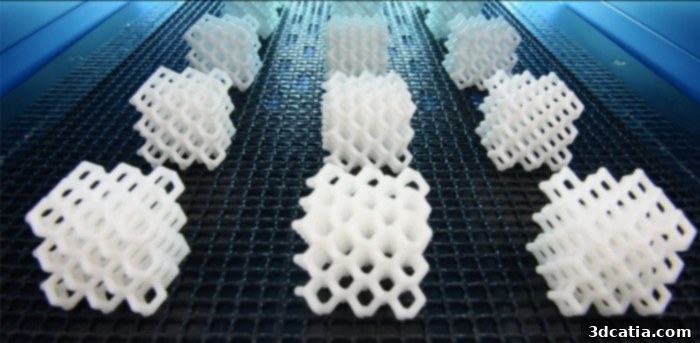
Origin works with light-curing technology to deliver high-performance parts.
A Groundbreaking Partnership with BASF: Unlocking New Material Possibilities
Following its successful $10 million funding round, Origin announced a landmark partnership with the global chemical leader, BASF. This collaboration is set to significantly enhance Origin’s open platform by integrating cutting-edge solutions from BASF, a company with an already proven track record of success and innovation in the additive manufacturing market, having previously partnered with industry giants like HP and Poietis. The synergy between Origin’s advanced printing technology and BASF’s deep expertise in material science is truly transformative.
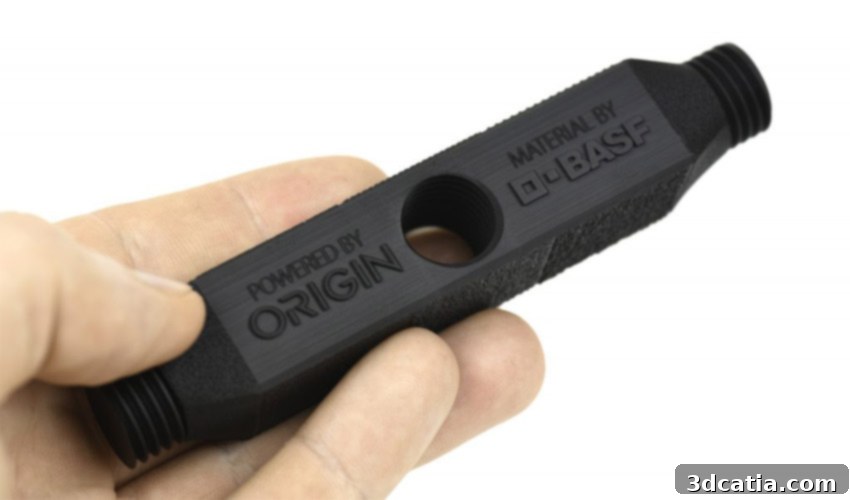
Through this strategic alliance, Origin has meticulously developed a specialized printing process optimized for BASF’s innovative new photopolymers. This collaboration has yielded remarkable results, combining industry-leading surface finish with exceptional strength and performance characteristics. To illustrate the capabilities of this partnership, Origin successfully printed parts such as a 21 x 21 x 114 mm textured sample (depicted below). This particular sample demonstrated the ability to be printed rapidly and efficiently post-cured, showcasing a range of customizable textures and colors, all while maintaining the robust mechanical strength essential for high-volume production applications. This represents a significant leap forward, as it enables manufacturers to not only create aesthetically precise parts but also to ensure they meet the rigorous functional demands of industrial use.
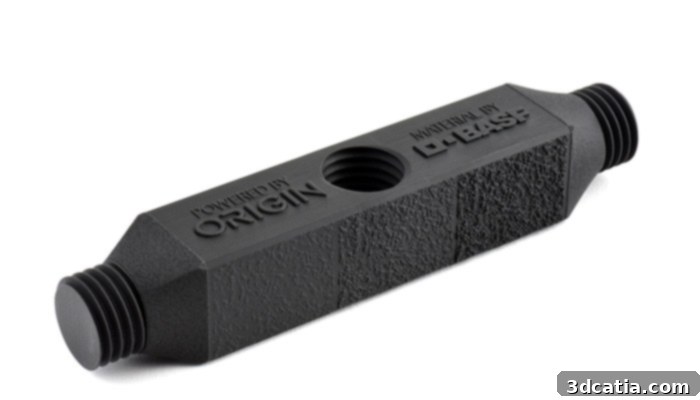
A sample printed by Origin using materials developed by BASF, showcasing exceptional finish and strength.
BASF’s Commitment to Open Innovation in Additive Manufacturing
Arnaud Guédou, Commercial Director of Photopolymer Solutions at BASF 3D Printing Solutions, unequivocally expresses the company’s enthusiasm for this collaboration. “We’re really excited about Origin’s open platform and are investing a lot in this partnership,” he states, highlighting BASF’s deep commitment and belief in Origin’s vision. He further elaborates on their strategic intent: “We plan to work with Origin to optimize our photopolymers and other additive materials to create a whole series of new options for high volume manufacturers.” This statement underscores BASF’s dedication not just to material innovation, but to fostering an open and collaborative environment that directly benefits end-users in manufacturing. By actively optimizing their photopolymers specifically for Origin’s system, BASF is ensuring that manufacturers will have access to a continually expanding portfolio of high-performance materials, tailored for the demands of scalable additive production.
The investment from BASF in this partnership extends beyond mere material supply; it signifies a strategic alignment towards democratizing advanced additive manufacturing. BASF’s extensive research and development capabilities, combined with Origin’s innovative hardware and software platform, promise to unlock unprecedented possibilities. This collaboration is particularly impactful for high-volume manufacturers who require not only reliable and consistent materials but also the flexibility to customize and optimize them for specific applications. By working closely with Origin, BASF is not just selling materials; they are actively shaping the future of industrial 3D printing by enabling the creation of stronger, more durable, and functionally superior parts at scale. This forward-looking approach is expected to significantly reduce material development cycles and accelerate the integration of additive manufacturing into mainstream production lines, making advanced manufacturing more accessible and efficient for industries worldwide.
The Future of Manufacturing: Scalable, Customizable, and Open
The collaboration between Origin and BASF marks a pivotal moment in the evolution of additive manufacturing. By championing an open ecosystem and integrating world-class material science with advanced printing technology, they are collectively addressing key challenges that have historically limited the adoption of 3D printing for mass production. This partnership promises to deliver not just better parts, but a more flexible, efficient, and cost-effective manufacturing paradigm. Manufacturers across various sectors—from automotive and aerospace to consumer goods and medical devices—stand to benefit immensely from the ability to rapidly produce customized, high-performance parts with an unprecedented level of material choice and process control. The future of manufacturing is increasingly looking towards agile, on-demand production, and the Open Additive Production approach spearheaded by Origin and BASF is perfectly positioned to lead this transformation, driving innovation and expanding the boundaries of what’s possible with 3D printing. This synergy aims to establish a new benchmark for industrial additive manufacturing, where material limitations are minimized, customization is maximized, and high-volume production becomes a tangible reality.
For those eager to delve deeper into Origin’s advancements and their strategic partnerships, more information can be found HERE. We invite you to share your thoughts on Origin’s open platform and its implications for the future of manufacturing. Let us know what you think in a comment below or join the discussion on our Facebook and Twitter pages! Don’t forget to sign up for our free weekly Newsletter, with all the latest news in 3D printing delivered straight to your inbox!