
Beyond Prototypes: Exploring Cutting-Edge 3D Printing Innovations from Industrial Pioneers to Artistic Creations
Welcome to this week’s immersive dive into the dynamic world of additive manufacturing, where we uncover groundbreaking innovations and inspiring applications. From the industrial forefront to the realm of high-performance sports and breathtaking artistry, 3D printing continues to redefine possibilities. Join us as we explore five compelling stories that showcase the versatility and impact of this transformative technology. We’ll take you behind the scenes with a leading 3D printer manufacturer, witness how digital fabrication is revolutionizing golf equipment, marvel at the resurrection of a design classic, demystify powerful software tools, and finally, be astounded by the creation of hyper-realistic sculptures. Prepare to be inspired by the ingenuity and limitless potential of 3D printing as we highlight the creators, innovators, and technologies shaping our future.
Top 1: An Exclusive Tour of FELIXprinters in the Netherlands
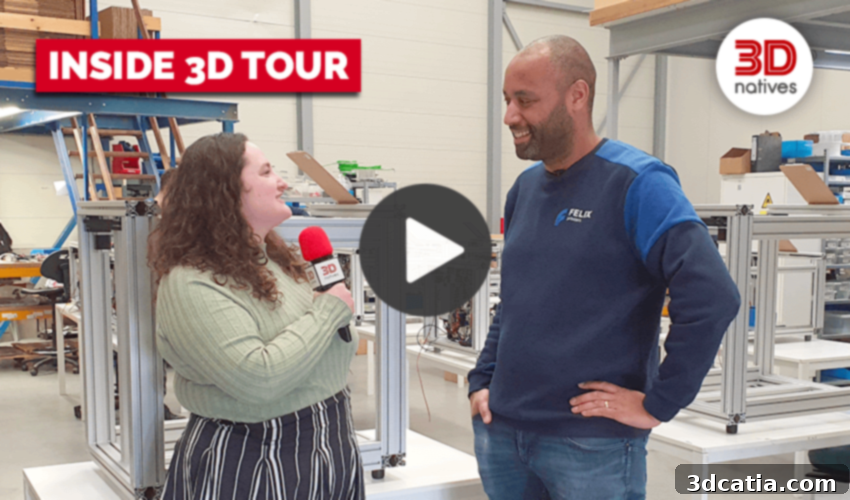
In our ongoing “Inside 3D Tour” series, which spotlights pioneering companies within the additive manufacturing sector across the globe, this week brings us to the Netherlands. We had the distinct privilege of touring FELIXprinters, a renowned company at the vanguard of 3D printer manufacturing. What truly sets FELIXprinters apart is its remarkably diverse and innovative product portfolio, extending far beyond conventional offerings. They engineer robust industrial 3D printers designed for high-precision, demanding production environments; develop specialized food 3D printers that are revolutionizing culinary applications; create advanced bioprinters crucial for medical research and tissue engineering; and offer bespoke FDM (Fused Deposition Modeling) printers tailored to unique client specifications.
During our visit, we engaged in insightful conversations with Guillaume Feliksdal, the visionary Founder and Co-Director, and Jakob Imhof, an accomplished 3D Printing Technician. Their candid discussions provided an invaluable behind-the-scenes perspective into FELIXprinters’ operations, shedding light on the company’s foundational journey, its commitment to innovation, and the intricate processes involved in developing such a varied range of sophisticated machines. We learned about the challenges and triumphs of manufacturing industrial-grade equipment, the exciting potential of printing edible creations, and the ethical considerations surrounding bioprinting. Furthermore, they shared fascinating anecdotes about the diverse projects their global clientele undertakes, illustrating the wide-reaching impact of FELIXprinters’ technology across various industries, from aerospace and automotive to healthcare and gastronomy. This exclusive look offers a deeper understanding of how FELIXprinters has cemented its reputation as a leading innovator, constantly pushing the boundaries of what’s achievable with additive manufacturing.
Top 2: Revolutionizing the Green: COBRA PUMA GOLF’s 3D Printed Equipment
The realm of sports equipment is ripe for innovation, and 3D printing is emerging as a game-changer, offering unparalleled opportunities for customization, performance enhancement, and rapid prototyping. Among the pioneers leveraging this advanced technology to its fullest is COBRA PUMA GOLF, a brand synonymous with cutting-edge design and performance in the golf industry. COBRA has embraced additive manufacturing to craft highly advanced golf equipment, pushing the boundaries of what’s possible in terms of club design, weight distribution, and feel. By utilizing 3D printing, they can create intricate geometries and internal structures that are impossible with traditional manufacturing methods, allowing for precise control over a club’s center of gravity, moment of inertia, and overall playability.
Their commitment to innovation will be showcased at the upcoming RAPID+TCT conference in Detroit, one of the additive manufacturing industry’s most significant events. We had the exclusive opportunity to speak with Ryan Roach, Director of Innovation at COBRA PUMA GOLF. He provided a fascinating, in-depth look into their additive manufacturing process, detailing how these groundbreaking golf clubs are conceived, designed, and brought to life. From initial concept to the final, performance-tested product, 3D printing allows COBRA to iterate faster, experiment with radical designs, and ultimately deliver superior equipment to golfers of all skill levels. This technology enables them to fine-tune performance characteristics for specific players, opening up new avenues for personalized golf equipment.
For golf enthusiasts and 3D printing aficionados eager to experience this innovation firsthand, there’s an exciting opportunity. Be sure to register HERE for RAPID + TCT. By using the special promo code “3DNATIVES” during registration, you’ll not only gain access to the leading event in additive manufacturing but also enter a fantastic giveaway. This includes a chance to win a highly coveted COBRA GOLF LIMIT3D Steel Mallet Tour Prototype Putter, currently undergoing rigorous testing on professional tours, representing the pinnacle of golf club engineering. Additionally, the prize package includes a Full Conference Pass to RAPID + TCT 2025, offering an invaluable opportunity to explore the latest advancements in 3D printing. Don’t miss this chance to be part of the future of sports technology!
Top 3: Reviving a Design Classic: 3D Printing the Iconic Braun Desk Fan
In an age where mass production often overshadows unique design, 3D printing offers a remarkable avenue for preserving culture and history while simultaneously creating functional, contemporary pieces. This video from “Distracted By Design” beautifully illustrates this concept, showcasing a truly unique application of additive manufacturing: the creation of a faithful replica of the classic Braun desk fan. This project is much more than just a reproduction; it’s a heartfelt ode to an iconic brand and a testament to the enduring principles of efficient, minimalist design championed by figures like Dieter Rams.
The original Braun desk fan, a masterpiece of mid-century industrial design, is highly sought after by collectors today, often fetching exorbitant prices on the vintage market. Recognizing this, the video creator embarked on a journey to recreate this timeless piece using 3D printing. This not only makes the fan accessible but also highlights the power of modern fabrication techniques to celebrate and extend the legacy of classic designs. The video meticulously documents every stage of this ambitious project, from the initial design phase – likely involving careful measurements, reverse engineering, and CAD modeling – to the intricate 3D printing process itself. It then delves into the essential post-processing steps, such as sanding, painting, and finishing, which are crucial for achieving the smooth, refined aesthetic characteristic of Braun products. Finally, the assembly of the numerous printed components into a fully functional fan is demonstrated, revealing the challenges and immensely rewarding aspects that accompanied this creative endeavor.
By bringing this forgotten icon back to life, the designer not only demonstrates the practical utility of 3D printing but also inspires a wider appreciation for industrial design heritage. It’s a powerful example of how digital fabrication empowers individuals to engage with history, interpret classic forms, and even improve upon them, proving that great design can truly be timeless and accessible through modern means. Watch as this vintage masterpiece is meticulously recreated, embodying both nostalgia and cutting-edge technology:
Top 4: Mastering Precision: A Guide to Bambu Studio’s Mesh Boolean Tool
For the rapidly growing community of Bambu Lab 3D printer users, Bambu Studio has become an indispensable tool. As the company’s powerful open-source slicer, it provides a comprehensive suite of features designed to optimize print quality and streamline the workflow from digital model to physical object. Among its many capabilities, the mesh boolean tool stands out as a particularly potent feature that can elevate your 3D designs to a professional level with surprisingly minimal difficulty. This tutorial provides a focused and practical guide on how to effectively wield this sophisticated tool.
At its core, the mesh boolean tool allows users to perform complex geometric operations on two or more 3D models, fundamentally altering their shapes and creating intricate new parts. It functions by applying three primary operations: union, difference, and intersection. The **union** operation merges two or more selected models into a single, cohesive entity, perfect for combining separate components into a single print or creating complex forms from simpler shapes. The **difference** operation is incredibly useful for subtracting one model from another, enabling you to create precise holes, cutouts, or internal cavities within your main design. Imagine needing to embed a specific component or create a unique interlocking mechanism – the difference tool makes this effortlessly precise. Finally, the **intersection** operation identifies and retains only the overlapping volume common to all selected models, an ideal function for creating perfectly fitting parts or extracting specific features from complex geometries.
Mastering these boolean operations within Bambu Studio empowers you to tackle design challenges that would otherwise require advanced CAD software. Whether you’re designing custom enclosures, intricate functional parts, precise jigs, or highly detailed artistic models, this tool offers an accessible way to achieve complex geometries directly within your slicer. By integrating these powerful operations into your workflow, you can refine your designs, optimize material usage, and solve common printing problems with greater efficiency. To delve deeper into the full capabilities of Bambu Studio and unlock even more advanced functionalities, be sure to consult our comprehensive guide here.
Top 5: Giovani Caramello’s Hyper-Realistic 3D Printed Sculpture
Prepare to be captivated by the extraordinary artistry of Giovani Caramello, a Brazilian artist renowned for pushing the boundaries of hyper-realistic sculpture. Caramello specializes in creating breathtakingly lifelike figures in mediums like silicone and resin, all brought forth from the depths of his imagination. While he draws inspiration from a vast library of internet photographs, his unique artistic philosophy dictates that he never replicates an existing person. Instead, his noble and ambitious goal is to meticulously build his own expansive universe of original characters, each with its own story and emotive presence.
In one of his latest and most striking works, Caramello masterfully leveraged the power of 3D printing to imbue one of his meticulously conceived characters with tangible form. His process beautifully bridges the gap between digital and traditional artistry. The journey begins in ZBrush, an industry-standard digital sculpting software that allows him to sculpt with an unparalleled level of detail and organic fluidity, precisely crafting every wrinkle, texture, and expression. Once the digital model is perfected, it transitions to the physical realm using the Elegoo Jupiter SE, a high-precision resin 3D printer. The Elegoo Jupiter SE, known for its ability to produce incredibly detailed prints with smooth surfaces, is an ideal tool for capturing the subtle nuances essential for hyper-realism.
However, Caramello’s magic doesn’t stop at the print. He integrates his profound traditional sculpture skills into the post-processing phase. This involves careful sanding, detailing, and often casting in silicone or resin, followed by intricate painting techniques that give his figures their astonishing lifelike quality. The result of this blend of cutting-edge technology and time-honored craftsmanship is nothing short of spectacular. For this particular project, he created a poignant sculpture of a man looking upwards, a piece that not only showcases his technical prowess but also evokes a profound sense of wonder and contemplation. Caramello’s work is a testament to how 3D printing, when combined with exceptional artistic vision and skill, can enable artists to realize imaginative worlds with an astonishing degree of realism and emotional depth.
We hope this week’s exploration into the world of 3D printing has ignited your imagination and showcased the incredible diversity of additive manufacturing applications. From the industrial innovations of FELIXprinters and the performance-driven advancements at COBRA PUMA GOLF to the artistic resurrection of a design icon, the practical utility of Bambu Studio’s powerful tools, and the breathtaking realism of Giovani Caramello’s sculptures, the possibilities are truly limitless. The additive manufacturing sector is constantly evolving, presenting new solutions, empowering creators, and pushing the boundaries of what we thought possible.
What were your favorite highlights from this week’s Top 5? Which of these stories resonated most with you, or which application of 3D printing do you find most fascinating? We’d love to hear your thoughts and insights! Share your comments and feedback with us below, or join the conversation on our social media platforms. Connect with us on LinkedIn, Facebook, and Twitter to stay updated with the latest news and discussions in the 3D printing community. Don’t miss out on crucial industry updates – sign up for our free weekly Newsletter here to get the freshest 3D printing news delivered straight to your inbox. For more captivating videos and in-depth content, make sure to visit and subscribe to our official YouTube channel, where you can find all our latest features and exclusive tours. Keep exploring, keep creating, and happy watching!