
How 3D Printing Revolutionized Emergency Response with Rapid Isolation Houses During the COVID-19 Pandemic
The early days of the COVID-19 pandemic presented unprecedented global challenges, rapidly transforming healthcare needs and infrastructure demands. As the novel coronavirus, COVID-19, began its swift and widespread dissemination across the globe, the strain on existing medical facilities became alarmingly apparent. While the initial epicentre was in China, its impact soon spread, reaching Europe with significant outbreaks, notably in Italy where tens of thousands were placed under quarantine. At its peak, nearly 80,000 individuals were confirmed infected, with the vast majority concentrated in China, forcing the nation to innovate and rapidly reorganize its healthcare system to cope with the sheer volume of patients and those requiring isolation.
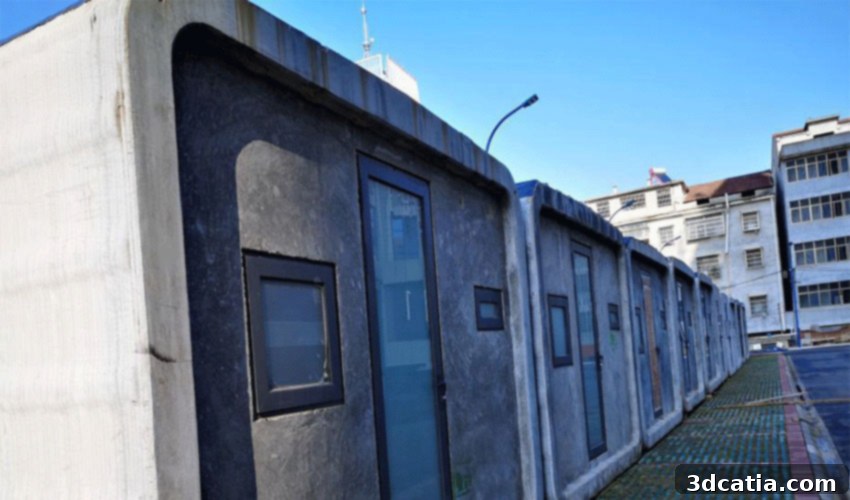
In Xianning, a city in Hubei province, an extraordinary solution emerged from the realm of additive manufacturing. The company Winsun, a pioneer in construction 3D printing, stepped forward to address the critical shortage of isolation facilities and medical staff accommodation. By leveraging its advanced 3D printing technology, Winsun rapidly produced numerous isolation houses designed to shelter quarantined individuals and frontline medical personnel. This innovative approach significantly alleviated the pressure on overstretched hospitals, demonstrating the profound potential of 3D printing in crisis management and humanitarian response.
The application of 3D printing in the construction sector is a field that has been steadily evolving, offering a multitude of advantages that make it particularly well-suited for emergency situations. Its inherent speed, efficiency, and flexibility provide a robust fallback solution when conventional construction methods are too slow or impractical. In times of crisis, the ability to rapidly deploy temporary, yet structurally sound, dwellings is invaluable, regardless of the geographic area or logistical challenges. Winsun, with its foresight and technological prowess, recognized this potential and swiftly adapted its capabilities to meet the urgent demands of the global health crisis. These modular houses, initially conceived for rapid deployment in the tourism sector due to their easy transportability and assembly, found a new, critical purpose in the fight against the pandemic, showcasing the adaptability of advanced manufacturing techniques.
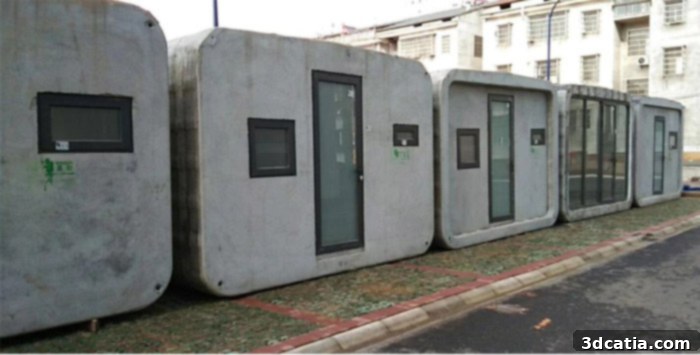
These isolation houses include 3D printed walls | Credits: Winsun
3D Printing: A Game-Changer for Overloaded Hospitals and Emergency Shelters
The impact of Winsun’s initiative on the healthcare infrastructure in Xianning was immediate and profound. The company reported an astonishing feat: they were able to 3D print the walls for 15 isolation houses within a mere 24 hours. This translates to an incredibly efficient printing time of less than two hours for the walls of each individual house. This remarkable speed was achieved through an advanced extrusion process, a core technology in construction 3D printing. In this method, a robotic arm, precisely mounted on rails that encircle the construction site, meticulously deposits successive layers of a specialized concrete mixture. This material is engineered to harden rapidly, ensuring structural stability and enabling quick subsequent layers. The efficiency of this process drastically cuts down construction timelines, which is paramount in emergency scenarios where every hour counts.
Each of these compact, yet fully functional, structures boasts a surface area of 10 square meters and a comfortable height of 2.8 meters. They were specifically designed with the primary objective of easing the immense burden on hospitals by providing dedicated spaces for quarantined individuals and essential medical staff. Understanding the need for comfort and basic amenities, Winsun ensured that each house was comprehensively equipped. According to the company, these isolation units feature private showers, air conditioning systems for climate control, and fully functional toilets. Crucially, they also meet stringent insulation standards, ensuring a safe and comfortable environment regardless of external conditions. Each house is designed to comfortably accommodate two people, maximizing space utility while maintaining necessary social distancing protocols.
The rapid deployment and robust features of these 3D printed isolation units underscore the transformative potential of additive manufacturing in public health emergencies. Beyond merely providing shelter, these houses offer a dignified and functional space for recovery and rest, critical for both patients and healthcare heroes. The ability to quickly scale up such infrastructure can be a decisive factor in managing the spread of infectious diseases and preserving the capacity of traditional medical facilities.
Sustainable Materials and Robust Construction: The Winsun Advantage
Beyond speed and functionality, Winsun’s approach also integrated a strong commitment to sustainability. The isolation houses were reportedly constructed using more environmentally friendly materials, a choice that could significantly enhance the long-term durability and ecological footprint of each structure. Ma Yufeng, General Manager of Winsun, elaborated on this innovative material strategy: “We use recyclable materials such as sand and construction rubble. It is very environmentally friendly. When it comes to safety, the constructions are at least twice as strong as concrete constructions.” This statement highlights a dual benefit: reducing environmental impact by repurposing waste materials and simultaneously achieving superior structural integrity. The use of recycled aggregates not only lessens the demand for virgin resources but also addresses the burgeoning problem of construction waste, making these emergency shelters a model for sustainable rapid deployment.
The claim that these constructions are “at least twice as strong as concrete constructions” is particularly noteworthy. While traditional concrete structures have proven resilience, the unique layered extrusion process of 3D printing, combined with specialized material compositions, can create monolithic structures with fewer joints and potential weaknesses. This inherent strength, even without extensive prior testing of this specific house design, suggests a high level of confidence in the technology and materials. In emergency situations, where conventional stress testing might be impractical due to time constraints, the intrinsic properties of 3D printed concrete, known for its high compressive strength and rapid curing, offer a reliable solution. The ability to build robust, durable shelters quickly from readily available, recycled materials represents a significant leap forward in humanitarian aid and disaster response capabilities.
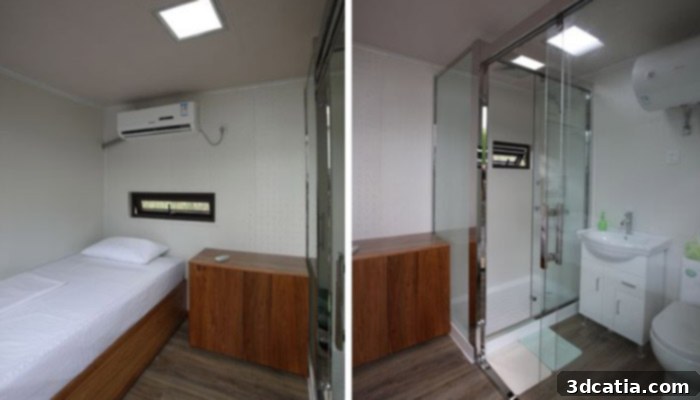
The isolation houses are equipped with a shower, toilet and bed
Cost-Effectiveness and Scalability: The Path Forward
The economic aspect of Winsun’s project further underscores its potential for global impact. Each completed isolation unit reportedly cost approximately $4,000, a remarkably low figure for a fully equipped, robust, and rapidly deployable dwelling. Initially, these costs were borne entirely by Winsun, demonstrating the company’s commitment to contributing to the pandemic response. Following this initial success, Winsun announced plans to 3D print an additional 200 houses, for which they initiated fundraising efforts and welcomed donations. This ambitious expansion highlights the scalability of the solution and its potential to address widespread housing needs in various crisis scenarios, not just public health emergencies. The cost-effectiveness makes it an attractive option for governments, NGOs, and humanitarian organizations looking to provide immediate, high-quality shelter without prohibitive expenses. More detailed information on their technology and current initiatives can be found on the manufacturer’s website.
The Broader Impact: 3D Printing Beyond Isolation Houses
Winsun’s pioneering effort in Xianning serves as a compelling case study for the transformative power of additive manufacturing in crisis management. The question isn’t just “Can 3D printing help fight the coronavirus outbreak?” but rather, “How extensively can 3D printing reshape our approach to global challenges?” The answer extends far beyond isolation houses. During the pandemic, 3D printing was instrumental in rapidly producing essential medical supplies, including personal protective equipment (PPE) like face shields, ventilator parts, and testing swabs, when traditional supply chains faltered. This agility demonstrated how additive manufacturing can mitigate supply chain vulnerabilities and ensure critical resources are available where and when they are needed most.
Looking ahead, the implications for humanitarian aid and disaster relief are immense. Imagine the capability to rapidly print temporary schools, community centers, or even essential infrastructure like bridges in post-disaster zones. The decentralized nature of 3D printing means that construction can occur on-site, reducing transportation costs and environmental impact. It also empowers local communities, offering a sustainable model for rebuilding and resilience. This technology can provide robust, custom-designed shelters tailored to specific environmental conditions, far surpassing the quality and speed of traditional emergency tents or temporary structures. As materials science and robotic capabilities continue to advance, the efficiency and versatility of construction 3D printing will only grow, making it an indispensable tool for future emergency preparedness and response efforts worldwide.
The deployment of 3D printed isolation houses by Winsun during the COVID-19 pandemic stands as a testament to human ingenuity and technological innovation in the face of adversity. It solidified additive manufacturing’s role as a critical tool not just for industrial innovation, but for global health and humanitarian endeavors. This technology offers a beacon of hope, demonstrating that rapid, sustainable, and cost-effective construction solutions are not only possible but increasingly vital in a world prone to unpredictable crises.
What do you think about the potential of 3D printing in emergency response and construction? Let us know your thoughts in a comment below or on our Facebook and Twitter pages! Don’t miss out on the latest advancements in additive manufacturing – sign up for our free weekly Newsletter to get all the news straight to your inbox!