
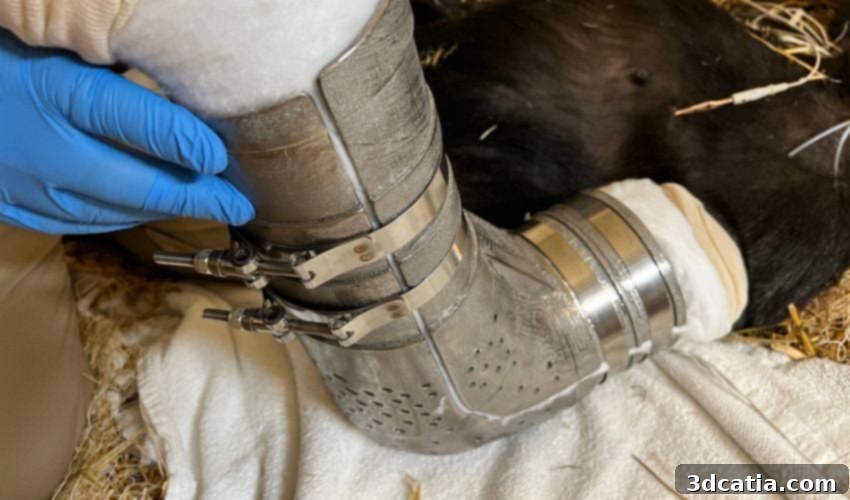
Groundbreaking Veterinary Innovation: Gladys the Gorilla Receives World-First 3D Printed Titanium Cast
Additive manufacturing, commonly known as 3D printing, has long been celebrated for its transformative impact on human healthcare, particularly in the creation of highly customized prosthetics and orthotics. These advanced solutions offer unparalleled fit, comfort, and functionality, drastically improving the quality of life for countless individuals. However, the revolutionary potential of this technology extends far beyond human applications, reaching into the realm of advanced veterinary care for our animal companions and, in this remarkable case, one of humanity’s closest living relatives. The Cincinnati Zoo recently announced a pioneering achievement that underscores this expansive capability: eleven-year-old Gladys, a Western lowland gorilla, has become the recipient of a world-first titanium, 3D-printed cast, marking a significant leap forward in zoological medicine and rehabilitation.
This innovative cast represents a critical advancement over traditional methods, which often fall short when dealing with the immense strength and unique anatomical challenges posed by large primates like gorillas. The primary objective behind this custom-engineered solution is to provide a significantly stronger and more durable device that is far harder for Gladys to damage during her recovery. Furthermore, the customized nature of 3D printing ensures a superior fit, which translates directly into enhanced comfort for the gorilla throughout her estimated six-week healing period. This personalized approach not only safeguards the healing process but also minimizes the stress and discomfort an animal might experience with a ill-fitting or easily compromised conventional cast.
The necessity for such an extraordinary medical intervention arose following an unfortunate incident within Gladys’s troop. According to a detailed press release from the Cincinnati Zoo, Gladys sustained a broken humerus – the long bone in her upper arm – after a scuffle with two younger females. This particular injury, described as a complete, oblique fracture, is not a common occurrence among the zoo’s gorilla population, presenting a unique and complex challenge for the veterinary staff. Recognizing the severity and rarity of the injury, the zoo’s medical team proactively sought the highest level of expertise available, enlisting top-tier surgeons and anesthesiologists from local human hospitals. This collaborative effort between human and animal medical specialists highlights the dedication required to ensure the best possible outcome for Gladys.
Initial attempts to immobilize Gladys’s arm with a conventional cast quickly revealed its limitations. Given the incredible strength and natural instincts of a gorilla, there was a significant and ongoing risk that Gladys would inevitably destroy any standard cast, severely hindering her recovery and potentially worsening the injury. It became clear that a fundamentally different, more robust solution was required. It was at this critical juncture that the Cincinnati Zoo reached out to GE Additive, a global leader in advanced additive manufacturing technologies. This crucial partnership paved the way for the development and production of the revolutionary titanium, 3D-printed cast, demonstrating the power of interdisciplinary collaboration in overcoming unprecedented veterinary challenges.
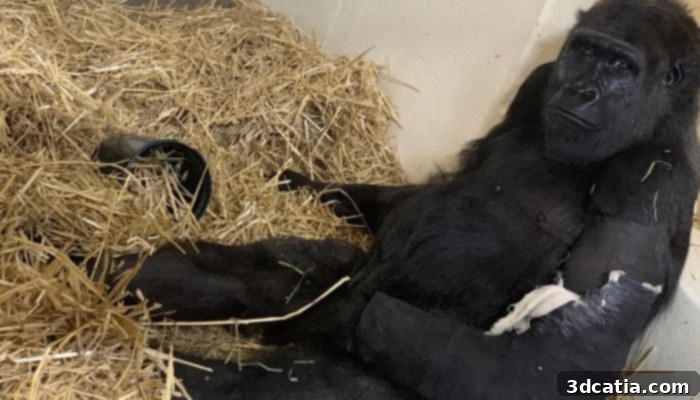
Gladys’ temporary cast lacked durability, a detriment to the healing process
Creating a Gorilla-Proof Titanium, 3D Printed Cast with Unprecedented Speed
The process of developing and manufacturing Gladys’s specialized cast showcases the unparalleled flexibility and rapid turnaround capabilities inherent in additive manufacturing. Unlike traditional fabrication methods that involve extensive tooling and lead times, 3D printing allowed for an incredibly swift response, a crucial factor in emergency veterinary situations. Shannon Morman, an advanced lead engineer at GE Additive (now Colibrium Additive), played a pivotal role in this endeavor, providing on-site support to ensure any necessary adjustments could be made in real-time. Her insights underscore the agility of the additive manufacturing process.
Morman elaborated on the extraordinary timeline: “One benefit of 3D printing is fast turnaround times. Following a call on Friday afternoon, our team met up over the weekend to create initial design ideas. The following Monday we scanned the original cast to create a 3D model and were ready to start printing the same day. The titanium cast took around 65 hours to print, and we were able to deliver it to the Zoo team in under a week.” This remarkable speed is a testament to the efficiency of modern additive manufacturing workflows, from initial consultation and design conceptualization to 3D scanning, model generation, printing, and final delivery. This rapid response minimized the time Gladys had to endure a less-than-ideal temporary cast, directly contributing to a smoother and potentially faster recovery.
The custom design process for Gladys’s cast was meticulous, beginning with the detailed 3D scanning of her temporary cast, which provided the precise anatomical data needed to create a perfectly fitting model. This digital blueprint was then used to engineer a cast that not only conformed to her unique limb structure but also incorporated strategic reinforcements to withstand the immense forces a gorilla can exert. Leveraging advanced metal 3D printing technologies, likely direct metal laser sintering (DMLS) or electron beam melting (EBM), GE Additive was able to transform this digital design into a physical reality using medical-grade titanium powder. These advanced processes build the cast layer by layer, allowing for complex geometries and internal structures that are impossible with conventional manufacturing, all while ensuring maximum strength and minimal weight.
The final product is an 8-pound cast, specifically engineered to be “gorilla-proof,” a testament to the rigorous design and material selection. The choice of titanium was paramount for several reasons. Renowned as one of the strongest and most durable materials on Earth, titanium offers an exceptional strength-to-weight ratio, which is crucial for a large, active animal. Its inherent corrosion resistance further enhances its longevity and suitability for a medical device that will be worn for an extended period. Beyond its mechanical properties, titanium is also highly biocompatible, meaning it is inert and causes no adverse reactions when in contact with living tissue. This biocompatibility is why titanium is also the material of choice for the screws and plates that were surgically implanted to stabilize Gladys’s broken humerus internally, which will remain a permanent part of her arm, ensuring long-term structural integrity.
Despite its 8-pound weight, the cast is not expected to pose a significant burden to Gladys. Gorillas possess immense strength in their arms, making the additional weight manageable and allowing her to continue her natural movements without undue strain. The overall engineering goal was to strike a delicate balance between maximum protection for the healing bone and sufficient comfort and mobility for the animal, an objective flawlessly achieved through the capabilities of advanced 3D printing and material science.
Initial observations of Gladys’s adaptation to her new cast have been overwhelmingly positive, marking a far greater success than the temporary solution. Victoria McGee, the Cincinnati Zoo’s zoological manager of primates, shared encouraging updates on Gladys’s progress. She elaborates, “That doesn’t mean that she likes it! But she is tolerating it better than she did the first one. She’s been locomoting comfortably, adapting her movements to the cast carefully and safely!” This immediate improvement in Gladys’s comfort and mobility is a direct indicator of the superior design and fit offered by the 3D-printed cast. The ability for her to move safely and comfortably is paramount for her physical and psychological well-being during such a critical recovery phase. The impact of this advanced care extends beyond mere physical healing.
McGee further highlights the significant improvements in Gladys’s daily life, stating, “Before the titanium cast, we were very limited on the spaces Gladys could safely be in. With this addition, Gladys can ‘graduate’ to additional behind-the-scenes spaces that will allow her to have more choice and exploration throughout the day.” This expanded access to diverse environments is vital for a highly intelligent and curious animal like a gorilla, providing essential enrichment and reducing potential stress associated with confinement. It allows her to engage in more natural behaviors, which is crucial for her overall recovery and long-term welfare. This case brilliantly illustrates how additive manufacturing, coupled with expert veterinary care, can dramatically improve outcomes for animals requiring complex medical interventions, offering tailored solutions that enhance both physical healing and quality of life. For those interested in delving deeper into Gladys’s incredible journey and her revolutionary 3D-printed cast, additional information and insights are available in the video below and through a detailed press release from the Cincinnati Zoo HERE.
The successful implementation of Gladys’s 3D-printed titanium cast heralds a new era for veterinary medicine, particularly for large and exotic animals where traditional medical solutions often fall short. This groundbreaking case opens doors for similar applications in zoological parks and wildlife rehabilitation centers worldwide, promising more effective, comfortable, and humane treatment options for animals facing severe injuries. The collaboration between specialists in human medicine, veterinary science, and advanced manufacturing highlights the interdisciplinary nature of innovation and its boundless potential when applied to critical challenges. As additive manufacturing technologies continue to evolve, we can anticipate even more sophisticated and integrated solutions that will further enhance animal welfare and veterinary care, ensuring that our animal relatives receive the best possible chances at recovery and a fulfilling life.
What are your thoughts on Gladys’s new 3D-printed titanium cast and the broader implications for veterinary medicine? We invite you to share your insights in a comment below or join the discussion on our LinkedIn, Facebook, and Twitter pages! Don’t forget to sign up for our free weekly newsletter here for the latest 3D printing news delivered straight to your inbox! You can also find all our compelling videos and industry updates on our YouTube channel, where we explore the most exciting developments in additive manufacturing.