
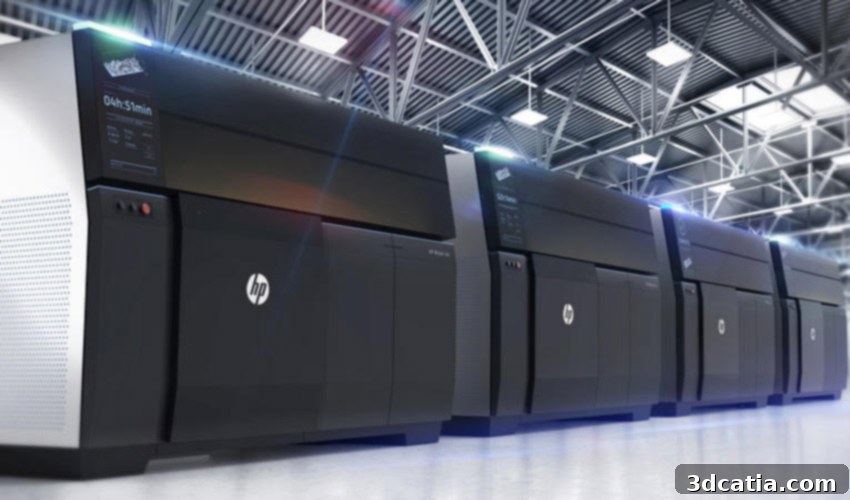
HP Metal Jet: Revolutionizing Industrial Metal 3D Printing for Mass Production and Global Impact
Earlier this year, the renowned American technology giant HP made a significant and highly anticipated announcement: its official entry into the burgeoning field of metal additive manufacturing. This pivotal declaration, which sent ripples across the industry, was subsequently confirmed and further detailed at the prestigious IMTS Chicago show. HP, already recognized as one of the leading global providers of professional 3D printers, unveiled its groundbreaking HP Metal Jet technology. Alongside this innovative hardware, the company also introduced the Metal Jet Production Service, an on-demand 3D metal printing service slated to become fully operational from 2019. This strategic move marks a critical expansion for HP, leveraging its extensive experience in plastic additive manufacturing to address the growing demand for advanced metal fabrication solutions across various industrial sectors.
At the core of HP’s new offering is a sophisticated metal additive manufacturing machine, engineered to deliver unparalleled performance. This cutting-edge system is founded on an advanced powder binding technique, drawing significant inspiration from the established principles of Metal Injection Molding (MIM). HP boldly claims that its Metal Jet technology is poised to revolutionize serial production capabilities, promising an astonishing 50 times greater productivity compared to other conventional metal powder bonding and sintering solutions currently available on the market. Furthermore, this dramatic increase in output is coupled with a projected twofold reduction in manufacturing costs, making industrial-scale metal 3D printing more economically viable than ever before. These claims underscore HP’s ambition to not just enter the market, but to fundamentally transform it by making high-volume, cost-effective metal part production a reality for diverse industries.
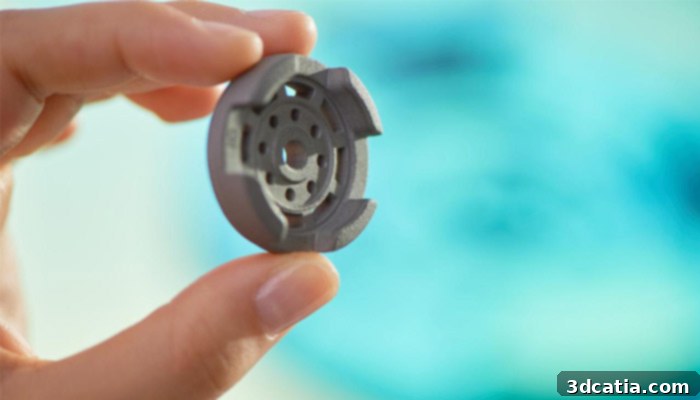
A metal piece printed by HP’s machine, showcasing the technology’s capability.
The landscape of metal additive manufacturing is experiencing an unprecedented boom, a trend emphatically highlighted by the Wohlers Reports 2018, which indicated that 80% of new solutions sold last year were in this rapidly expanding segment. This growth is a clear indicator of the industry’s widespread recognition of metal 3D printing’s transformative potential. Consequently, an increasing number of manufacturers are enthusiastically entering this niche, driven by a collective aspiration to lower prices and enhance the accessibility of this advanced technology. HP, a pioneer in digital printing and plastics 3D printing with its Multi Jet Fusion process, is certainly no exception to this trend. The American manufacturing giant has strategically introduced its metal machine, with initial availability slated for 2020 in select regions, followed by a broader global release in 2021. This phased rollout reflects a calculated approach to penetrate the market, allowing industries worldwide to gradually adopt and integrate this powerful new production method into their operations. The introduction of Metal Jet is set to democratize metal part production, enabling greater design freedom, faster iterations, and localized manufacturing previously considered impossible or cost-prohibitive.
Unveiling the HP Metal Jet Solution: Technology and Specifications
The core operational principle of HP Metal Jet technology revolves around a sophisticated binder jetting process. This method precisely projects a binding agent onto layers of metal powder, which are then solidified sequentially, layer by layer, to form a “green part.” This innovative approach allows for intricate geometries and complex designs to be realized with high precision. An advantage of the Metal Jet system is its ability to directly remove the binder within the 3D printer itself, streamlining part production. However, it’s crucial to note that the final sintering step, which transforms the green part into a dense, fully metallic component, must be conducted in a separate, specialized oven. This post-processing step is vital for achieving the desired mechanical properties and material strength. The initial HP metal machine is designed with a substantial print volume of 430 x 320 x 200 mm, offering ample space for producing a wide range of industrial components. Initially, the process will focus on producing high-quality stainless steel parts, a material widely used across various industries due to its strength and corrosion resistance. HP has also indicated future plans to expand its material compatibility to include other high-performance metals such as titanium, further broadening the application scope of this versatile technology.
With an announced price point below $399,000, the HP Metal Jet machine is strategically positioned within the competitive landscape of industrial additive manufacturing. This pricing strategy places the US manufacturer in direct competition with established players offering high-end industrial machines, such as 3D Systems, EOS, or Arcam. These companies have historically served the advanced manufacturing sectors with robust, high-performance systems. However, HP’s offering contrasts sharply with the strategies of startups like Desktop Metal and Markforged, which primarily target markets with lower-cost equipment, aiming for broader accessibility at an entry-level industrial scale. The Metal Jet’s aggressive pricing for a system boasting such high productivity and quality signals HP’s intent to disrupt the mid-to-high end of the industrial metal 3D printing market. First deliveries to early adopter users are anticipated in 2020, with broader market availability for all customers expected from 2021. This tiered rollout allows HP to refine its service and support networks while demonstrating the technology’s capabilities in real-world industrial applications.
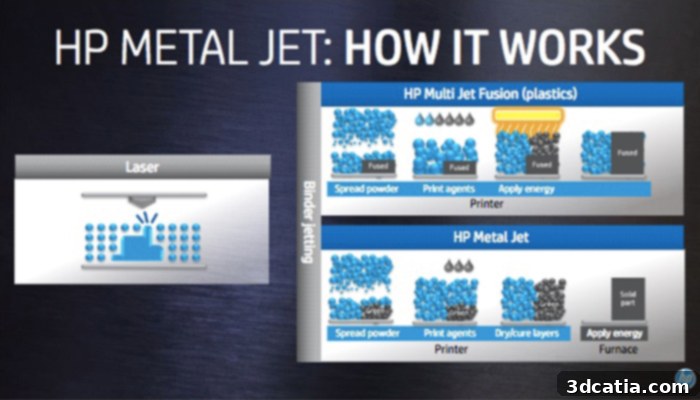
HP Metal Jet technology in action, demonstrating its precise binder jetting process.
Dion Weisler, the then CEO and President of HP Inc., eloquently articulated the significance of this venture, stating, “We are in the midst of a digital industrial revolution that is transforming the $12 trillion manufacturing industry. HP has helped lead this transformation by pioneering the 3D mass production of plastic parts and we are now doubling down with HP Metal Jet, a breakthrough metals 3D printing technology.” His remarks underscore the immense scale of the manufacturing sector and HP’s long-standing commitment to driving digital innovation within it. Weisler further elaborated on the far-reaching implications of Metal Jet, asserting, “The implications are huge – the auto, industrial, and medical sectors alone produce billions of metal parts each year. HP’s new Metal Jet 3D printing platform unlocks the speed, quality, and economics to enable our customers to completely rethink the way they design, manufacture, and deliver new solutions in the digital age.” This vision highlights HP’s ambition to empower industries to achieve unprecedented levels of efficiency, customization, and innovation, fundamentally reshaping global supply chains and product development cycles. The technology promises not just faster production, but also the ability to create previously impossible geometries, consolidate multiple parts into single, more efficient components, and enable truly on-demand manufacturing.
Strategic Partnerships Driving the HP Metal Jet Deployment
In a move designed to accelerate the adoption and deployment of its metal additive manufacturing solution, HP concurrently announced the formation of two strategic partnerships alongside the Metal Jet launch. These collaborations are crucial for establishing a robust ecosystem around the new technology. One of the primary partners is GKN Powder Metallurgy, a global leader in powder metal solutions. GKN will play a pivotal role by installing HP Metal Jet machines within its extensive network of factories. This integration will enable GKN to manufacture high-volume, functional metal parts for prominent automotive and industrial leaders, including industry stalwarts such as Volkswagen and Wilo. Volkswagen, in particular, has already commenced production of 3D-printed components using this technology, focusing on applications like shift knobs and mirror holders. These are not merely prototypes but production-ready parts, demonstrating the immediate applicability and reliability of Metal Jet. GKN Powder Metallurgy, with its staggering annual production of over 3 billion components, harbors ambitious plans to significantly scale its 3D printing capabilities, aiming to produce millions of parts via Metal Jet technology within the coming year. This partnership underscores the technology’s readiness for large-scale industrial adoption and its potential to integrate seamlessly into existing manufacturing processes.
Peter Oberparleiter, the CEO of GKN Powder Metallurgy, expressed immense enthusiasm for the partnership and the capabilities of the new technology. He explained, “HP’s new Metal Jet technology enables us to expand our business by taking on new opportunities that were previously cost prohibitive.” This statement highlights a key advantage: the ability to manufacture complex, high-performance parts economically, opening up new market segments and product possibilities. He further elaborated on the synergistic benefits, continuing, “…By combining the forces of HP and GKN Powder Metallurgy, we will push the productivity and capability of our customers to unprecedented levels based on the economic and technical advantages of HP Metal Jet technology.” This collaborative effort is set to unlock significant value for customers across various industries, offering a blend of HP’s technological innovation and GKN’s deep expertise in powder metallurgy and high-volume manufacturing. The partnership exemplifies how advanced additive manufacturing can be scaled effectively through strategic alliances, bridging the gap between cutting-edge technology and real-world industrial application. It also provides a clear pathway for businesses to transition from traditional manufacturing methods to more agile and efficient digital workflows, thereby gaining a competitive edge in rapidly evolving markets.
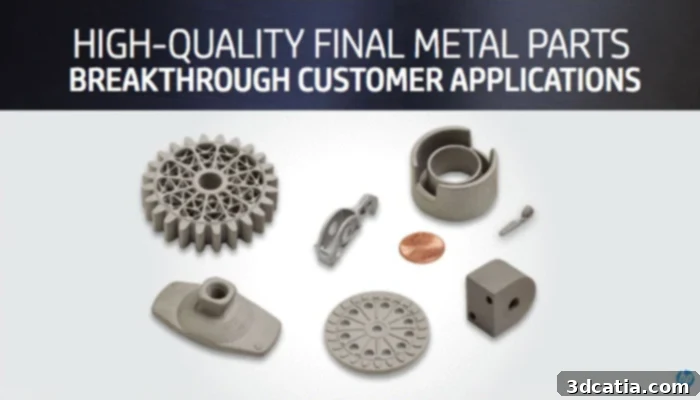
HP Metal Jet technology is designed to enable the creation of high-quality metal parts with intricate details.
Beyond the industrial and automotive sectors, HP is also strategically targeting the highly specialized medical industry. To effectively serve this demanding market, HP has forged a partnership with Parmatech, a distinguished leader in metal injection molding and precision manufacturing. This collaboration will empower Parmatech to produce intricate and critical parts for a roster of esteemed customers, including OKAY Industries, Primo Medical Group, and other key specialists within the medical sector. The Californian company envisions utilizing HP Metal Jet technology to manufacture complex components, such as sophisticated endoscopic surgical instruments. This application is particularly significant because the medical industry often requires parts with extremely complex geometries, high precision, biocompatible materials, and stringent quality standards. Metal additive manufacturing, with its ability to create custom, patient-specific devices and intricate internal structures not achievable with traditional methods, is perfectly suited for these demands. The partnership with Parmatech, with its deep expertise in medical device manufacturing, ensures that HP Metal Jet can meet the rigorous requirements and regulatory challenges inherent in this vital industry, ultimately leading to innovative solutions that can improve patient care and surgical outcomes.
Introducing a Dedicated 3D Metal Printing Service: Metal Jet Production Service
Recognizing the diverse needs of its potential customer base, the US manufacturer also seized the opportunity to unveil the launch of its dedicated on-demand 3D printing service, aptly named the Metal Jet Production Service. This service is designed to provide unprecedented accessibility to HP’s advanced metal 3D printing capabilities, particularly for companies that may not yet be ready to invest in their own Metal Jet machines or who require specialized part production. From the first quarter of 2019, HP customers gained the ability to seamlessly upload their 3D design files to the secure platform. Shortly thereafter, they would receive their finished, high-quality 3D printed metal parts. A key aspect of this service model is that the actual manufacturing of these parts will be expertly handled by HP’s strategic partners, GKN Powder Metallurgy and Parmatech. This collaborative approach leverages the specialized manufacturing expertise and infrastructure of these partners, ensuring optimal production quality and efficiency. This sales strategy—combining direct machine sales with an accessible service delivery model—is not new to the additive manufacturing industry. It mirrors the successful approaches employed by other giants in the sector, such as 3D Systems, Stratasys, and Prodways in France. By offering both options, HP caters to a broader range of businesses, from those looking for full in-house production capabilities to those seeking agile, on-demand manufacturing solutions without the upfront capital investment. This dual strategy aims to accelerate market adoption, educate potential buyers about the technology’s benefits, and establish Metal Jet as a versatile solution across the entire product development and manufacturing lifecycle.
Learn more about the new HP Metal Jet technology here:
What do you think of the groundbreaking HP Metal Jet technology and its potential to reshape industrial manufacturing? We invite you to share your insights and opinions in a comment below, or connect with us on our Facebook and Twitter pages! And don’t forget to sign up for our free weekly Newsletter. By subscribing, you’ll receive all the latest news on progress, innovative research, and insights from entrepreneurs in the dynamic world of 3D printing, delivered straight to your inbox! Stay informed and be a part of the future of manufacturing with us.