

Revolutionizing Maritime Engines: How 3D Printing Drives Sustainability and Efficiency in Cargo Shipping
The global maritime industry, a cornerstone of international trade, faces an urgent strategic challenge: transitioning towards greater sustainability. Modern cargo ships rely on colossal, intricate engines that are currently optimized using traditional manufacturing methods. However, these conventional approaches often present limitations in terms of design freedom and material usage, impacting fuel efficiency and environmental footprint. For years, the sector has been actively seeking innovative solutions to enhance sustainability, primarily by optimizing engine components to reduce weight and, consequently, fuel consumption and harmful emissions. Additive manufacturing, commonly known as 3D printing, is emerging as a powerful technological enabler, offering a promising pathway to achieve these ambitious goals. A collaborative research project between the Technical University of Denmark (DTU) and MAN Energy Solutions, a leading German engine manufacturer, has specifically investigated the potential advantages of 3D printing an essential engine component: the injection nozzle.
Maritime shipping constitutes the backbone of global commerce, accounting for over 80% of the world’s trade volume and approximately 70% of its trade value. This multi-trillion-dollar industry, estimated at around 60% of the 14 trillion US dollar seaborne trade in 2019 alone, comes with significant environmental implications. Cargo ships contribute substantially to various forms of pollution, including air pollution (through the emission of greenhouse gases and other harmful substances), water pollution, and oil spills. The environmental impact is stark: in 2018, the International Maritime Organization (IMO) reported that total greenhouse gas emissions from shipping reached approximately 1.056 million tonnes of CO2 in 2019. Within the European Union, shipping alone is responsible for 13.4% of all transport-related greenhouse gas emissions. These figures underscore the critical need for change, making the industry a prime candidate for eco-friendly transformations, with a growing number of innovative projects aimed at decarbonization and improved environmental performance.
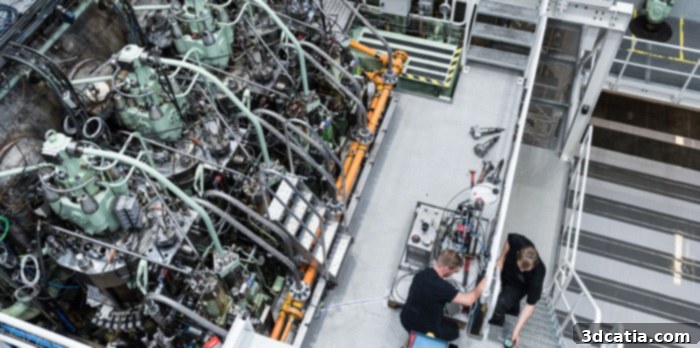
Engine durability is a strategic issue for the marine industry (photo credits: DTU)
Optimizing the Heart of the Engine: The Injection Nozzle
The project specifically focused on the injection nozzle, a vital component responsible for precisely injecting fuel into the engine’s combustion chamber. The accuracy and efficiency of this fuel delivery system are paramount, as the fuel must mix optimally with air to ensure complete and efficient combustion. A well-designed nozzle directly impacts engine performance, fuel economy, and emission levels. Historically, these nozzles have been designed and manufactured using traditional methods, which often impose limitations on the complexity of internal geometries. Such limitations can inadvertently compromise combustion efficiency, leading to higher fuel consumption and, consequently, increased operational costs and a larger environmental footprint. Given the intense scrutiny on the sustainability of cargo ships, optimizing a critical component like the injection nozzle becomes not just an engineering challenge, but a strategic imperative for the entire marine industry.
A Collaborative Approach: DTU and MAN Energy Solutions
The pioneering research was conducted by Thomas Dahmen, a post-doctoral fellow in DTU’s Mechanical Engineering department, in close collaboration with MAN Energy Solutions. MAN Energy Solutions, a prominent German multinational, is renowned for manufacturing large-bore diesel engines and turbomachinery, including those specifically designed for the demanding marine industry. This partnership brought together DTU’s academic expertise in advanced manufacturing and material science with MAN’s deep industrial knowledge and engine testing capabilities. Peter Hagen, a mechanical engineer within MAN Energy Solutions, articulated the strategic rationale behind this joint venture, explaining, “At MAN Energy Solutions, we’ve long been aware that 3D-printed metal can provide us with some opportunities to design important parts of our ship engines that were not previously possible. This made a collaboration with DTU on exploring the potential an obvious choice.” This statement highlights the recognition within the industry that additive manufacturing offers unprecedented design freedom, enabling the creation of geometries and internal structures that are simply unachievable with conventional subtractive or formative manufacturing techniques. The goal was to leverage this capability to push the boundaries of engine efficiency and environmental performance.
Methodology and Design Innovation with Additive Manufacturing
To systematically evaluate the potential of 3D printing for engine components, Thomas Dahmen employed a Quality Function Deployment (QFD) matrix, a structured methodology adapted specifically for additive manufacturing applications. QFD is a powerful analytical technique that helps translate customer requirements and needs into technical specifications and engineering characteristics. In the context of 3D printing, it allows researchers and engineers to identify components where additive manufacturing can provide the greatest added value, considering factors like design complexity, material performance, and cost-efficiency. By applying this refined QFD matrix to the injection nozzle, Dahmen was able to systematically assess various design parameters and manufacturing approaches. The outcome of this rigorous analysis was the development of a modular kit concept for 3D printed nozzles, offering a flexible framework for designing optimized nozzles that can be tailored for specific engine requirements and fuel types. This modularity is a direct benefit of additive manufacturing, allowing for rapid iteration and customization without the need for extensive retooling.
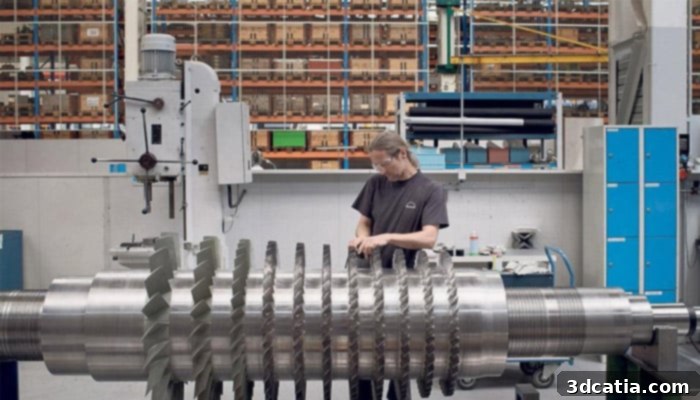
The MAN Energy Solutions Group manufactures gas turbines (photo credits: Christoph Ruckstuhl / NZZ)
The true value of additive manufacturing often lies in its ability to unlock unparalleled design freedom, allowing for the creation of complex internal geometries and organic shapes that would be impossible with traditional methods. In this project, Dahmen leveraged this capability to significantly improve the injection nozzle’s design. By introducing subtle ‘bends’ and intricate internal channels within the nozzle, he realized that the fuel flow could be dramatically optimized. This innovative internal geometry leads to a smoother, more uniform flow of fuel, enhancing atomization and ensuring a more consistent and efficient mixture with air within the combustion chamber. The result is superior combustion, which directly translates to reduced fuel consumption for the engine. Furthermore, this improved combustion efficiency is anticipated to significantly reduce the engine’s NOx (nitrogen oxide) emissions – a major environmental concern in maritime transport. While initial tests are highly promising, further rigorous testing is ongoing to conclusively quantify this reduction. The prototype part underwent extensive validation on one of MAN Energy Solutions’ test engines in Copenhagen, where the results were described as “very conclusive,” indicating a strong potential for real-world application and significant benefits.
Choosing the Right Additive Manufacturing Process: Binder Jetting’s Advantage
Beyond the revolutionary design, the young researcher also meticulously investigated various 3D printing processes to determine which one was best suited to the unique constraints and requirements of an engine injection nozzle. His detailed analyses compared several prominent metal additive manufacturing technologies, specifically focusing on powder bed laser fusion (such as Selective Laser Melting or Direct Metal Laser Sintering) and metal powder bonding (Binder Jetting). Each process has distinct advantages and limitations regarding material compatibility, part density, surface finish, build speed, and the ability to create complex internal features. After thorough evaluation, Dahmen concluded, “This part of the analyses highlighted the suitability of Binder Jetting for intricate flow-related nozzle features and special high-temperature materials which would be impossible to realize with other manufacturing processes.”
This finding is crucial. Powder bed fusion methods, while excellent for creating dense, high-strength parts, often require support structures within complex internal channels and can be limited in the range of high-temperature alloys they can process efficiently. Binder Jetting, on the other hand, operates by selectively depositing a liquid binder onto a thin layer of powder particles, building up the part layer by layer. This process requires no support structures for internal features, making it ideal for the intricate, tortuous flow paths designed into the new nozzle. Furthermore, Binder Jetting is highly compatible with a wider array of high-temperature and specialized materials, including refractory metals and ceramics, which are essential for components operating in the extreme thermal and chemical environments of an engine’s combustion system. The ability to use these advanced materials, combined with the freedom to create previously impossible internal geometries, positions Binder Jetting as a transformative technology for engine component optimization. You can find more detailed information on this breakthrough research HERE.
The Future of Sustainable Maritime Transport
The successful development and testing of a 3D printed injection nozzle for cargo ship engines represent a significant leap forward for the maritime industry’s sustainability efforts. This project demonstrates how additive manufacturing can move beyond prototyping to deliver tangible improvements in critical engine components, directly addressing issues of fuel efficiency, emissions reduction, and overall environmental impact. As the global shipping industry continues to face stringent environmental regulations and mounting pressure to decarbonize, innovations like these will be crucial. The potential extends beyond injection nozzles to other complex engine parts, such as impellers, heat exchangers, and turbine components, where AM’s design freedom and material versatility can offer similar benefits. Furthermore, the ability to produce spare parts on demand closer to operational sites could revolutionize supply chain logistics, reducing lead times, inventory costs, and the carbon footprint associated with manufacturing and transport of traditional spare parts. This research paves the way for a new era of optimized, more sustainable, and cost-effective solutions for the backbone of global trade.
What are your thoughts on this innovative 3D printed injection nozzle and its implications for cargo ships and the future of sustainable maritime transport? We invite you to share your insights in a comment below or engage with us on our social media channels: LinkedIn, Facebook, and Twitter! Don’t miss out on the latest advancements in additive manufacturing – remember to sign up for our free weekly Newsletter here, delivered straight to your inbox! You can also explore all our compelling videos and further discussions on our YouTube channel.
*Cover Photo Credits : MAN Energy Solutions