
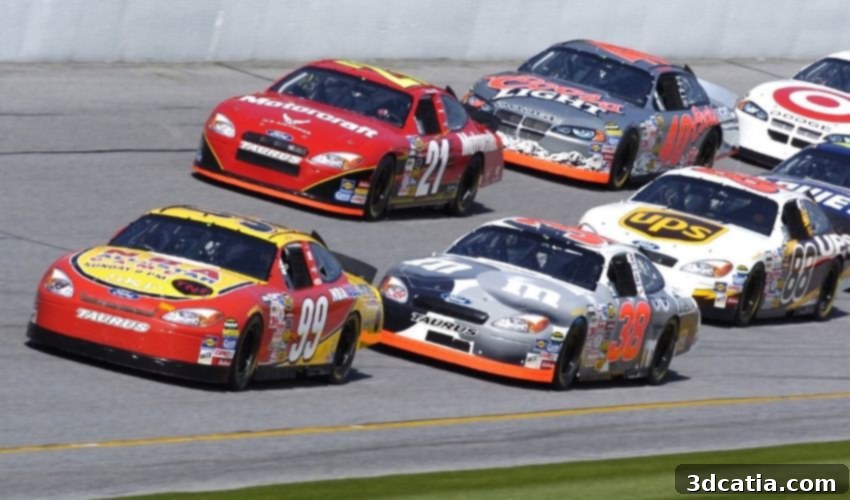
Stratasys and NASCAR Forge Ahead: 3D Printing Drives Next Gen Race Car Performance and Innovation
The integration of 3D printing within the automotive industry has profoundly reshaped traditional manufacturing paradigms, evolving far beyond its initial applications in prototyping and research & development. Today, additive manufacturing technologies are instrumental in producing high-performance end-use parts across a diverse range of vehicles, from cutting-edge electric cars to bespoke luxury vehicles. This transformative shift is particularly evident in the highly competitive world of motorsports, where the pursuit of marginal gains is paramount. Racing teams, renowned for their embrace of innovation, have enthusiastically adopted additive manufacturing to create lighter, stronger, and more aerodynamically optimized components. Formula 1, for instance, has long championed 3D printing for its ability to deliver superior performance advantages. Now, NASCAR, America’s premier stock car racing series, is making its own significant stride into this advanced manufacturing era. A groundbreaking partnership between leading 3D printing solutions provider Stratasys and NASCAR has been announced, confirming their collaboration to integrate 3D printed production parts into every NASCAR Next Gen racecar, marking a pivotal moment for the sport.
The Next Gen car, previously known during its development as the Gen-7 car, represents a monumental leap forward in NASCAR vehicle design and engineering. After facing initial delays due to global challenges, this revolutionary racecar officially debuted in February of the current year (referring to the year of original publication), introducing a host of exciting features aimed at enhancing competition, safety, and driver experience. Central to this evolution is the strategic partnership with Stratasys. Through this collaboration, Stratasys has officially confirmed that a custom-designed, 3D printed windshield air cockpit ventilation unit will be standard equipment in every Next Gen car. This vital component underscores NASCAR’s deepened commitment to leveraging additive manufacturing for critical, functional parts, moving beyond simple prototypes to high-performance production-grade solutions.
Pat Carey, Senior Vice President of Strategic Growth at Stratasys, eloquently articulated the growing confidence and investment NASCAR is placing in additive manufacturing. He commented, “It is exciting to see the evolution of how NASCAR has used additive manufacturing across their vehicles. We’ve helped them move from 3D printed prototypes to end-use production parts on their high-performance race cars. This partnership is a natural extension of the relationship we’ve built over nearly 18 years with NASCAR teams like Joe Gibbs Racing and Penske Racing. These teams have been quick to adopt cutting-edge technologies to enhance their car designs and provide performance advantages, and now we’re happy to support the expansion to all NASCAR Next Gen cars.” This statement highlights not only the long-standing relationship between Stratasys and various NASCAR teams but also the significant trajectory of 3D printing adoption – from experimental prototyping to widespread, mission-critical component integration.
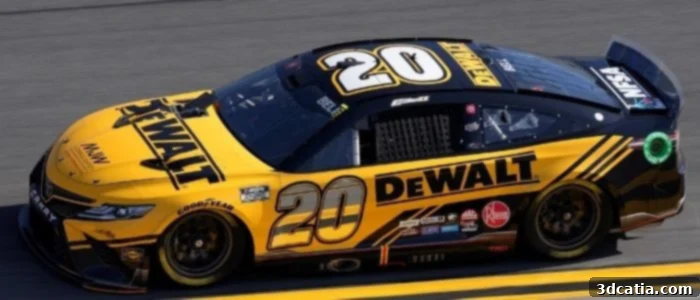
Joe Gibbs Racing #20 car driven by Christopher Bell with the 3D printed windshield cockpit ventilation unit (photo credits: Stratasys)
3D Printing: A Game Changer for NASCAR Performance and Efficiency
NASCAR’s decision to embrace additive manufacturing for the Next Gen car was driven by a clear understanding of its multifaceted benefits for race car engineering. The 3D printed components are engineered to deliver critical improvements in performance, offering unparalleled design flexibility, significant cost savings, and enhanced aerodynamics—all factors of immense importance in the high-stakes world of professional racing. The strategic implementation of these parts across every single team competing in the NASCAR Cup Series underscores their proven value and the sport’s commitment to a level playing field built on cutting-edge technology.
Stratasys emerged as the unequivocal partner of choice due to its nearly two decades of collaborative history with NASCAR teams, particularly with powerhouse organizations like Joe Gibbs Racing and Penske Racing. This extensive experience provided a robust foundation of trust and technical expertise. The crucial windshield air cockpit ventilation units, for example, were manufactured by Stratasys Direct Manufacturing, leveraging the advanced SAF™ (Selective Absorption Fusion) powered Stratasys H350™ 3D printer. The material of choice was Stratasys High Yield PA11, a high-performance polyamide derived from more sustainable castor oil, emphasizing not only performance but also a step towards environmental responsibility. Following the printing process, these parts underwent a meticulous post-processing regimen involving cleaning, finishing, dyeing, and shot-blasting with DyeMansion equipment. This advanced finishing workflow is a continuation of a successful partnership between Stratasys and DyeMansion, which began in May of the previous year (referring to the year before original publication).
The benefits of adopting additive manufacturing in this context are extensive. For NASCAR, the ability to rapidly iterate and produce complex geometries that are impossible or cost-prohibitive with traditional methods is a game-changer. The windshield ventilation unit, for instance, can be optimized for precise airflow and driver comfort without the constraints of conventional tooling. This directly translates into improved aerodynamic efficiency and a more comfortable environment for the drivers during grueling races. Furthermore, 3D printing allows for significant weight reduction compared to traditionally manufactured parts, which is a critical factor in racing where every gram saved contributes to better acceleration, braking, and handling. The PA11 material, with its excellent mechanical properties and high-temperature resistance, ensures that these essential components can withstand the extreme conditions inside a high-performance race car.
John Probst, Senior Vice President of Racing Innovation at NASCAR, underscored the indispensable nature of this collaboration. He stated, “The Next Gen car could not have been completed without the collaboration with NASCAR Competition Partners like Stratasys and Stratasys Direct Manufacturing. During testing, we realized we needed an additive manufacturing solution that could withstand high temperatures and needed the parts delivered quickly. We approached Stratasys Direct, and they delivered not only as a supplier but as a consultant on this project. They provided us with strategic direction on design, materials, and the right additive manufacturing technologies to use to create the highest performance parts for the Next Gen cars.” This highlights Stratasys’ role not just as a technology provider, but as a crucial strategic partner, offering expertise that informed critical design and material choices under tight deadlines and demanding performance specifications. The agility of additive manufacturing was key to overcoming design challenges and ensuring rapid delivery of production-ready parts.
Future Implications and the Broader Impact of Additive Manufacturing in Motorsports
The collaboration between Stratasys and NASCAR for the Next Gen car is more than just a technological upgrade; it’s a testament to the maturation of additive manufacturing as a viable and indispensable production method for the most demanding applications. This partnership sets a powerful precedent for how other motorsports series, and indeed the broader automotive industry, can leverage 3D printing to drive innovation, improve performance, and streamline manufacturing processes. The adoption of end-use 3D printed parts in all NASCAR Next Gen cars signals a future where custom, optimized components become the norm, enhancing competitive parity while pushing the boundaries of engineering excellence.
Looking ahead, this initiative paves the way for even greater integration of 3D printing in racing. We can anticipate more components across various vehicle systems benefiting from the design freedom, material versatility, and speed that additive manufacturing offers. From intricate engine parts and braking system components to driver safety enclosures and personalized ergonomic elements, the potential applications are vast. This move by NASCAR also emphasizes a strategic shift towards more flexible and resilient supply chains, reducing reliance on conventional tooling and long lead times. The ability to produce parts on demand, with complex internal structures for lightweighting or enhanced functionality, will continue to fuel the relentless pursuit of speed and safety in racing. Furthermore, the use of sustainable materials like PA11 derived from castor oil points towards a future where high-performance engineering can also align with environmental considerations.
This landmark partnership between Stratasys and NASCAR is a clear indication that additive manufacturing has firmly established itself beyond the realm of prototyping, becoming a critical enabler for performance, efficiency, and innovation in the pinnacle of automotive engineering and high-speed competition. You can delve deeper into the full story by reading Stratasys’ official press release HERE.
What are your thoughts on NASCAR’s groundbreaking partnership with Stratasys and the increasing role of 3D printing in high-performance motorsports? Share your insights and join the conversation by leaving a comment below, or connect with us on our social media channels: Linkedin, Facebook, and Twitter! Don’t miss out on the latest advancements and news in the additive manufacturing world – be sure to sign up for our free weekly Newsletter here, delivering the most important 3D printing updates directly to your inbox. For a visual deep dive into the technologies and innovations we cover, explore all our videos on our dedicated YouTube channel.
*Cover Photo Credits: U.S. Air Force photo by Larry McTighe, Public domain, via Wikimedia Commons