
The Future of Metal Additive Manufacturing: Unpacking Key Trends and Market Predictions
The landscape of industrial manufacturing is continuously reshaped by innovation, and few technologies exemplify this more profoundly than metal additive manufacturing. Earlier this year, a comprehensive report from the research firm IDTechEx shed light on the burgeoning metal additive manufacturing market, offering an optimistic outlook. Their analysis estimates that the market’s value is poised to soar to an impressive $18.5 billion within the next decade, signaling a robust and sustained recovery. This extensive study delved deep into the various processes underpinning metal additive manufacturing, critically comparing existing technologies to uncover major industry trends and identify potential new revenue streams. The report challenged industry stakeholders to consider critical questions: Which technologies, from powder bed fusion and concentrated energy deposition (CED) to wire extrusion, warrant the most attention? And more broadly, where exactly does the future of metal 3D printing truly lie?
IDTechEx’s meticulous investigation covered an expansive array of fourteen distinct metal 3D printing processes. This broad scope allowed for a thorough comparative analysis, encompassing both well-established and emerging technologies. Among the more recognized processes scrutinised were Binder Jetting, which uses a liquid binder to join powder particles layer by layer; Directed Energy Deposition (DED), a process often employed for repairing existing components or creating large structures; and various forms of extrusion, including those utilising granules, pastes, and metal filaments. Laser Powder Bed Fusion (L-PBF), known for its precision and ability to produce complex geometries, also featured prominently. Beyond these mainstream methods, the study also examined less common but potentially impactful processes like electrochemical deposition, which builds parts atom by atom through an electroplating process, and cold spray, a solid-state deposition technique ideal for large-scale repair and manufacturing. For each of these processes, IDTechEx evaluated a crucial set of criteria: achievable print volume, part accuracy, the upfront cost of the machine, the ongoing expense of materials, and the necessity and complexity of post-processing steps. This multi-faceted comparison aimed to provide a holistic view of each technology’s inherent strengths and weaknesses, offering invaluable insights for businesses navigating this complex market.
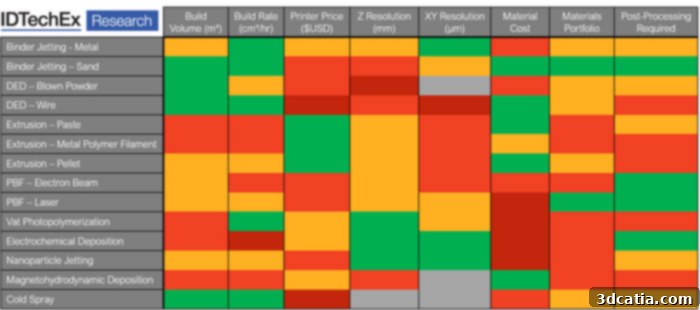
IDTechEx compared 14 metal 3D printing processes according to specific criteria (photo credits: IDTechEx)
Navigating Current Metal Additive Manufacturing Market Trends
Understanding the current dynamics of the metal additive manufacturing market requires a close look at the factors that most influence user adoption and business investment. As with many advanced technologies, two overarching elements—price and build volume—stand out as particularly critical for potential users. Starting with cost, it’s widely recognized that metal powder, especially the highly uniform and spherical powders required for processes like laser powder bed fusion, can be prohibitively expensive. This high material cost often acts as a significant barrier to entry for numerous companies, preventing them from exploring the vast potential of powder-based additive manufacturing processes, despite their proliferation in the market. This economic hurdle has, however, spurred an exciting trend: the rapid advancement and increasing popularity of extrusion technologies. More specifically, the deposition of metal filaments (often referred to as rods or metal-filled polymers) and granules is gaining considerable traction. These methods typically utilise lower-cost raw materials, making them a more accessible entry point into metal 3D printing. A prime example is manufacturers like Meltio, which has pioneered machines that ingeniously combine different types of raw materials, such as metal wire and powder, to significantly drive down the cost per 3D printed part. Furthermore, an increasing number of companies traditionally specialised in Fused Deposition Modeling (FDM) or Fused Filament Fabrication (FFF) for polymers are now developing and presenting extruders specifically capable of handling metallic materials, further democratising access to metal additive manufacturing.
While extrusion processes emerge as a more cost-effective alternative, it’s important to remember that some established metal AM technologies inherently rely on raw materials other than traditional metal powder. Directed Energy Deposition (DED), for instance, often employs metal wire or coarse powder blown through a nozzle, while sand powder binding uses a binder to form parts from sand particles. However, a primary drawback for these two highly capable technologies often remains their high initial machine cost. A quick glance at the IDTechEx comparison chart immediately reveals that DED and sand powder binding machines frequently represent some of the most expensive 3D printers on the market. Consequently, users seeking a more economical entry point into metal additive manufacturing are naturally inclined towards extrusion-based solutions, which offer a more approachable investment without sacrificing the benefits of metal prototyping and production. This highlights a clear bifurcation in the market: high-end, high-performance systems for specialised applications, and more accessible, cost-conscious solutions for broader industrial adoption.
Shifting our focus to build volume, the metal additive manufacturing market presents an encouragingly wide spectrum of capabilities. Users are not restricted by size constraints, with the ability to design incredibly small, intricate parts on highly precise laser melting machines, and simultaneously produce exceptionally large components through processes like cold spray. This versatility in build volume is a significant positive trend, suggesting that users are not held back by the current size limitations of available technologies. This expansive range enables a broader array of possible applications across diverse industries. From aerospace components requiring large, strong structures to delicate medical implants demanding intricate details, metal 3D printing can cater to vastly different needs. This adaptability directly translates into increased adoption and expanded use cases for metal 3D printing, fostering innovation across sectors that previously faced design or manufacturing limitations due to size constraints.
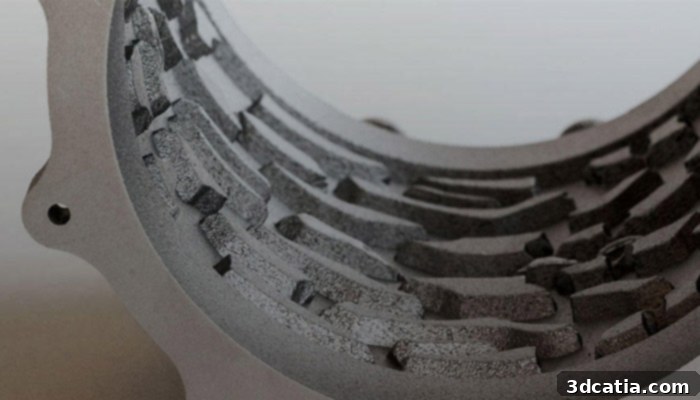
Current solutions allow the design of parts of varying sizes (photo credits: 3D Systems)
The Evolving Landscape: What is the Future of Metal Additive Manufacturing?
As the metal additive manufacturing sector continues its trajectory of rapid evolution, the IDTechEx report offers invaluable predictions regarding the ideal characteristics of future systems. According to their findings, a metal 3D printer that successfully combines a relatively low entry price – ideally around $500,000, rather than the several million dollars typically associated with high-volume, high-performance machines – with a generously large build volume would undoubtedly create a sensation among users. Such a machine would dramatically lower the barriers to entry for many more businesses, enabling them to harness the benefits of large-scale metal additive manufacturing without the prohibitive initial capital investment. Beyond affordability and size, two other critical properties will define the success of future metal 3D printers: exceptional surface finish and superior tensile strength. Users consistently demand solutions capable of designing and producing high-quality parts that not only meet but exceed the most rigorous industrial requirements, ensuring optimal performance, durability, and safety in demanding applications. The desire for high-strength parts with smooth surfaces is driven by a need to minimise costly and time-consuming post-processing steps, such as machining or polishing, while ensuring the integrity and functionality of the final product.
Crucially, the IDTechEx report highlights a pervasive challenge in current metal additive manufacturing: the persistent trade-off between manufacturing speed and resolution. Existing technologies often compel users to sacrifice one for the other. Typically, achieving an excellent surface finish and high resolution is prioritised, but this comes at the expense of slower build speeds and lower material throughput. This compromise significantly impacts the economic viability of metal AM for mass production and large-batch manufacturing. However, the report provocatively asks: What if this compromise could be overcome, allowing for both high speed and high resolution simultaneously? We’ve seen this paradigm shift occur in the polymer 3D printing sector, with technologies like Carbon’s Digital Light Synthesis (DLS) and EnvisionTec’s Continuous Digital Light Manufacturing (cDLM) successfully combining rapid production with intricate detail. These polymer processes achieve this through innovative approaches like continuous printing, smart material science, and precise control over the curing process, drastically reducing build times without compromising part quality. The potential for similar breakthroughs in metal additive manufacturing is immense. Imagine the transformative impact of a metal AM system that can produce finished, high-quality metal parts in large series, at speeds comparable to traditional manufacturing, while retaining the geometric complexity and material efficiency that AM offers. This would unlock entirely new applications, from mass customisation of end-use components to significantly accelerated product development cycles across industries like automotive, aerospace, and medical devices. The coming years will undoubtedly focus on breakthroughs that address this dual challenge, pushing the boundaries of what’s possible in metal additive manufacturing and accelerating its adoption into mainstream industrial production. Rest assured, we will be closely monitoring these exciting developments and keeping our readers informed as the industry progresses.
We’d love to hear your thoughts on the future of metal additive manufacturing. What trends do you foresee shaping the industry? Share your insights and predictions by leaving a comment below or connecting with us on our Linkedin, Facebook, and Twitter pages! For the latest 3D printing news delivered straight to your inbox every week, don’t forget to sign up for our free weekly Newsletter here. You can also explore all our insightful videos and interviews on our dedicated YouTube channel.
*Cover Photo Credits: Lasercutting