

Revolutionizing Flexible Batteries: The Future of Wearable Tech Through 3D Printing
In an era defined by rapid technological advancement, 3D printing has consistently demonstrated its potential as a transformative ally across an expansive array of technologies. We are witnessing an accelerating trend where additive manufacturing is penetrating diverse fields, yielding truly remarkable outcomes. Among the most exciting recent developments is the innovative proposal put forth by a collaborative team of researchers from various esteemed Chinese universities: the concept of leveraging 3D printing for the production of flexible batteries. This groundbreaking initiative, detailed in their comprehensive scientific article, not only spotlights a significant leap in battery technology but also profoundly reshapes the landscape for future advancements in manufacturing, particularly within the dynamic realm of flexible electronics and beyond.
The advent of flexible batteries has undeniably fueled a monumental surge in the proliferation of wearable electronic devices and other adaptable technologies. From the ubiquitous smartwatches and next-generation foldable smartphones to sophisticated smart clothing and life-saving medical implants, these adaptable power sources have become indispensable. Their inherent ability to bend, stretch, and conform to various shapes without compromising functionality makes them perfectly suited for devices with highly varied and often ergonomic designs. This capability allows for seamless integration into the contours of the human body or into complex mechanical systems, offering unprecedented design freedom. Much like flexible batteries have redefined the possibilities within technology, 3D printing has, in parallel, revolutionized manufacturing capabilities. Today, we delve into this pioneering collaboration among leading researchers in China, exploring their visionary fusion of additive manufacturing and flexible battery production, a synergy poised to redefine how we power the future.
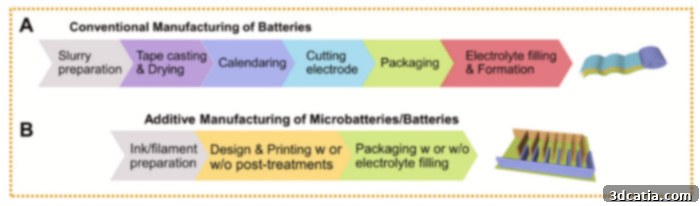
The concept of 3D printing flexible batteries holds promise, potentially streamlining the manufacturing process with fewer steps.Propuesta de impresión 3D de baterías flexibles. (Photo Credits: Journal of Power Sources)
The Conventional Conundrum: Limitations of Traditional Battery Manufacturing
For decades, the conventional approach to manufacturing flexible batteries has largely relied on methods often referred to as “sludge coating” or slurry casting. This process typically involves the preparation of highly viscous slurries by combining finely ground active materials for cathodes (positive electrodes), anodes (negative electrodes), and electrolytes (ion-conducting medium), along with binders and conductive additives. These slurries are then coated onto thin metallic current collectors, followed by drying, calendering (compressing), and cutting into specific shapes before being assembled into battery cells. While this method has proven effective and scalable for mass production of traditional, rigid batteries, researchers acknowledge that it presents significant limitations when applied to the unique demands of flexible electronics. The primary drawback lies in its inability to offer sufficient control over the battery’s intricate architecture, precise configuration, or customized appearance. This traditional, top-down approach inherently restricts the creation of complex, non-planar geometries and often results in material waste, proving less than ideal for the highly specialized and integrated power solutions required by modern flexible devices.
Recognizing these inherent challenges and the escalating demand for more adaptable energy storage solutions, a formidable collaborative team has emerged from China, comprising researchers from the China University of Petroleum, Qingdao University, and Wuhan University of Technology. Their innovative response to this technological bottleneck is comprehensively detailed in a recent scientific article. This publication serves as an exhaustive review of the existing battery manufacturing landscape, while concurrently underscoring the immense potential and undeniable advantages of integrating 3D printing into the production workflow for flexible batteries. Through their meticulously crafted proposal to merge these two powerful technologies, they directly address both the persistent hurdles and the promising solutions within this specialized domain. Given the relentless increase in derivative products requiring bespoke power sources – from sophisticated medical sensors to advanced IoT devices – there is an urgent and undeniable demand for radical advancements in production techniques to truly optimize outcomes and unleash the full potential of flexible electronics.
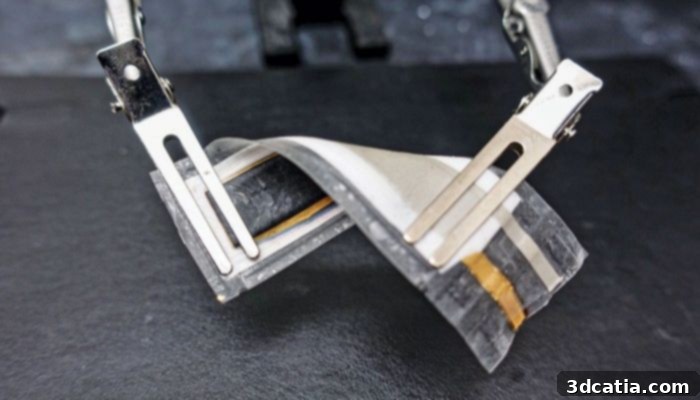
A flexible battery pack. (Photo Credits: American Chemical Society)
Unlocking Potential: The Multifaceted Benefits of Additive Manufacturing for Batteries
The researchers express profound optimism regarding the integration of 3D printing into the manufacturing process of flexible batteries, viewing it as a pivotal solution to many existing challenges. They highlight several critical advantages that collectively promise to revolutionize the field. Firstly, the ability to transform conventional battery materials into specialized, printable inks is a game-changer, opening doors to novel material combinations and unique electrochemical properties. Secondly, and perhaps most significantly, 3D printing offers an unparalleled degree of freedom in design and customization, enabling the creation of intricate, conformable battery architectures previously unattainable. This transformative potential stems directly from 3D printing’s inherent attributes, which include extraordinary precision, advanced automation capabilities, bespoke customization, broad material compatibility, superior efficiency, and long-term cost-effectiveness. Let’s explore these benefits in more detail:
Unprecedented Design Freedom: Unlike traditional manufacturing that often relies on rigid, planar formats, 3D printing allows for the creation of batteries in virtually any shape or size. This means batteries can be intricately designed to fit complex, non-standard geometries within a device, or even integrated directly onto a component’s surface. Think of batteries that are curved to fit a wrist, woven into smart fabrics, or custom-shaped to fill the irregular voids in a medical implant. This ability to create highly conformal and integrated power sources not only saves space but also enhances the overall aesthetics and functionality of the end product, making devices truly seamless and ergonomic.
Revolutionary Material Versatility and Printable Inks: A core innovation lies in adapting conventional battery components—cathodes, anodes, electrolytes, and separators—into printable “inks.” This involves formulating materials with specific rheological properties to ensure they flow smoothly through printer nozzles while retaining their crucial electrochemical performance. This capability allows for the precise deposition of active materials layer by layer, enabling researchers to experiment with novel material compositions and structures that could significantly boost energy density, power output, and cycle life. The development of advanced conductive and ionically active inks is key to unlocking the full potential of 3D printed batteries.
Enhanced Precision and Miniaturization: 3D printing offers micron-level precision, which is critical for fabricating high-performance batteries. This allows for the creation of intricate internal structures, such as optimized electrode architectures or interdigitated patterns, which can significantly improve ion transport and electron flow. This precision also facilitates the miniaturization of batteries without sacrificing capacity, making them ideal for tiny sensors, micro-robotics, and especially medical implants where compact, reliable, and conformable power sources are paramount. Custom-shaped batteries can be tailored to reduce invasiveness and improve the fit of devices within the human body.
Streamlined Automation and Production Efficiency: Additive manufacturing processes are inherently amenable to automation. This leads to streamlined production workflows, reduced manual labor, and consistent quality control. Rapid prototyping becomes significantly faster, allowing designers and engineers to iterate on battery designs and test performance much more quickly, accelerating the development cycle from concept to functional product. The ability to produce on-demand further optimizes inventory and responsiveness to market needs.
Cost-Effectiveness and Reduced Waste: While initial investments in 3D printing technology can be substantial, the long-term benefits in terms of cost-effectiveness are compelling. By enabling precise material deposition, 3D printing minimizes waste compared to subtractive manufacturing methods. Furthermore, the ability to produce custom parts on demand reduces the need for large inventories and specialized tooling for each unique design, leading to significant savings over time. Faster R&D cycles also contribute to overall project cost reduction.
Improved Performance and Safety: The ability to precisely engineer the internal structure of batteries can lead to enhanced performance characteristics. For instance, optimized 3D electrode architectures can increase surface area, leading to higher power densities and faster charging/discharging rates. Furthermore, advanced designs can facilitate better thermal management, which is crucial for battery longevity and safety. The controlled deposition of materials can also help mitigate common failure points and improve the overall reliability of flexible power sources.
The innovative viewpoint presented by these Chinese researchers, while speculative at this stage, is unequivocally aimed at catalyzing future research and initiating a profound revolution in flexible battery manufacturing. As an essential initial step, they have judiciously outlined several critical avenues warranting intensive exploration and development. These include the advancement of ultra-precise 3D nano-printing technologies, the rigorous application of finite element simulations for design optimization, and the continuous development of sophisticated, high-performance printable ink formulations. With the burgeoning market for portable, wearable, and integrated electronic devices showing no signs of slowing, the appearance of the first truly 3D printed flexible batteries, tailored precisely to their applications, remains not just imminent but eagerly anticipated, promising a new era of power solutions. To delve deeper into the specifics of this visionary project and access the original scientific article, you can click here.
What are your thoughts on the proposed utilization of 3D printing for flexible batteries? Do you foresee these innovations powering the next generation of wearable tech and medical devices? Let us know your insights and predictions in a comment below or join the conversation on our LinkedIn, Facebook, and Twitter pages! Don’t forget to sign up for our free weekly newsletter here, to get the latest 3D printing news straight to your inbox! You can also find all our videos and interviews on our dedicated YouTube channel.
*Cover Photo Credits: Pexels