
Revolutionizing Manufacturing: Lawrence Livermore National Lab Achieves Breakthrough in 3D Printing Transparent Glass
A groundbreaking achievement at the Lawrence Livermore National Laboratory (LLNL) is set to redefine the landscape of advanced manufacturing. Researchers have successfully developed a novel method for 3D printing transparent glass, a feat accomplished remarkably at room temperature. This innovative process isn’t just about producing clear glass; it also paves the way for creating intricate glass structures featuring complex composition gradients. This capability represents a monumental leap forward, as such designs were previously deemed impossible using conventional glass manufacturing techniques, which are often limited by high temperatures, restrictive geometries, and a lack of precise material control.
The implications of this breakthrough are far-reaching, promising to unlock new possibilities across numerous scientific and industrial sectors. Traditional glass fabrication, typically involving high-temperature melting and shaping, restricts the complexity and integration of various optical properties within a single component. LLNL’s new approach, rooted in additive manufacturing, sidesteps these limitations, offering unprecedented design freedom and material customization. The ability to print optically clear glass with tailored properties, on-demand and without extreme heat, heralds a new era for optics, photonics, microfluidics, and beyond.
The Unsung Hero: Why Glass Matters More Than You Think
While commonly associated with everyday objects or, humorously, bar brawls, glass is an indispensable material in the scientific and technological realms. Its unique combination of transparency, exceptional chemical and heat resistance, and inherent strength makes it incredibly attractive to researchers and engineers alike. Beyond its scientific utility, glass permeates almost every facet of modern society. From corrective eyewear and camera lenses that capture our world to mirrors reflecting our images, and from robust display screens on our devices to vital fiber optic cables transmitting data globally, glass is fundamental to our daily lives and technological progress. It forms the backbone of countless innovations, enabling advancements in communication, entertainment, healthcare, and exploration.
The capacity to 3D print glass into bespoke, intricate shapes is therefore exceptionally good news for scientists. This additive manufacturing approach allows for rapid prototyping and iterative design, significantly accelerating experimental workflows. Researchers can now quickly fabricate custom labware, microfluidic devices, or specialized optical components tailored to specific experimental conditions, potentially leading to more efficient research and faster discoveries that ultimately benefit humanity. Imagine creating complex, multi-layered lab-on-a-chip systems with integrated optical pathways, all within a single print. This level of customization and integration was previously unachievable, opening doors to novel scientific investigations and breakthroughs.
Furthermore, the ability to 3D print glass with customisable properties stands to revolutionize the optical industry, particularly for opticians and eyeglass wearers. The traditional process for crafting prescription lenses is complex, time-consuming, and involves multiple grinding and polishing steps. With this new technology, personalized lenses could be printed with precise corrections, potentially even integrating multiple prescriptions or advanced optical features into a single, seamless design. A patient could conceivably have a perfectly tailored set of glasses made on-site during a check-up, offering unparalleled convenience, precision, and potentially, cost-effectiveness. This not only streamlines the production process but also opens up possibilities for creating lenses with dynamic properties or enhanced visual capabilities.
This particular breakthrough is especially significant because, while it’s not the absolute first instance of glass being 3D-printed, it marks the first time transparent, high-quality glass has been successfully fabricated using additive manufacturing. Previous attempts often resulted in opaque, porous, or inferior quality glass unsuitable for optical applications. This new method yields glass that is finally superior to, or at least comparable with, glass produced by traditional, more restrictive methods. The resulting material boasts excellent optical clarity and structural integrity, differentiating it from earlier, lower-quality 3D-printed glass compositions.
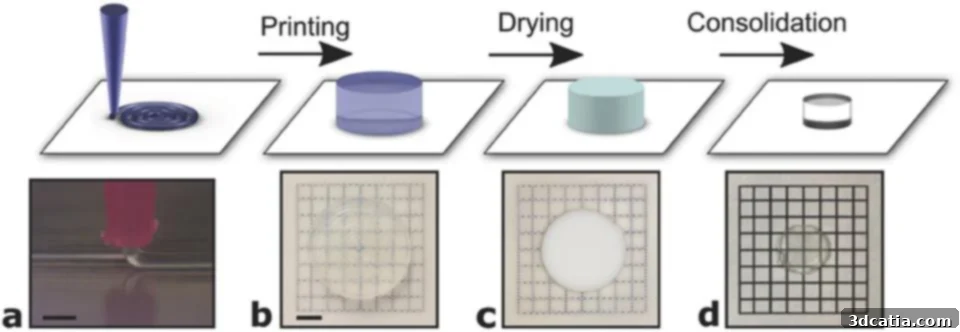
The innovative glass fabrication process itself involves two primary steps: printing and then sintering. Initially, a specialized “ink” – a slurry containing glass particles – is precisely deposited layer by layer to form the desired object’s shape. This green body, a pre-sintered form, is then carefully heated in a controlled environment. During this sintering phase, the individual glass particles fuse together, densifying the material and, crucially, transforming the opaque structure into a transparent one. The meticulous control over temperature and atmosphere during sintering is critical to achieving optical clarity and preventing defects. After cooling, the resulting object shows no discernible evidence of having been printed, resembling a traditionally manufactured piece of glass. The final steps typically involve polishing and finishing to achieve a flawless surface, ready for its intended application. This precise control over material deposition and post-processing allows for the creation of components with exceptional detail and optical performance.
The Dawn of a New Era: Advantages of Superior 3D-Printed Glass
The advantages offered by this ‘superior’ 3D-printed glass are manifold and transformative, particularly for advanced optical systems. One of the most significant breakthroughs is the unprecedented ability to customize the refractive index of the glass within a single component. The refractive index, a measure of how much light bends as it passes through a material, is a fundamental property in optics. Traditionally, achieving varying refractive indices required assembling multiple lenses made from different types of glass. This new method allows for the creation of graded-index (GRIN) lenses or other complex optical elements where the refractive index changes continuously or discontinuously across the material. This capability is revolutionary, enabling the design of highly compact and efficient optical systems. For example, a single flat optic could now incorporate multiple zones with distinct refractive properties, performing the functions of several traditional lenses in a much thinner and lighter package. This level of integration was previously impossible, opening doors for novel optical designs that are smaller, lighter, and more powerful.
The focus on ‘flat optics’ further underscores the benefits of this technology. Flat optics, by their very nature, are superior in terms of compactness and ease of integration into modern electronic devices. Their flat surfaces are significantly easier to polish and finish compared to the complex curves of traditional lenses, which reduces manufacturing complexity and cost. This ease of processing, combined with the ability to embed complex optical functionalities, suggests that higher quality optics can be produced for a wide array of applications. Consider the potential impact on consumer electronics: thinner camera lenses for smartphones with enhanced image quality, more powerful virtual or augmented reality headsets, and more compact projection systems. In the realm of professional optics, it could lead to lighter, more precise lenses for advanced cameras, telescopes, and microscopes. For corrective eyewear, it means thinner, lighter lenses with superior optical performance tailored precisely to an individual’s vision needs. Furthermore, flat optics are highly compatible with emerging technologies like metasurfaces, which manipulate light at the nanoscale, potentially leading to ultra-thin, highly functional optical devices for telecommunications, sensing, and defense.
Beyond optical properties, the ability to produce more intricate shapes offers another diverse range of benefits. Additive manufacturing excels at creating geometries that are impossible or prohibitively expensive to produce with subtractive or formative methods. This includes complex internal channels for microfluidic devices, leading to more sophisticated lab-on-a-chip technologies for drug discovery and diagnostics. It also encompasses custom-designed waveguides for integrated photonics, enabling faster data transmission and more efficient optical computing. In biomedical applications, intricate glass implants or scaffolds could be tailored to specific patient anatomies, potentially integrating sensing or drug delivery capabilities. For industrial uses, custom glass components with unique internal structures could be developed for chemical reactors, specialized sensors, or robust transparent protective casings with optimized strength-to-weight ratios. The design freedom offered by 3D printing transparent glass means that engineers are no longer constrained by manufacturing limitations but can focus purely on functional design, leading to truly innovative solutions.
This exciting development is yet another testament to the ever-expanding utility of 3D printing technology, further solidifying its importance across virtually every sector. From aerospace and defense, where lightweight and high-performance optical components are critical, to telecommunications, enabling next-generation fiber optics and integrated photonic circuits, the impact is undeniable. In the medical field, it promises advancements in diagnostics, surgical tools, and custom prosthetics. Even in the energy sector, specialized glass components could improve solar cell efficiency or nuclear fusion research. The versatility and precision offered by 3D printing transparent glass at room temperature truly demonstrate its potential to drive innovation and reshape industries on a global scale.
Are you a photographer eager for lighter, more powerful lenses, an optometrist excited by the prospect of fully customized eyewear, or simply thrilled by these incredible scientific developments? We’d love to hear your thoughts! Share your insights in a comment below or connect with us on our Facebook and Twitter pages! And don’t forget to subscribe to our free weekly Newsletter to stay informed with all the latest news and breakthroughs in the dynamic world of 3D printing, delivered directly to your inbox!