
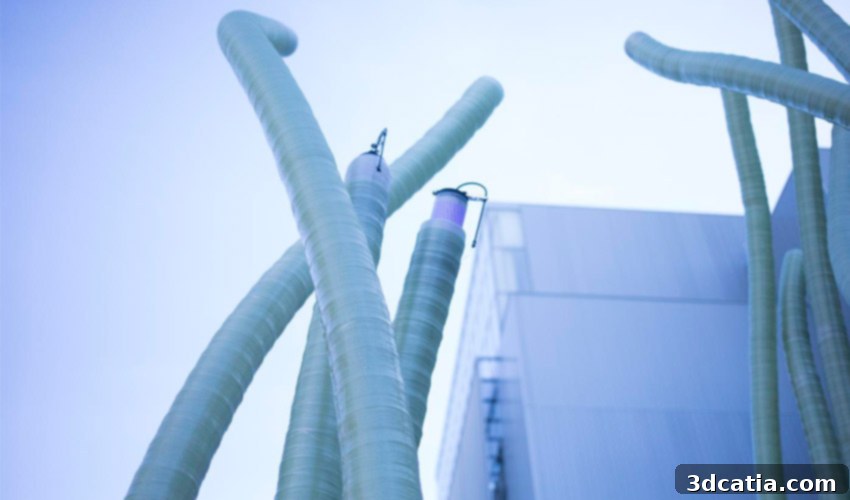
FIBERBOTS: MIT Media Lab’s Swarm Robotics Revolutionizing Large-Scale Additive Construction
The MIT Media Lab stands as a beacon of innovation, consistently pushing the boundaries of what’s possible at the intersection of technology, science, and design. Among its numerous groundbreaking contributions, the work of esteemed architect and researcher Neri Oxman and her Mediated Matter Group has frequently garnered global attention, especially in the realm of advanced manufacturing and biomimicry. This commitment to pioneering research continues with their latest marvel: FIBERBOTS. This revolutionary digital manufacturing platform ingeniously marries the disciplines of architecture and robotics, proposing a fundamentally new approach to large-scale construction.
FIBERBOTS introduces a novel paradigm where small, autonomous robots collaboratively build intricate tubular structures using additive manufacturing techniques. The ambitious goal is to redefine architectural design and construction processes, enabling the creation of structures on an unprecedented scale and with remarkable adaptability. By mimicking natural processes and leveraging the collective intelligence of a robotic swarm, the Mediated Matter Group is paving the way for a future where buildings are not just constructed, but grown.
Biomimicry: Nature’s Blueprint for Robotic Construction
The genesis of the FIBERBOTS project is deeply rooted in biomimicry – the emulation of nature’s best ideas to solve human challenges. The research team drew profound inspiration from the collective intelligence and collaborative building strategies observed in social insects like bees and ants. These creatures, individually small, are capable of rapidly constructing complex, resilient structures that are often many times larger than themselves, through synchronized swarm behavior.
Furthermore, researchers extensively studied spiders and their extraordinary ability to spin protein fibers. Spider silk is renowned for its adjustable, flexible, and robust properties, capable of creating intricate webs with exceptional strength-to-weight ratios. This natural method of fiber spinning and weaving, creating structures from continuous filaments, strongly influenced the design principles behind FIBERBOTS. This biomimetic approach is not entirely new to advanced manufacturing; it echoes the innovative methods seen in projects like the Atropos robot, which is capable of 3D printing fiberglass structures, demonstrating a parallel evolution in material and robotic fabrication inspired by the natural world.
By observing these natural engineers, the Mediated Matter Group sought to translate the principles of distributed intelligence, material efficiency, and adaptive construction into a robotic system. The result is a platform that promises to replicate nature’s capacity for building complex, optimized forms with remarkable efficiency and resilience, moving beyond traditional constraints of size and fixed manufacturing sites.
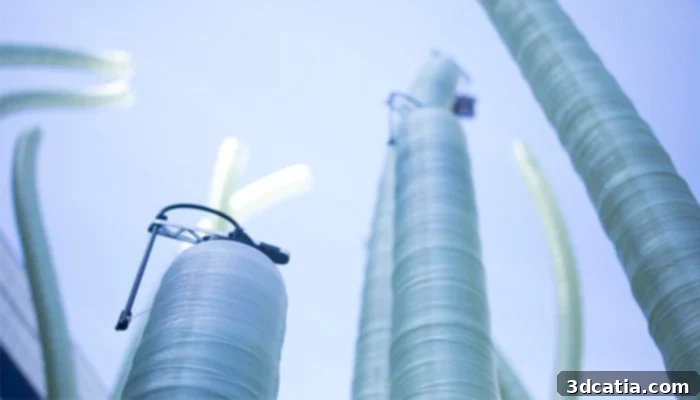
Robots superimpose layers of fiberglass to create tube structures (photo credits: The Mediated Matter Group)
FIBERBOTS: Autonomous Swarm Robotics for Additive Construction
At its core, FIBERBOTS represents a sophisticated swarm of autonomous robots meticulously engineered to weave fiberglass around themselves, incrementally creating robust tubular structures layer by layer. The operational mechanics of each robot are fascinatingly precise: it functions much like a miniature, mobile 3D printer. Each robot continuously superimposes layers of highly resistant fiberglass material, meticulously revolving around its own axis to wind the fiber and progressively erect a tube. This process allows for precise control over the height and structural integrity of the growing tubular form.
What truly sets FIBERBOTS apart is their inherent mobility and advanced sensor suite. Equipped with sophisticated sensors, these robots can autonomously navigate their environment, continuously monitoring and controlling critical parameters such as the length and curvature of each tube. This dynamic control is executed in accordance with a pre-defined digital architectural path, ensuring that the structures conform precisely to the intended design. Because these robots operate as a cohesive swarm, their capabilities extend far beyond what a single unit could achieve. They can collaboratively create intricate interlaced networks of tubes, parallel arrays, or entirely novel configurations to form a much larger, complex architectural entity. This distributed intelligence enables the construction of structures with unprecedented scale and geometric complexity, opening new frontiers in additive construction.
Scalability and Resilience: Demonstrating FIBERBOTS’ Potential
To prove the immense potential of this innovative platform, the Mediated Matter Group developed and deployed a swarm of 16 FIBERBOTS. This system included not only the physical robots but also an advanced design and control system that meticulously programs and coordinates their actions. The objective was to demonstrate their ability to autonomously construct a substantial structure, specifically a tube reaching 4.5 meters in height.
The impressive demonstration involved the robots operating outdoors for several months, successfully enduring the challenging cold weather conditions of Massachusetts. This extended deployment provided invaluable validation of the technology’s robustness, autonomy, and resilience in a real-world environment. The successful construction and prolonged stability of the structure underscore the practical viability of swarm robotics for future construction endeavors.
The researchers eloquently articulate the profound implications of their work: “A swarm approach to manufacturing can radically transform digital construction by digitally fabricating structural materials; generating products and objects larger than their gantry size; and supporting non-layered construction by offering novel fabrication processes such as robotic weaving and free-form printing. These methods are conducive to function generation, however cannot be easily scaled to large systems. With swarm sensing and actuation, systems can become more responsive and adaptive to environmental conditions. Following Nature’s example, a swarm offers reliability and efficiency through distributed tasks, parallel actuation, and redundancy.” This statement highlights several critical advantages: the ability to transcend the size limitations of traditional gantry-based 3D printers, the introduction of flexible non-layered construction techniques like robotic weaving, and the inherent robustness and efficiency gained from a distributed, redundant system that can adapt dynamically to its surroundings.
The FIBERBOTS project thus represents a significant leap towards a future where construction is not a static, centralized process but a dynamic, adaptive, and distributed one, capable of creating bespoke structures with unparalleled efficiency and environmental responsiveness. This paradigm shift could unlock new possibilities for sustainable architecture, rapid deployment in challenging terrains, or even extraterrestrial construction.

FIBERBOTS has been exhibited for months in the United States (photo credits: The Mediated Matter Group)
The Future of Construction: Where Robotics Meets Additive Manufacturing
The groundbreaking work of the MIT Media Lab’s Mediated Matter Group with FIBERBOTS powerfully demonstrates that when the ingenuity of robotics is combined with the transformative potential of additive manufacturing, truly monumental projects become not just feasible, but increasingly efficient and scalable. This confluence of technologies promises to revolutionize the entire architectural and construction landscape, moving beyond conventional limitations and embracing new forms of digital fabrication.
FIBERBOTS are more than just a research project; they represent a tangible vision for the future of large-scale design and construction. Their ability to autonomously weave strong, lightweight structures from fiberglass, adaptable to various environmental conditions and design specifications, positions them at the forefront of innovative building practices. This technology could lead to a new generation of adaptive buildings, self-repairing infrastructures, or structures that can be rapidly deployed in disaster zones or remote locations where traditional construction is impractical or impossible.
To delve deeper into this fascinating project and witness the robots in action, we encourage you to explore more information about FIBERBOTS on the official MIT Media Lab website. You can also gain a visual understanding of their operational principles and capabilities by watching the compelling video below, which beautifully illustrates the intricate dance of these collaborative construction robots.
What are your thoughts on this revolutionary project? How do you envision swarm robotics and additive construction shaping the future of our built environment? We invite you to share your perspectives and engage in the conversation by leaving a comment below or connecting with us on our Facebook and Twitter pages! Don’t forget to sign up for our free weekly Newsletter to receive all the latest news and innovations in 3D printing directly in your inbox.