
Exploring the Cutting Edge: This Week’s Top 5 3D Printing Innovations and Applications
Welcome to our weekly deep dive into the fascinating world of 3D printing! As Sunday rolls around once more, we’re excited to present our curated selection of the top five most impactful and inspiring videos from the additive manufacturing sphere. This week, we journey through a diverse range of applications that showcase the incredible versatility and transformative power of 3D printing technology. From groundbreaking advancements in manufacturing processes like injection molding, championed by industry leader Formlabs, to sustainable innovations in material science, such as Forust’s revolutionary approach to 3D printing wood, the landscape of additive manufacturing continues to evolve at a breathtaking pace.
Our roundup also prominently features the burgeoning field of additive concrete production, highlighting its immense potential to disrupt and redefine the construction industry. We’ll explore how 3D printing is not only revolutionizing the way buildings are made but also optimizing traditional construction methods through innovative solutions like 3D printed concrete formwork. Each video offers a unique perspective on how these technologies are pushing boundaries, improving efficiency, and opening new avenues for creativity and sustainability across various sectors. So, prepare to be inspired by the latest breakthroughs and discover what the future holds for this rapidly advancing industry. We wish you a fantastic day and hope you enjoy watching these insightful videos!
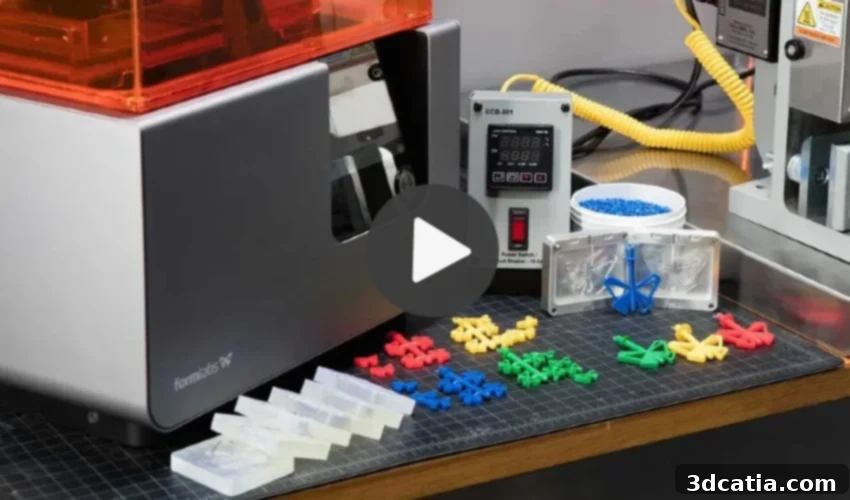
Top 1: Formlabs Unleashes the Power of 3D Printing in Injection Molding
Formlabs stands as an undisputed titan in the modern 3D printing industry. This American pioneer, renowned for its innovative development and manufacturing of stereolithography (SLA) and selective laser sintering (SLS) 3D printing technologies, consistently pushes the boundaries of what’s possible. Early 2021 saw Formlabs generate significant buzz, particularly with the introduction of their Fuse 1, an accessible and high-performance SLS printer that brought industrial-grade additive manufacturing capabilities to a wider audience. However, their influence extends far beyond standalone printers, as demonstrated in this week’s featured video.
The video specifically delves into Formlabs’ compelling application of 3D printing for injection molding, a traditional manufacturing process critical for mass production. Traditionally, creating injection molds is a costly and time-consuming endeavor, often making low-volume production or rapid prototyping financially prohibitive. Formlabs addresses these challenges head-on by showcasing how 3D printed tools can dramatically streamline the injection molding workflow. This includes the direct manufacture of parts using 3D printed tools, enabling quick iterations and custom designs without the immense overhead of conventional tooling. Furthermore, the video illustrates the efficiency of 3D printed tool assemblies for injection molding, allowing for intricate designs and complex geometries that would be difficult or impossible to achieve with traditional methods.
The ultimate benefit highlighted is the economic viability of small-batch production with 3D printed plastic injection molds. This empowers businesses to test market demand, produce specialized components, or create limited edition products with unprecedented speed and cost-effectiveness. By integrating additive manufacturing into the injection molding process, Formlabs offers a powerful solution for accelerating product development cycles, reducing lead times, and expanding the scope of what’s economically feasible for manufacturers of all sizes. It’s a testament to how 3D printing isn’t just a standalone technology but a powerful enabler for optimizing established industrial practices. Get ready to witness a truly transformative application of additive manufacturing!
Top 2: Is 3D Printing Shaping the Future of the Construction Industry?
The buzz around additive manufacturing with concrete has grown exponentially, making it abundantly clear that we are on the cusp of a revolutionary era in the construction industry. A new generation of innovative startups, armed with industrial 3D printers and cutting-edge software, is systematically automating production and fundamentally reshaping how we build. This transformation is not merely incremental; it’s a paradigm shift, promising to address some of the most pressing challenges faced by traditional construction: escalating costs, skilled labor shortages, material waste, and lengthy project timelines.
Advocates for construction 3D printing assert that the synergistic combination of advanced machines, intelligent software, sophisticated robotics, and novel building materials can construct homes and infrastructure faster, more affordably, and significantly more sustainably. Imagine entire residential neighborhoods or public structures emerging from printers in a fraction of the time, with minimal human intervention on-site, and using materials optimized for performance and environmental impact. This technology offers unprecedented design freedom, allowing for complex geometries and organic shapes that are difficult and expensive to achieve with conventional methods, thereby opening new architectural possibilities.
Beyond speed and cost, sustainability is a key driver. 3D concrete printing precisely deposits material only where needed, drastically reducing waste compared to traditional formwork-intensive methods. It also enables the use of locally sourced materials and the development of specialized concrete mixes that are more eco-friendly, incorporating recycled aggregates or low-carbon binders. Furthermore, the automated nature of the process improves site safety and allows for rapid deployment in areas requiring emergency housing or reconstruction. This video provides a comprehensive overview of the latest advancements in the 3D printing construction industry, offering a tantalizing glimpse into a future where buildings are not just constructed, but additively manufactured with unparalleled efficiency and ingenuity. Discover the incredible potential and what the future holds for automated construction.
Top 3: Revolutionizing Aviation: The Impact of Digitization with 3D Technologies
The aviation sector, with its stringent safety regulations and demands for peak performance, has rapidly embraced 3D technologies, leveraging their immense advantages and transformative potential. 3D printing and scanning in aeronautics are no longer experimental concepts but integral tools in maintenance, repair, and overhaul (MRO) operations, design, and manufacturing of critical components. These technologies offer solutions for lightweighting, reducing lead times for spare parts, and producing complex geometries previously unachievable with traditional manufacturing methods.
This week’s video provides a captivating look into the practical application of 3D scanning within an aircraft maintenance team. We witness the deployment of the Creaform HandyScan 700, a state-of-the-art handheld 3D scanner, at Travis Air Force Base in California. The primary objective is to capture precise digital information from aircraft parts, enabling the creation of highly accurate three-dimensional digital models within specialized computer software. This digital twin serves multiple critical purposes: it allows engineers to meticulously analyze wear and tear, identify structural deformities, and reverse-engineer damaged or obsolete components with unparalleled precision.
The true power of this digitization process comes to fruition when the 3D scanner is paired with additive manufacturing capabilities. The video highlights its use in conjunction with two types of industrial 3D printers: one optimized for polymers and another for metals. This powerful combination enables the in-situ (on-site) printing of aircraft parts. The ability to manufacture replacement components directly at the airbase, rather than waiting for external suppliers, dramatically reduces aircraft downtime, lowers logistics costs, and minimizes inventory requirements for spare parts. This rapid, on-demand production capability is a game-changer for operational readiness and maintenance efficiency, ensuring that aircraft can be returned to service faster and more reliably. It’s a prime example of how digital workflows are enhancing safety, efficiency, and sustainability in the demanding world of aviation.
Top 4: Desktop Metal and Forust Pioneer Sustainable 3D Printed Wood
Desktop Metal, a significant player in the additive manufacturing space, has strategically expanded its portfolio beyond its initial focus on metal 3D printing. Earlier this year, the company made a considerable move into the resin additive manufacturing market through the acquisition of EnvisionTEC, a recognized leader in resin-based 3D printing technologies. This expansion showcases Desktop Metal’s commitment to offering a comprehensive suite of additive manufacturing solutions across various materials and applications. Now, with a groundbreaking partnership announcement with Forust Corporation, Desktop Metal is positioning itself at the forefront of a truly innovative and sustainable sector: the 3D printing of functional wooden parts.
This collaboration is set to revolutionize how wooden products are manufactured, moving beyond traditional milling and carving to embrace the design freedom and efficiency of additive processes. To achieve this, Desktop Metal will employ a novel process rooted in binder jet technology. This method involves selectively jetting a liquid binding agent onto a powder bed, layer by layer, to create a solid object. What makes Forust’s approach particularly remarkable is the material itself: it utilizes waste products from the wood industry, specifically sawdust and lignin. By repurposing these abundant industrial byproducts, Forust and Desktop Metal are not only creating high-quality, functional wooden components but also championing an incredibly sustainable manufacturing model.
This sustainable manufacturing process significantly reduces reliance on virgin timber, contributing to forest conservation and decreasing the environmental footprint associated with wood production. The ability to 3D print wood opens up vast possibilities for intricate designs, customized furniture, architectural elements, consumer goods, and even prototyping without the constraints of traditional woodworking. Imagine complex, organic shapes or highly personalized textures that are nearly impossible to achieve with conventional methods, now effortlessly produced through additive manufacturing. The resulting parts offer the aesthetic and tactile qualities of real wood, making them suitable for a wide range of applications where natural material appeal is desired. This video below offers an exclusive look into this exciting project, showcasing how innovation in 3D printing is merging with eco-conscious practices to craft the future of design and manufacturing. Discover how wood waste is being transformed into valuable products with unparalleled design flexibility.
Top 5: BigRep and ForwardAM Forge Ahead with 3D Printed Concrete Formwork
In a strategic move to maximize their complementary strengths, BigRep and Forward AM have announced an expanded partnership that promises to significantly impact the construction and design industries. This collaboration brings together BigRep’s expertise in large-format 3D printing with Forward AM’s profound knowledge in advanced material development, virtual engineering, and additive manufacturing. The core objective of this strengthened alliance is to optimize their combined technologies specifically for the production of 3D printed concrete formwork, a key application poised to revolutionize concrete construction.
Traditional concrete formwork, which provides the mold into which wet concrete is poured, is often a labor-intensive, time-consuming, and material-wasteful process, especially for complex or custom architectural designs. The creation of intricate shapes often requires skilled craftsmanship and generates significant material offcuts. By leveraging large-format 3D printing for formwork, BigRep and Forward AM are addressing these critical inefficiencies head-on. This innovative approach offers a multitude of benefits that directly translate into substantial savings and improved sustainability.
Firstly, 3D printing concrete formwork allows for immense savings in both time and money. The automated nature of the additive process drastically reduces the manual labor involved in constructing molds, accelerating production schedules. For complex or one-off designs, the cost benefits are particularly pronounced, as the digital fabrication eliminates the need for expensive, custom-made traditional molds. Secondly, this method virtually eliminates material waste. Instead of cutting and shaping large sheets of material, the 3D printer precisely deposits only the necessary material to create the formwork, optimizing resource utilization and minimizing environmental impact.
Beyond efficiency, 3D printed formwork unlocks unprecedented design freedom for architects and engineers. It enables the creation of highly complex, organic, or doubly curved concrete structures that were previously challenging or prohibitively expensive to produce. This capability fosters architectural innovation, allowing for greater aesthetic expression and functional optimization in building design. The partnership between BigRep and Forward AM represents a powerful synergy, combining hardware, software, and material science to deliver advanced solutions for the construction sector, making complex concrete structures more accessible, efficient, and sustainable. Dive into the video below to learn more about how these pioneering companies are working together to reshape the future of concrete design and construction.
What are your thoughts on this week’s remarkable selection of 3D printing innovations? Were you particularly impressed by Formlabs’ ingenious application of 3D printing in injection molding, or perhaps the sustainable future envisioned by Desktop Metal and Forust’s 3D printed wood? We’d love to hear your insights and opinions! Feel free to share your comments below or connect with us on our vibrant social media platforms: Facebook, Twitter, and LinkedIn! Don’t miss out on any future breakthroughs; ensure you stay at the forefront of additive manufacturing news by signing up for our free weekly Newsletter. Get the latest updates, exclusive insights, and trending stories from the 3D industry delivered straight to your inbox every week!