
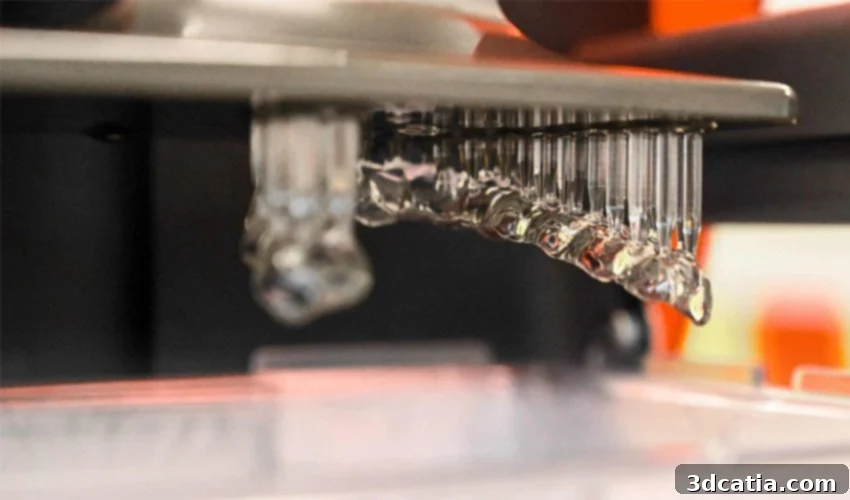
DTU’s Revolutionary 3D Printer: Combining CT Scanning and Light for Unprecedented Precision and Speed
In a groundbreaking development at the Technical University of Denmark (DTU), a team of visionary researchers has unveiled a new class of 3D printer that ingeniously fuses advanced CT scanner technology with precisely controlled light. This innovative approach fundamentally reverses the traditional principle of CT scanning, allowing for the rapid creation of intricate three-dimensional objects from diverse polymer resins. What truly sets this technology apart is its unprecedented ability to manipulate material properties, such as hardness and flexibility, within a single print. Such capabilities open vast new horizons, particularly in fields like bioprinting, where it could facilitate the realistic reproduction of complex biological structures like blood vessels or muscle tissue with exceptional fidelity.
Computed Tomography (CT) scans are a cornerstone of modern medical diagnostics. These sophisticated X-ray machines generate detailed, cross-sectional images, or “slices,” of internal body parts, enabling medical professionals to visualize tissues of varying densities and pinpoint anomalies. While conventionally employed to establish diagnoses and guide treatments, the DTU team has ingeniously repurposed the core concept behind this diagnostic tool. Instead of using X-rays to image existing structures, they are leveraging the tomographic principle to *create* structures, transforming the conventional CT scanner into a rapid and highly versatile resin 3D printer. This innovative reversal of a well-established medical imaging technique marks a significant leap forward in additive manufacturing, pushing the boundaries of what is achievable in terms of speed, material control, and structural complexity.
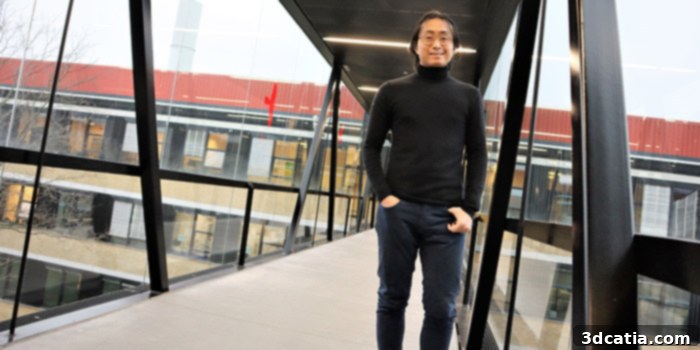
Assistant Professor Yi Yang is behind this project (photo credits: DTU)
The Genesis of Innovation: Tomographic Vat Photopolymerization (TVP)
At the heart of this transformative project is Assistant Professor Yi Yang from DTU Chemistry, a driving force behind the development. Professor Yang elaborated on the underlying methodology, stating, “Our printer will build a physical object at the intersects of computed tomographic images. The technology enables us to build 3D objects embedded with different properties and material transitions. We use a method called Tomographic Vat Photopolymerization (TVP), which allows us to print all points in a 3D object simultaneously. One has to imagine a box containing a liquid polymer – a kind of polymeric printer ink. By exposing the ink to light of certain wavelengths, determined by a 3D image and built up as a CT scan, the ink turns solid in the desired shape.” This explanation highlights the profound conceptual shift: instead of scanning to *see*, the system ‘scans’ with light to *create* a desired form.
Traditional vat photopolymerization techniques, such as Stereolithography (SLA) or Digital Light Processing (DLP), typically build objects layer by layer. While effective, this sequential process can be time-consuming, especially for large or complex parts. TVP, as pioneered by the DTU team, offers a revolutionary alternative. By projecting an inverted CT image — essentially a 3D map of the desired object’s internal structure and material properties — into a vat of liquid photopolymer resin, the entire object begins to solidify almost instantaneously. The light patterns, carefully choreographed and projected from multiple angles, penetrate the resin volume. Where these light beams intersect with sufficient intensity and the correct wavelength, the polymer ‘ink’ undergoes a photochemical reaction, curing and solidifying to form the precise shape dictated by the digital model. This volumetric printing approach bypasses the need for layer-by-layer construction, unlocking unparalleled speeds for complex geometries.
Unleashing Speed and Material Versatility
In practical terms, the DTU machine operates by taking an inverted CT image as its digital blueprint and then precisely manipulating the liquid resin using light rays. This method presents a significant advancement in efficiency compared to conventional laser-based 3D printing technologies. While laser-based systems meticulously solidify resin point by point or layer by layer, the TVP process simultaneously cures the entire desired shape throughout the resin volume. This simultaneous solidification drastically reduces print times, making it an ideal candidate for rapid prototyping and high-volume production of intricate components where speed is a critical factor.
Beyond sheer speed, one of the most compelling capabilities of this new printer lies in its unprecedented control over material properties. By directly modulating the wavelengths and intensity of the light used during the solidification process, the DTU system can precisely vary the flexibility and hardness of different sections within a single printed part. This means that a single object can be designed with areas ranging from rigid to highly pliable, all fabricated in one continuous process. Imagine a component that requires a hard structural core but flexible joints, or a medical implant that needs to mimic both the rigidity of bone and the elasticity of cartilage. Such complex material transitions, previously requiring multi-material printing with disparate technologies or post-processing, can now be achieved natively and efficiently. This level of granular control over mechanical properties opens up a vast array of design possibilities that were previously impractical or impossible.
Revolutionizing Bioprinting and Beyond
The initial tests of this novel 3D printer have yielded remarkably conclusive results, demonstrating its ability to accurately realize a diverse range of geometries with impressive detail. However, the DTU team envisions its most profound impact within the burgeoning field of bioprinting. The unique capability to precisely control the flexibility and other mechanical properties of the printed material holds immense potential for creating biologically functional structures. By playing with the material’s pliability, researchers can begin to imagine and engineer vascularized parts for patients critically in need of new tissues and organs. This could represent a paradigm shift in regenerative medicine, moving closer to the goal of printing patient-specific organs that are structurally and functionally viable.
Assistant Professor Yi Yang articulated this ambitious vision, concluding, “The degree of detail and flexibility in our 3D printing will hopefully be so extensive that the technique can be used to produce fully vascularized constructs using biopolymers as ‘ink’. This technology might be able to replicate the softness and unique build-up of blood vessels, capillaries, and muscles. There is a long way to go, but hopefully the printer can bring us closer to the goal.” The ability to print intricate capillary networks, for instance, is crucial for sustaining larger tissue constructs, ensuring nutrient and oxygen delivery. Without effective vascularization, printed organs and tissues often fail due to a lack of blood supply. The TVP method’s inherent precision and capacity for gradient material properties are perfectly suited to tackle these complex biological challenges, paving the way for the creation of functional human tissues and potentially even whole organs. Beyond bioprinting, this technology holds promise for other cutting-edge applications, including the development of advanced soft robotics with embedded flexible sensors, personalized prosthetics that perfectly match natural body mechanics, and microfluidic devices with highly tailored internal channels.
The journey from laboratory prototype to widespread clinical or industrial application is often long and arduous. Yet, the foundations laid by the DTU team offer a compelling glimpse into the future of additive manufacturing. The combination of volumetric printing speed with unprecedented material control presents a powerful tool that could accelerate innovation across numerous sectors, from healthcare and biomedical engineering to aerospace and consumer electronics. The ability to craft complex objects with tailored mechanical properties in a fraction of the time promises to unlock new design freedoms and significantly reduce manufacturing lead times. You can find more comprehensive information in the official press release HERE.
Join the Conversation
What are your thoughts on this revolutionary 3D printer that ingeniously combines the principles of a CT scanner with the precision of light-based solidification? Do you foresee its rapid adoption in medical fields, or do you believe its impact will extend to other industries first? We invite you to share your insights and predictions in a comment below or join the discussion on our social media platforms. Connect with us on Linkedin, Facebook, and Twitter to stay updated on the latest breakthroughs in additive manufacturing. Don’t forget to sign up for our free weekly Newsletter here, ensuring the latest 3D printing news is delivered straight to your inbox! You can also find all our compelling videos and demonstrations on our YouTube channel.
*Cover Photo Credits: Prototype Hubs