
Branch Technology: Leading the Revolution in 3D Printed Construction and Prefabrication
Over recent years, 3D printing has rapidly emerged as a powerful catalyst for innovation within the construction sector. This groundbreaking additive manufacturing paradigm unlocks a vast array of possibilities for architectural design, enabling the creation of intricate and organic forms that would be prohibitively complex or even impossible to achieve with traditional building methods. Furthermore, it facilitates the versatile use of diverse materials and leverages cutting-edge technologies for the efficient creation of prototypes, specialized parts, and even entire buildings. To delve deeper into these transformative advancements and a pioneering new project, we had the opportunity to speak with David Goodloe. David is a key member of the Advanced Concepts Team (ACT) at Branch Technology, a leading 3D printing construction technology company renowned for its significant achievement of being International Building Code (IBC) compliant.
An Introduction to David Goodloe and His Connection to 3D Printing

David Goodloe introduced himself, explaining, “My name is David Goodloe, and I contribute to the Advanced Concepts Team (ACT) at Branch Technology. My academic foundation is in physics, and I am currently pursuing an MBA at Vanderbilt University, all while actively working with Branch Technology.” His journey into 3D technologies began during his undergraduate studies in physics. He recalls, “One of my classmates was engaged in 3D printing technology during an internship at NASA, which sparked my initial interest.” This early exposure motivated him to seek out opportunities in the field, leading him directly to Branch Technology immediately after graduation.
The Advanced Concepts Team (ACT) plays a crucial role within the company. David elaborated, “The ACT is the segment of our business specifically dedicated to pushing the boundaries of our Cellular Fabrication (C-Fab®) technology, exploring and developing its most cutting-edge applications.” This work is frequently conducted through strategically funded Research and Development (R&D) projects, often in collaboration with prominent government agencies or large enterprise partners. David proudly manages these pivotal projects, stating, “I have the privilege of managing our collaborations with esteemed organizations such as NASA, the US Air Force, the National Science Foundation, and other incredibly innovative partners.” These collaborations underscore Branch Technology’s commitment to advancing the science and application of large-scale additive manufacturing in critical sectors.
Unveiling Branch Technology: Genesis and Vision
The origin story of Branch Technology is deeply rooted in a desire to overcome traditional limitations. David explained, “Our founder and Chief Innovation Officer, Platt Boyd, conceived the company while practicing as an architect. He was increasingly frustrated by the inherent design constraints imposed by conventional construction methods, which often stifled creative architectural expression.” Platt found profound inspiration in the elegance of natural forms and structures, observing how nature efficiently constructs complex geometries. Simultaneously, he was captivated by the burgeoning capabilities of emerging 3D printing technologies to offer unparalleled geometric customization.
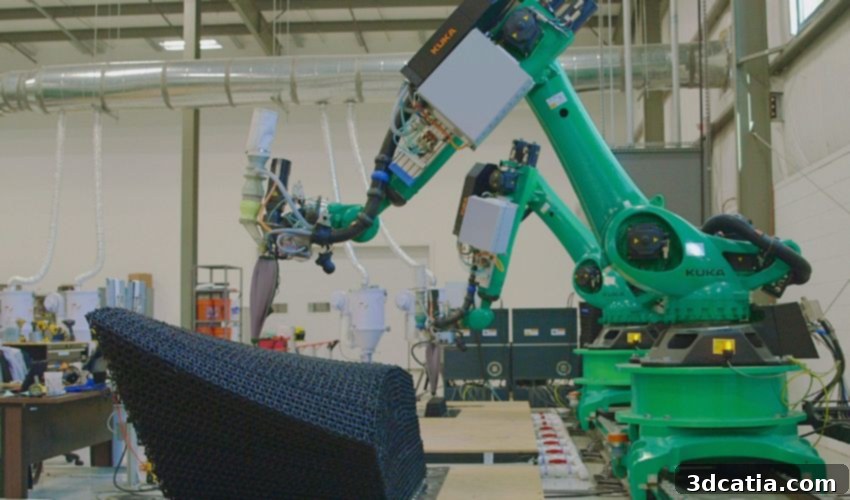
Driven by this dual inspiration, Platt made the pivotal decision to leave his architecture firm. His mission was to invent Branch’s proprietary Freeform 3D printing technology and subsequently develop Cellular Fabrication (C-Fab®). Since its inception, the company has experienced remarkable growth, evolving into a robust team comprising 30 skilled human professionals and an impressive array of 18 advanced robotic systems, all working in synergy to redefine construction possibilities.
Branch Technology stands as a premier construction technology firm, singularly focused on engineering innovative solutions for the built environment and the broader construction industry. The core of their approach lies in leveraging direct digital manufacturing, advanced 3D design and fabrication processes, and sophisticated prefabrication technologies. While the team engages across numerous industries, their primary focus remains on commercial construction and the intricate development of building envelopes. Beyond this core, Branch Technology also serves diverse sectors, including the creation of large-scale 3D art and sculptures, advanced furniture manufacturing, the production of rapidly deployable prefabricated shelters, and spearheading applied 3D printing research and development.
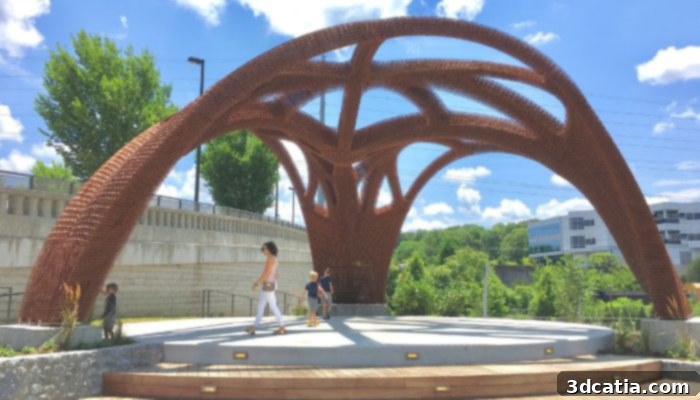
Within the bustling commercial construction arena, Branch Technology provides comprehensive design services alongside its signature 3D facade and building-enclosure products. Their particular expertise lies in commercial building rainscreens and facades, offering solutions that combine aesthetic appeal with high performance. The company’s flagship product line in this sector, known as BranchClad™️, represents a cutting-edge Freeform architectural cladding system specifically engineered for commercial buildings. Through the innovative application of BranchClad™️, the team has achieved a significant milestone, successfully producing what are recognized as the world’s largest 3D printed facades, demonstrating the unparalleled scalability and design freedom of their technology.
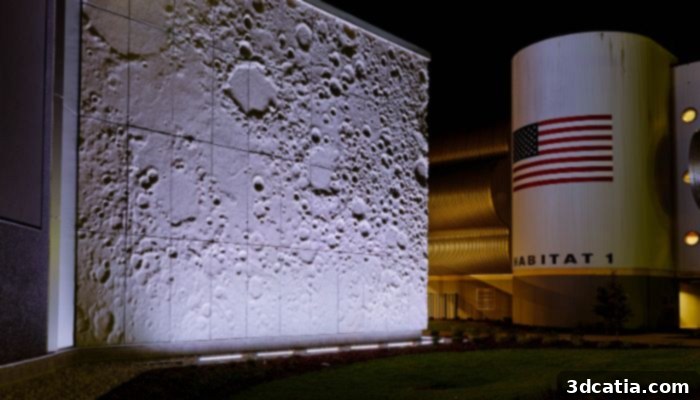
Venturing beyond commercial building, Branch Technology’s versatile 3D printing technology is also instrumental in creating essential prefabricated shelters. These shelters are designed for rapid deployment and can effectively address urgent needs arising from homelessness, natural disaster relief efforts, refugee crises, or other housing emergencies where swift and efficient shelter solutions are paramount. Furthermore, the company applies its expertise to the realm of art, producing captivating large structural art pieces and sculptures that push creative boundaries. They also collaborate with furniture manufacturers, crafting lightweight yet durable frames for upholstered pieces, thereby enhancing efficiency and design flexibility in furniture production. Finally, their deep engagement in applied research with prestigious entities like NASA, the USAF, and the NSF showcases the broader impact of their C-Fab® technology. These research initiatives tackle critical challenges such as the ambitious goal of 3D printing habitats on the moon, developing methods for retrofitting existing buildings for improved energy efficiency, exploring the utilization of in-situ materials for construction, and devising strategies to significantly reduce carbon emissions within the built environment, among other pioneering applications.
The Advantages of Branch Technology’s Innovations: Benefits and Overcoming Limitations
Branch Technology’s Cellular Fabrication (C-Fab®) represents a significant leap forward in direct digital manufacturing, uniquely capable of achieving mass customization on an unprecedented scale. The inherent nature of this 3D printing process grants unparalleled geometric design freedom, allowing architects and designers to conceptualize and realize forms that were previously unimaginable. A core advantage lies in its lightweight and highly material-efficient “Freeform” 3D capability, which results in an exceptional strength-to-weight ratio for constructed components. This means structures can be robust and durable without being excessively heavy or material-intensive, contributing to both structural efficiency and cost savings.
Moreover, the integration of other functional materials into Branch’s wall assemblies means these products are inherently multifunctional. This holistic approach embeds multiple critical properties—design aesthetics, structural integrity, impermeability, superior insulation, crucial fire resistance, and a finished surface—all within a single, prefabricated product. This level of integration streamlines the construction process, reduces material layers, and enhances overall building performance.
As a sophisticated prefabrication approach, C-Fab® manufacturing is characterized by extreme efficiency, rapid production cycles, enhanced safety protocols, and a dramatic minimization of waste when compared to traditional, on-site construction practices. By moving much of the fabrication to a controlled factory environment, Branch Technology significantly mitigates common construction challenges, leading to faster project completion and reduced environmental impact. Perhaps one of the most compelling advantages, and a significant differentiator in the industry, is that all of Branch’s products undergo rigorous testing to ensure full compliance with the International Building Code (IBC). For example, their BranchClad™️ product line successfully passes NFPA 285, the flagship fire resistance test for exterior building products concerning flame propagation of an exterior wall assembly. To the best of their knowledge, Branch Technology stands alone as the only 3D printing company globally that possesses multiple IBC-compliant commercial construction product systems, a testament to their commitment to safety, quality, and regulatory adherence. This compliance is a critical factor for widespread adoption in commercial building projects, where safety and regulatory standards are paramount.
While some emerging 3D printing methods in construction face limitations such as restricted form factors or challenges in achieving code compliance for large structures, Branch Technology’s approach is specifically engineered to overcome these. By focusing on prefabricated, off-site manufacturing of large, complex components that are then assembled on-site, they bypass the constraints of gantry-style on-site printers typically used for smaller residential projects. This strategic shift allows for the inherent benefits of additive manufacturing – design freedom and material efficiency – to be applied to commercial-scale projects without sacrificing regulatory compliance or structural integrity.
The Future Trajectory of Additive Manufacturing in Construction
David Goodloe expressed profound optimism regarding the future of additive manufacturing, envisioning its role in comprehensively addressing many persistent challenges within the built environment. He noted, “The industry is already witnessing significant adoption of residential concrete 3D printing, especially for single-family homes. However, there has been comparatively limited adoption of additive products within the commercial construction sector.” David posits a compelling reason for this discrepancy: “We believe the primary limiting factor for widespread commercial adoption has been the restrictive form factor of typical on-site, gantry-style 3D printers, which are best suited for smaller, residential buildings. To truly scale additive manufacturing to the construction industry at large, a fundamentally new approach is imperative.”
Drawing a powerful historical parallel, David highlighted, “Fifty years ago, the automotive industry underwent a radical transformation by embracing the tenets of prefabrication, automation, and advanced manufacturing processes. This revolution fundamentally reshaped how cars were designed, produced, and delivered.” Branch Technology is driven by an ambitious vision to instigate a similar transformative shift within the construction industry. “Our technology,” David proudly stated, “represents the first-ever successful combination of prefabrication and additive manufacturing specifically engineered for construction scale. This unique synthesis allows our technology to produce components for an incredibly diverse range of buildings, spanning from the dimensions of a modest small house all the way up to the vastness of an enormous skyscraper.” The remarkable scalability inherent in this innovative approach is precisely why David remains so confident and “bullish on our company’s future, seeing us leading the way for the broader adoption of additive manufacturing in construction, extending far beyond the residential sector into the commercial and industrial realms.” This forward-looking perspective positions Branch Technology not just as a participant, but as a potential pioneer in the next era of construction.
Final Thoughts and Engagement Opportunities
David Goodloe concluded the interview with an invitation to learn more and engage with Branch Technology. “If you are interested in delving deeper into our company’s mission and groundbreaking work, we encourage you to visit our official website HERE.” For those who prefer a more visual and detailed understanding of their innovative processes and the technology behind them, he added, “There is a comprehensive video series showcasing our technology available on our YouTube channel, which can be accessed HERE.” Finally, for potential partners or those with collaborative ideas, David extended an open invitation: “Please feel free to reach out to us directly through our website if you have any ideas for collaboration or wish to discuss how our technology could benefit your projects.”
We hope you found our insightful interview with Branch Technology about the transformative role of 3D printing in the construction world informative and inspiring. We would love to hear your thoughts! Share your comments below or engage with us on ourLinkedIn,Facebook, andTwitter pages! Don’t miss out on the latest advancements and news in additive manufacturing – subscribe to our free weeklyNewsletter here to receive fresh 3D printing updates directly in your inbox. You can also explore all our engaging videos and content on ourYouTube channel.
*All Photo Credits: Branch Technology