
NASA’s GRX-810 Superalloy: Revolutionizing 3D Printing for Aerospace and Boosting the US Economy
The aerospace industry has always been a crucible for innovation, relentlessly pushing the boundaries of what’s possible in flight and space exploration. This drive for progress necessitates materials that can withstand extreme conditions, perform reliably, and enable unprecedented engineering feats. In a pivotal development, NASA has recently announced the co-exclusive licensing of its revolutionary superalloy, GRX-810. This breakthrough material, developed under the agency’s Transformational Tools and Technologies project, signifies not only a monumental leap forward in future aerospace technology but also promises substantial economic benefits for the United States. GRX-810 is poised to drastically enhance the manufacturing of critical air and spacecraft components, primarily due to its exceptional properties and its perfect compatibility with additive manufacturing techniques, specifically 3D printing. This strategic move by NASA underscores its commitment to leveraging federally funded research for public good, fostering innovation, and strengthening the nation’s industrial base.
Strategic Partnerships: Licensing GRX-810 for National Benefit
In a move designed to maximize the public return on investment from taxpayer-funded research, NASA granted co-exclusive licenses for the GRX-810 superalloy to four distinguished American companies. These industry leaders include Carpenter Technology Corporation, Elementum 3D, Inc., Linde Advanced Material Technologies, Inc., and Powder Alloy Corporation. This collaborative approach is critical for several reasons. Firstly, it ensures that this cutting-edge material quickly transitions from laboratory development to industrial application, accelerating its integration into the American aerospace supply chain. Secondly, by partnering with established material science and additive manufacturing specialists, NASA facilitates the robust production, rigorous testing, and widespread adoption of GRX-810. This licensing strategy not only amplifies the alloy’s potential impact on aerospace but also stimulates job creation, fosters technological leadership, and contributes significantly to the nation’s economic vitality. The selection of these companies highlights their proven capabilities in advanced materials and manufacturing, making them ideal partners to bring GRX-810’s benefits to the forefront of the industry.
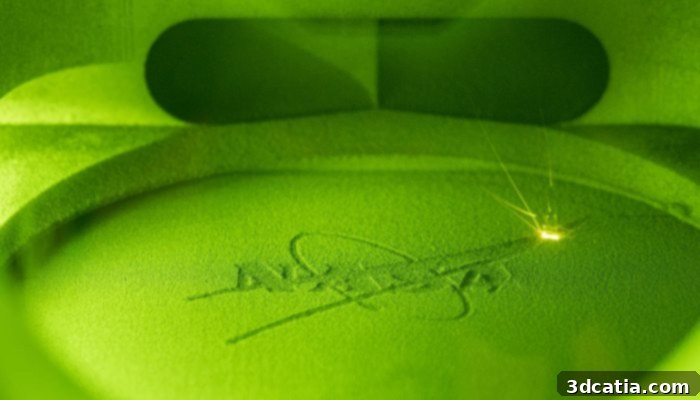
A visual representation of the NASA emblem being 3D printed using the GRX-810 superalloy, demonstrating the material’s compatibility with advanced manufacturing techniques.
“NASA invests tax dollars into research that demonstrates direct benefit to the U.S. and transfers its technologies to industry by licensing its patents,” explained Amy Hiltabidel, licensing manager at NASA’s Glenn Research Center in Cleveland. This statement encapsulates the core philosophy behind NASA’s technology transfer program, emphasizing how groundbreaking scientific discoveries are translated into practical applications that benefit society and the economy.
GRX-810: Engineered for Extreme Environments
What truly sets GRX-810 apart from conventional alloys is its meticulously engineered design, specifically conceived to withstand the most extreme and unforgiving conditions encountered in both atmospheric flight and the vacuum of space. Unlike traditional materials that often reach their operational limits in high-stress, high-temperature environments, GRX-810 boasts unparalleled durability and strength. It is specifically engineered to endure temperatures exceeding a staggering 2,000 degrees Fahrenheit (approximately 1,093 degrees Celsius), a threshold that few other materials can sustain. This makes GRX-810 almost perfectly suited for critical high-stress components within advanced aerospace systems, such as liquid rocket engine injectors, combustors, and turbine blades in next-generation jet engines.
The Microstructural Advantage: How GRX-810 Achieves Superiority
The development of GRX-810 is a testament to cutting-edge material science and advanced manufacturing techniques, credited to the innovative work of Dr. Tim Smith and Christopher Kantzos, researchers at NASA. Their groundbreaking approach combined sophisticated computer modeling with the exquisite precision offered by laser-based additive manufacturing – often referred to as 3D printing. This synergy allowed them to design and build an incredibly high-performance alloy with exceptional strength and resilience. The secret to the alloy’s improved strength, ductility, and resistance to creep and oxidation lies in its unique microstructure. GRX-810 achieves its remarkable properties by strategically incorporating oxygen-enhanced atoms within its metallic lattice. These dispersed oxide particles act as internal barriers, impeding the movement of dislocations and crystal grain boundaries at high temperatures. This innovative atomic-level engineering prevents the material from deforming or degrading under intense thermal and mechanical stress, providing a significant advantage over conventional superalloys that rely on different strengthening mechanisms. The ability to precisely control the material’s microstructure through additive manufacturing was crucial to realizing these advanced properties, demonstrating the power of integrating computational design with revolutionary fabrication methods.
Unparalleled Performance and Longevity
When directly compared to conventional nickel-base superalloys currently used in aerospace, GRX-810 offers dramatically superior performance across several key metrics. Its exceptional capability to withstand extreme temperatures and stress levels, coupled with its significantly improved oxidation resistance, translates into a revolutionary extension of component lifespans. Specifically, GRX-810 holds the promise of prolonging the operational lifespan of critical aerospace components by up to an astonishing 2,500 times. This level of durability is not merely an incremental improvement; it represents a paradigm shift for component design and maintenance cycles. Imagine rocket engine parts or jet turbine components that require significantly less frequent replacement, reducing maintenance costs, increasing operational uptime, and enhancing safety margins across the board. Furthermore, the alloy exhibits superior ductility, meaning it is less prone to brittle fracture under stress, and it boasts remarkable resistance to cracking, a critical factor for parts operating under constant thermal cycling and mechanical load. These combined attributes make GRX-810 an indispensable material for the next generation of aerospace and space exploration vehicles.
Driving Sustainable Aerospace and Economic Prosperity
The widespread adoption of GRX-810 is expected to usher in a new era for sustainable aviation and space exploration, driving significant cost savings and improved efficiency throughout the aerospace industry. According to Dale Hopkins, deputy project manager of NASA’s Transformational Tools and Technologies project, the impact will be profound. “Adoption of this alloy will lead to more sustainable aviation and space exploration. This is because jet engine and rocket components made from GRX-810 will lower operating costs by lasting longer and improving overall fuel efficiency,” Hopkins added. The implications of this are far-reaching. Longer-lasting components mean less frequent replacement, which reduces material consumption, manufacturing energy, and waste. Improved fuel efficiency, achieved through lighter, more robust engine designs made possible by GRX-810, translates into lower emissions and reduced operational expenses for airlines and space agencies alike. This commitment to sustainability aligns with global efforts to minimize environmental impact while maximizing the economic and scientific benefits of aerospace activities. By enabling the creation of more durable and efficient parts, GRX-810 contributes directly to a greener, more cost-effective future for air and space travel.
NASA’s Legacy of Innovation: The Technology Transfer Program
The licensing of GRX-810 is a prime example of NASA’s enduring and highly successful Technology Transfer Program. For decades, this program has served as a vital bridge between groundbreaking government-funded research and commercial application, significantly boosting the US economy. Through this initiative, NASA actively identifies and licenses its patented technologies to private companies, fostering innovation, creating new industries, and generating economic growth. Since its inception, the program has already driven the commercialization of over 2,000 innovations, ranging from medical devices and environmental technologies to advanced materials and software. Each licensed patent represents an opportunity for American businesses to develop new products and services, creating jobs and strengthening the nation’s competitive edge on the global stage. The GRX-810 superalloy perfectly embodies this mission, transforming scientific discovery into tangible economic and technological advantages for the United States. To learn more about this significant milestone and the broader impact of NASA’s technology transfer efforts, click here.
The Future Takes Flight with GRX-810
The advent of GRX-810 and its strategic licensing represent a pivotal moment for both the aerospace industry and the broader US economy. By enabling the production of components that are not only stronger and more durable but also more fuel-efficient and sustainable, NASA is paving the way for the next generation of aircraft and spacecraft. This superalloy will empower engineers to design lighter, more efficient engines and structures, pushing the boundaries of performance and reliability. The integration of GRX-810 through additive manufacturing is set to reduce operational costs, extend mission lifespans, and accelerate advancements in everything from commercial air travel to deep space exploration. It is a powerful testament to the value of public investment in scientific research and the innovative spirit that continues to define America’s leadership in aerospace technology.
What are your thoughts on NASA’s revolutionary GRX-810 alloy and its potential impact on aerospace and the US economy? We invite you to share your insights in a comment below or join the discussion on our LinkedIn, Facebook, and Twitter pages! Don’t forget to sign up for our free weekly newsletter here for the latest 3D printing news delivered straight to your inbox! You can also find all our compelling videos and interviews on our dedicated YouTube channel.
*All Photo Credits: NASA