
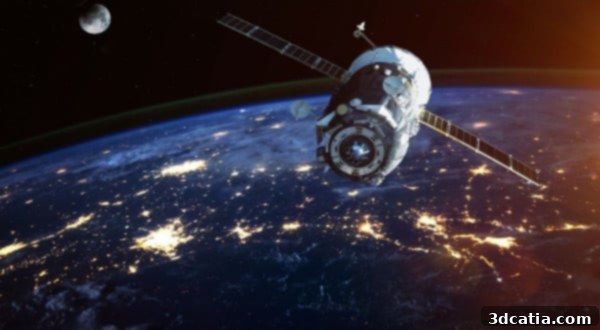
NASA’s Revolutionary 3D-Printed “Space Fabric”: Redefining Space Exploration Materials
When the concept of chainmail crosses your mind, images of medieval knights, clad in intricate metal links, battling gallantly for their kingdoms often come to the forefront. This ancient form of protective armor, a testament to historical ingenuity, is now undergoing a remarkable transformation, thanks to cutting-edge innovations at NASA. What was once a terrestrial necessity for warriors is being reimagined as a futuristic material for space exploration. Dubbed “Space Fabric” by NASA, this groundbreaking development holds the promise of being a cornerstone for the future of space travel, with its existence owing entirely to the transformative power of 3D printing technology.
This revolutionary Space Fabric prototype is the brainchild of a dedicated team at the Jet Propulsion Laboratory (JPL) in Pasadena, California, spearheaded by the visionary Raul Polit Casillas. The potential applications for this advanced material are vast and critical to ongoing space missions and future endeavors. Imagine spacecraft fortified against the relentless assault of micrometeorites and orbital debris, or insulated effectively against the brutal temperature extremes of the vacuum of space. Furthermore, its unique properties could prove invaluable for the construction of large, deployable structures, such as enormous antennas that unfurl in orbit or adaptable devices requiring intricate movement and resilience.
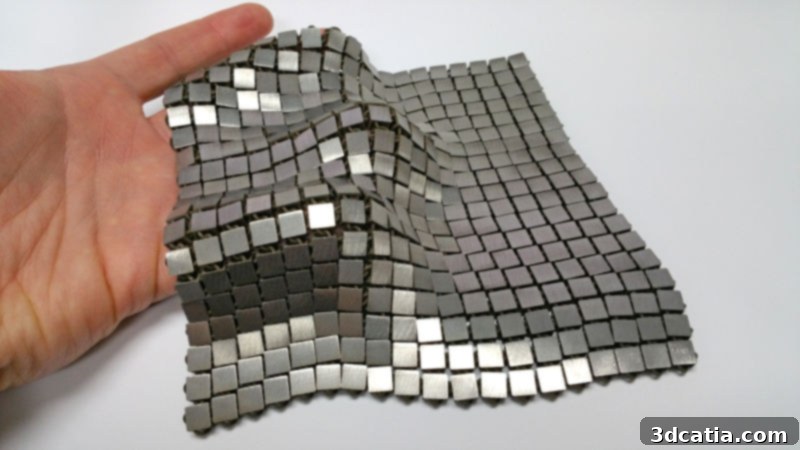
The new “Space Fabric” prototype looks like Medieval chainmail
The creation of this marvel is deeply rooted in additive manufacturing, specifically 3D printing, which allowed the JPL team to customize and design the Space Fabric with unparalleled precision, specifically tailored for the rigors of space travel. This bespoke approach has endowed the prototype with a remarkable suite of four distinct functional capabilities, integrated seamlessly into its design. On one side, the fabric possesses the inherent ability to reflect light, a crucial property for managing thermal loads by bouncing away intense solar radiation. Conversely, its other side is engineered to absorb light, enabling it to act as an efficient insulator, trapping heat when necessary to maintain stable temperatures within a spacecraft. Beyond these thermal management features, the very architecture of its chainmail-inspired design imbues the prototype with extraordinary foldability and flexibility. This allows it to adapt its shape dynamically, making it incredibly versatile for various spatial configurations and deployment scenarios, from compact storage during launch to expansive structures once in orbit.
The true genius of Space Fabric lies not just in its current form, but in the boundless potential it unlocks for future innovation. Andrew Shapiro-Scharlotta, the Early Stage Innovation Manager at JPL, eloquently captures this sentiment, stating, “We are just scratching the surface of what’s possible.” He emphasizes the profound impact of additive manufacturing: “The use of organic and non-linear shapes at no additional costs to fabrication will lead to more efficient mechanical designs.” This statement underscores a paradigm shift in engineering. Traditional manufacturing often imposes limits on design complexity due to cost and technical constraints. However, 3D printing liberates engineers to explore intricate, biomimetic, and highly optimized geometries that were previously impossible or prohibitively expensive to produce. These “organic and non-linear shapes” are not merely aesthetic; they are functional, allowing for unprecedented strength-to-weight ratios, integrated functionalities, and superior performance, particularly vital in the demanding environment of space where every gram and every inch of space counts.
The journey to develop Space Fabric began with a clear understanding of the challenges faced by conventional materials in space. The vacuum, intense radiation, and extreme temperature fluctuations (from hundreds of degrees Celsius in direct sunlight to near absolute zero in shadow) can degrade and compromise typical alloys and composites. Space Fabric, however, is designed to not only withstand these conditions but to actively manage them. Its metallic composition, precisely arranged through 3D printing, creates a material that is not only robust but also highly adaptable. This adaptability is key to shielding spacecraft from the constant barrage of micrometeoroids and space debris, which pose a significant threat to mission integrity. The chainmail structure is hypothesized to dissipate kinetic energy more effectively than solid panels, offering a new layer of protection against high-velocity impacts.
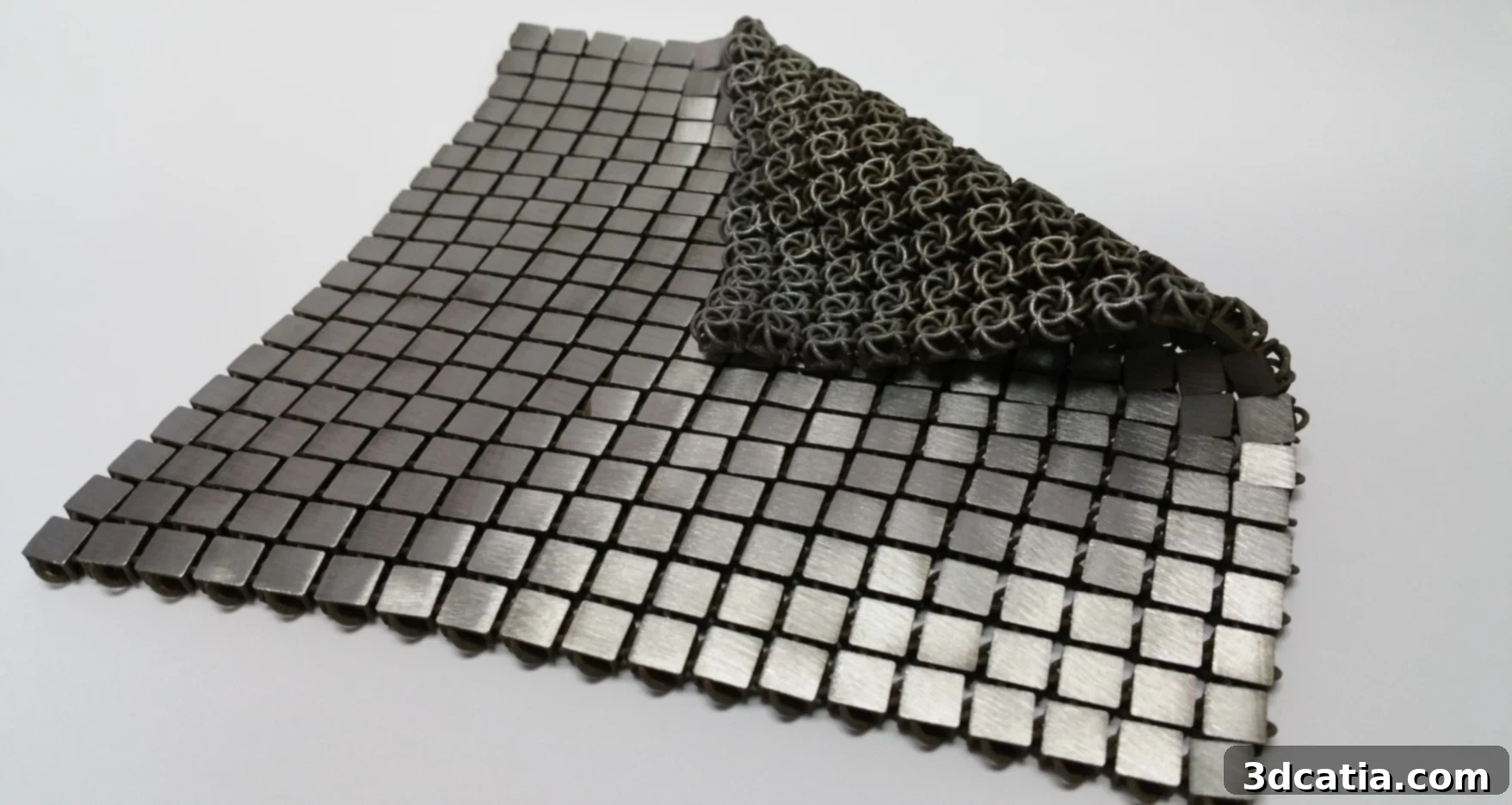
Each side of the “Space Fabric” has different functions: absorb light or reflect light
Beyond protective capabilities, the thermal management aspect of Space Fabric is a game-changer. By having one side capable of reflecting solar radiation and the other designed for absorption, a spacecraft equipped with this material can dynamically regulate its internal temperature. Imagine a satellite adjusting its ‘skin’ to either reject heat when orbiting in direct sunlight or absorb it when passing through Earth’s shadow. This passive yet intelligent thermal control reduces the reliance on complex active cooling systems, thereby decreasing weight, power consumption, and potential points of failure – all critical advantages for long-duration space missions. The ability to precisely control the radiative properties of the material through its 3D-printed texture and metallic composition is a testament to the advanced materials science at play.
The structural flexibility and foldability of this 3D-printed chainmail are equally transformative. Traditional large space structures, such as communication antennas or solar sails, often require complex mechanical deployment mechanisms that are heavy, prone to failure, and take up significant payload volume during launch. Space Fabric, with its inherent ability to be compactly stowed and then unfurled into vast, intricate shapes, offers a lightweight and robust alternative. Its reconfigurable nature could enable adaptable structures that change their form or function based on mission requirements, potentially leading to more versatile spacecraft and even self-assembling structures in orbit. This flexibility also opens doors for future designs of planetary habitats, where deployable structures could create living spaces from compact modules, expanding significantly upon arrival.
The success of Space Fabric is a powerful endorsement of additive manufacturing’s growing role in pushing the boundaries of engineering and design. The intricate geometries, multi-material integration, and rapid prototyping capabilities of 3D printing allowed researchers to experiment with numerous iterations, optimizing the design for specific functions and environmental challenges. This iterative design process, coupled with the ability to produce complex, interlinked structures in a single print run, is what truly sets this innovation apart. It’s a compelling example of how advanced manufacturing techniques can enable breakthroughs in material science, leading to entirely new classes of functional materials that were previously confined to science fiction.
This new innovation from NASA signifies much more than just an advanced material; it heralds a new era for both additive manufacturing and space travel. We are now witnessing the opening of numerous doors for further discoveries and technological advancements, not only here on Earth but also in the vast, unexplored reaches of the cosmos. The fascinating capabilities of this technology promise a future where space exploration becomes safer, more efficient, and more ambitious than ever before. From lunar bases clad in adaptive materials to self-repairing components on distant probes, the implications are profound and far-reaching. It’s a clear indication that the synergy between cutting-edge manufacturing processes and the ambitious goals of space agencies will continue to yield solutions that reshape our understanding and capabilities in the universe.
What are your thoughts on this groundbreaking innovation from NASA? Do you foresee more such transformative innovations emerging from their labs in the near future, fundamentally altering how we perceive and conduct space exploration? Share your insights and perspectives in a comment below, or engage with us on our Facebook and Twitter pages!