
Revolutionizing Car Manufacturing: Volkswagen’s Strategic Adoption of HP Metal Jet 3D Printing
The automotive industry stands at the precipice of a manufacturing revolution, with additive manufacturing, commonly known as 3D printing, emerging as a pivotal technology. This shift is epitomized by the strategic partnership between German automotive giant Volkswagen and American manufacturing leader HP. In September 2018, HP unveiled its groundbreaking metal 3D printer, the HP Metal Jet, a technology specifically designed to address the challenges of high-volume metal parts production. Among the very first to rigorously test and integrate this innovative technology was Volkswagen, a move that underscores their commitment to future-proofing their manufacturing processes and pushing the boundaries of vehicle production.
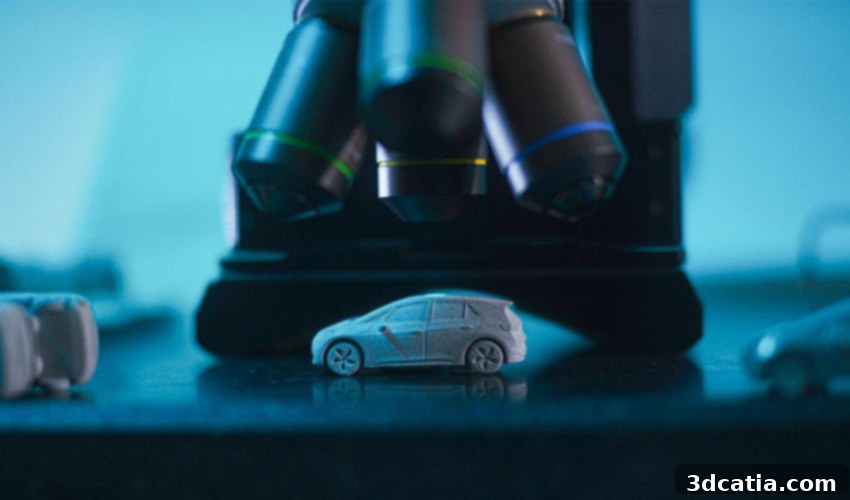
For the past year following its announcement, Volkswagen has been meticulously evaluating the HP Metal Jet machine’s capabilities. Far from being disappointed, the German automaker has achieved remarkable results, successfully 3D printing an astonishing 10,000 parts in just a few weeks. This initial, high-volume production run served a dual purpose. Firstly, it demonstrated the Metal Jet’s capacity for rapid, industrial-scale output. Secondly, it was a strategic marketing initiative for the launch of Volkswagen’s new electric vehicle, the ID.3. Through a collaborative partnership with GKN Powder Metallurgy, Volkswagen produced intricate, 2.5 cm long metal miniatures of the ID.3. These beautifully crafted 3D printed parts, distributed as promotional items, represent a significant and successful first step in Volkswagen’s ambitious roadmap. The company aims to achieve the 3D printing of structural parts for its production cars by as early as 2021, signaling a profound shift from traditional manufacturing methodologies.
Volkswagen’s commitment to additive manufacturing is evident in its rapidly expanding infrastructure. The company currently boasts 90 3D printers installed across its various factories, a significant portion of which are HP Metal Jet printers. This substantial investment highlights a clear long-term vision for integrating 3D printing into their core production strategy. The initial phase of this integration focused on creating custom aesthetic components. Examples include personalized car keys and other unique decorative elements, allowing for enhanced customization and brand expression. This stage served as a valuable learning ground, enabling Volkswagen engineers to understand the nuances of the technology and its application to automotive standards without immediately venturing into safety-critical components.
The second, more ambitious phase, is now squarely focused on the production of functional parts. This includes components like gearshift knobs and mirror mounts – parts that are integral to a vehicle’s operation and passenger experience. Volkswagen’s long-term goal for this phase is highly aggressive yet attainable: to print between 50,000 to 100,000 functional parts per year, each roughly the size of a football. This target demonstrates a clear intent to move beyond niche applications towards genuine mass production of vital automotive components using additive manufacturing. Dr. Martin Goede, Head of Technology Planning and Development at Volkswagen, articulated the company’s enthusiasm: “Our vision of industrializing additive manufacturing is quickly becoming a reality with HP Metal Jet, changing the game for the automotive sector. The pace of HP’s innovations and the advanced capabilities of the technology have exceeded our expectations. We achieve our objectives and actively identify and develop functional components for production.” His statement underscores not only the current success but also the forward momentum and proactive approach Volkswagen is taking in this transformative journey.
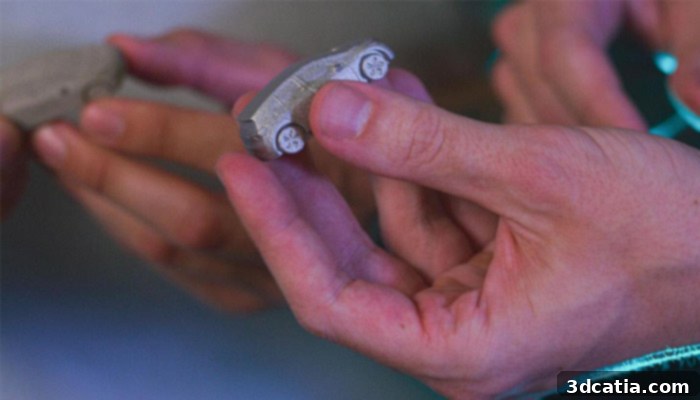
The miniature 3D printed car
The car manufacturer’s strategic roadmap is clearly progressing according to its ambitious plans. The successful production of 10,000 miniatures of the new ID.3 car stands as irrefutable proof of the technology’s readiness and Volkswagen’s capability to leverage it. This impressive series was manufactured in just a few weeks at HP’s facilities and at its partner, GKN Powder Metallurgy’s plant in Barcelona. Such rapid turnaround times for high-volume metal parts were once unimaginable with traditional manufacturing methods or even earlier forms of metal additive manufacturing. The small, meticulously detailed cars were subsequently distributed to Volkswagen employees and dealers across the globe, serving as tangible symbols of innovation and the company’s electric future. Dr. Goede further elaborated on the success: “What better way to showcase innovation at Volkswagen than to use our own technologies in the marketing campaign for the first ID.3 launch. We are extremely satisfied with the technical specifications, speed, quality and low cost per part provided by HP Metal Jet. The surface quality and resolution allowed for great attention to detail and added a special touch to this important milestone for the company.” This feedback highlights the critical combination of technical performance and economic viability that HP Metal Jet brings to the table, making it an attractive solution for industrial applications.
HP Metal Jet technology, at its core, utilizes binder jetting, an additive manufacturing process that offers significant advantages for high-volume metal part production. Unlike powder bed fusion methods (like SLM or DMLS) that use lasers or electron beams, binder jetting employs a liquid binding agent to selectively join powdered metal particles layer by layer. The resulting “green part” is then sintered in a furnace to achieve its final density and strength. This process is inherently faster and more cost-effective for large batches, as it doesn’t require support structures for most geometries and can print multiple parts simultaneously across the build platform. The ability to achieve excellent surface quality and fine resolution, as noted by Dr. Goede, is crucial for both aesthetic and functional components, ensuring that 3D printed parts meet the stringent quality demands of the automotive sector. Furthermore, the flexibility in material choice, including stainless steel and other alloys, opens up possibilities for a vast array of applications within vehicle manufacturing, from powertrain components to interior fixtures.
While we are still a considerable way from seeing cars fully 3D printed, the continuous advancements in additive manufacturing are enabling car manufacturers to set crucial milestones that progressively contribute to this ultimate objective. Volkswagen’s pioneering efforts with HP Metal Jet are certainly not isolated; the market is witnessing a broader industry trend. For instance, BMW, another German automotive powerhouse, announced the production of one million 3D printed parts just last year. Their applications range from prototyping and tooling to customized components and spare parts for luxury vehicles. These examples underscore a collective industry movement towards integrating additive manufacturing across various stages of the automotive lifecycle, from initial design to aftermarket support. The implications for supply chain resilience, design freedom, weight reduction, and faster iteration cycles are immense. With each successful application, the technology moves closer to becoming a mainstream production method for critical components.
The steady integration of 3D printed components promises to transform how vehicles are designed, manufactured, and customized. For Volkswagen, the ability to rapidly produce functional metal parts offers significant strategic advantages. It allows for quicker design iterations, reducing the time from concept to market. It also enables the production of complex geometries that are difficult or impossible to achieve with traditional methods, potentially leading to lighter, stronger, and more efficient components. Furthermore, distributed manufacturing models, where parts can be printed on demand closer to the point of assembly or customer, could revolutionize spare parts logistics and customization options. Who knows, perhaps the upcoming ID.3 model will incorporate a greater number of 3D printed components than initially expected, setting a new benchmark for mass-produced electric vehicles. Until we witness the first results of Volkswagen’s structural part integration target in 2021, you can delve deeper into HP’s cutting-edge metal additive manufacturing technology by visiting their website HERE.
This pivotal partnership between Volkswagen and HP is a testament to the transformative power of industrial 3D printing, especially in the demanding automotive sector. It showcases a clear path from innovative technology to tangible production benefits, setting a precedent for how future vehicles will be built. As companies like Volkswagen continue to push the boundaries, the landscape of car manufacturing is evolving at an unprecedented pace, driven by the capabilities of metal additive manufacturing. The future looks increasingly digital and additive.
What are your thoughts on Volkswagen’s groundbreaking use of HP’s Metal Jet technology in automotive production? Do you believe this will accelerate the adoption of 3D printing for structural components across the industry? We invite you to share your insights and engage with us in a comment below, or connect with us on our Facebook and Twitter pages! Don’t miss out on the latest advancements in additive manufacturing – sign up for our free weekly Newsletter to receive all of the latest news about 3D printing straight to your inbox!