

Pioneering Sustainable 3D Printing: TU Hamburg Transforms Recycled Paper into Eco-Friendly Prototypes
The global movement towards a more sustainable and environmentally conscious future has spurred countless innovations, particularly in advanced manufacturing sectors. Among these, additive manufacturing, commonly known as 3D printing, is increasingly being leveraged to develop greener processes and products. Addressing this critical need, a visionary research group at the Technical University of Hamburg (TUHH), under the distinguished leadership of Prof. Dr.-Ing. Claus Emmelmann, has embarked on a fascinating quest: to discover the shared ground between everyday objects like egg cartons, paper, and cutting-edge sustainable 3D printing technology. This ambitious endeavor culminates in their groundbreaking initiative, aptly named “Green 3D Printing,” which is dedicated to revolutionizing the creation of prototypes and models through inherently sustainable methods and materials.
Traditionally, the fabrication of prototypes and functional models in 3D printing relies heavily on various types of plastics. While plastics offer versatility and specific mechanical properties, a significant concern arises from their lifecycle. A substantial portion of these materials originates from non-renewable sources, and more often than not, prototypes serve their intended purpose for a limited duration before being discarded. This short lifespan contributes massively to the global waste crisis, exacerbating environmental degradation. To put this into perspective, alarming statistics reveal that 85% of the 40 million tons of municipal plastic waste generated annually in the U.S. alone ends up in landfill sites, highlighting an urgent need for alternatives. Recognizing this pervasive problem, the forward-thinking researchers at TUHH have meticulously explored and championed a dramatically more resource-conserving and environmentally friendly solution: the innovative application of paper fiber materials in additive manufacturing.
At the core of the “Green 3D Printing” project lies a focused commitment to leveraging paper fiber materials as a viable and sustainable alternative to conventional plastics. This pioneering approach envisions a future where 3D printed objects can be derived from recycled sources, specifically targeting the transformation of commonplace items like used egg cartons into a novel, papier-mâché-like printing medium. The central objective of this research is to rigorously evaluate the potential and utility of this material for future 3D printing applications, assessing its technical feasibility, structural integrity, and environmental benefits. The project, underscoring its profound dedication to sustainability, has garnered crucial financial backing through the “Calls for Transfer” program of the Science Authority, securing a total sum of €26,300. This funding is instrumental in propelling the research forward, enabling the team to delve deep into the mechanics and possibilities of paper-based additive manufacturing and pave the way for a truly circular economy in prototyping.
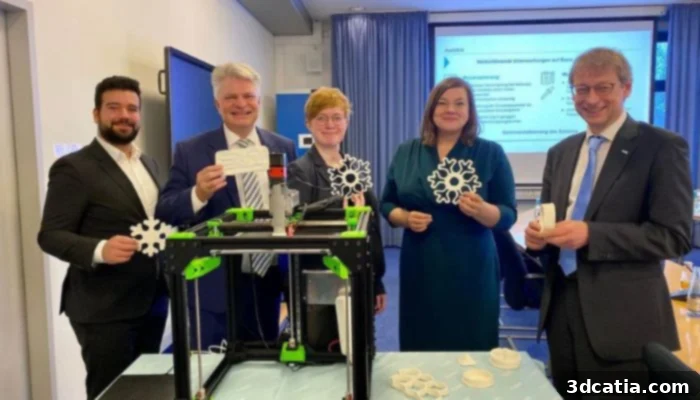
First prints have already been made with paper (photo credits: BWFGB)
From Papier-Mâché to Finished Sustainable 3D Printing Material
Transforming something as unassuming as used egg cartons into a high-tech 3D printing material requires a meticulous and innovative approach. To successfully produce the paper-based material for their sustainable 3D printed prototypes and illustrative models, the brilliant researchers at the Technical University of Hamburg are employing a specialized process. This involves carefully separating individual paper fibers, which are then expertly mixed with water and a bonding adhesive to form a homogenous, flowable mass. This viscous pulp is specifically engineered to be extrudable through a 3D printer nozzle, layer by layer, until the desired object takes shape. The team is currently dedicating significant efforts to fine-tune the exact material mixture, rigorously testing various ratios and compositions to ensure optimal flowability, structural integrity, and printability for different 3D printer systems. A truly revolutionary aspect of their research involves the potential integration of a biological adhesive into this mixture. If successfully implemented, prototypes produced using this bio-adhesive enhanced paper material could be safely disposed of in organic waste streams, completing a truly circular product lifecycle and setting an unprecedented standard for eco-friendly manufacturing.
The scope of this pioneering research at TUHH extends far beyond mere industrial prototypes. While creating environmentally responsible prototypes is a significant achievement in itself, the team is also investigating the potential for these paper-fiber composites in the production of durable end-use parts. Imagine everyday items, components for low-stress applications, or even temporary structures that are not only functional but also completely biodegradable at the end of their service life. Furthermore, a particularly promising application lies in the realm of customized packaging. With the global outcry against excessive plastic packaging, this paper-based 3D printing material offers an unparalleled opportunity to create tailor-made, protective, and fully sustainable packaging solutions for shipping and logistics. This could significantly reduce the environmental footprint of e-commerce and various industries, providing innovative alternatives to polystyrene foams and other non-recyclable materials. The versatility and environmental benefits of this material open doors to a vast array of possibilities, poised to impact numerous sectors from product design to logistics.
The enthusiasm surrounding this transformative project is palpable within the university, as eloquently articulated by Prof. Dr. Andreas Timm-Giel, President of the TUHH. He affirms with immense pride, “We are pleased that we are once again able to support a number of innovative projects with the “Calls for Transfer” program that we initiated; especially about the TU project “Green 3D Printing” of the TU Hamburg. This project is an impressive example of how engineering solutions can significantly reduce resource consumption and lead us to a more sustainable future. Specifically, the use of paper fiber composites for 3D printing is being tested here. This can provide a sustainable alternative for plastic-based manufacturing of prototypes and illustrative models. The goal of the project is now to develop a prototype system to evaluate its technical and economic suitability.” This statement underscores TUHH’s unwavering commitment to fostering innovation that directly addresses pressing global challenges, positioning itself at the forefront of sustainable engineering research. The project’s focus on technical and economic viability is crucial, as it aims not just for scientific breakthroughs but for practical, implementable solutions that can genuinely make a difference in industrial practices and consumer choices.
The research group at the Technical University of Hamburg, specifically within the esteemed Institute for Laser and Plant Systems Technology, has a distinguished history of pioneering excellence and international recognition in the field of 3D printing. Their previous groundbreaking work has earned them prestigious accolades, solidifying their reputation as leaders in advanced manufacturing. For instance, their innovative research into industrial metal 3D printing was honored with the coveted Innovation Award of the German Economy in 2014. Building on this legacy, they were further recognized with the Future Prize of the Federal President in 2015, highlighting their consistent contribution to technological advancement and societal benefit. This impressive track record lends significant credibility and weight to their current endeavors in sustainable paper-based 3D printing. Driven by this rich history of success and a clear vision for the future, the team is already actively working towards securing a patent application for their cutting-edge process for producing this unique 3D printing material. This step is vital for protecting their intellectual property and ensuring that their innovative solutions can be scaled and widely adopted, bringing their vision of green additive manufacturing closer to reality.
The potential implications of TU Hamburg’s “Green 3D Printing” project are vast, promising a paradigm shift in how we approach manufacturing and material consumption. By transforming readily available waste materials like egg cartons into valuable resources for 3D printing, the project not only reduces landfill waste but also decreases reliance on fossil fuel-derived plastics. This initiative exemplifies the principles of a circular economy, where resources are kept in use for as long as possible, extracting the maximum value from them whilst in use, then recovering and regenerating products and materials at the end of each service life. The research is a testament to the power of interdisciplinary collaboration, combining expertise in materials science, mechanical engineering, and environmental sustainability. As the team continues to refine the material composition, optimize printing parameters, and develop robust prototype systems, the world watches with anticipation. This innovative approach could soon enable manufacturers and individual creators alike to produce components, prototypes, and even consumer products with a significantly smaller environmental footprint, making sustainable choices more accessible and economically viable.
Could you imagine incorporating paper-based materials into your own 3D printing projects, contributing to a more sustainable future? We invite you to share your thoughts and ideas in a comment below or join the conversation on our Linkedin, Facebook, and Twitter pages! Don’t forget to sign up for our free weekly Newsletter here to receive the latest 3D printing news, innovations, and insights straight to your inbox. You can also explore all our compelling videos and fascinating demonstrations on our YouTube channel, where we showcase the cutting edge of additive manufacturing.