
Revolutionizing Lighting Design: Yael Akirav’s Conductive Origami with 3D Printed Textiles
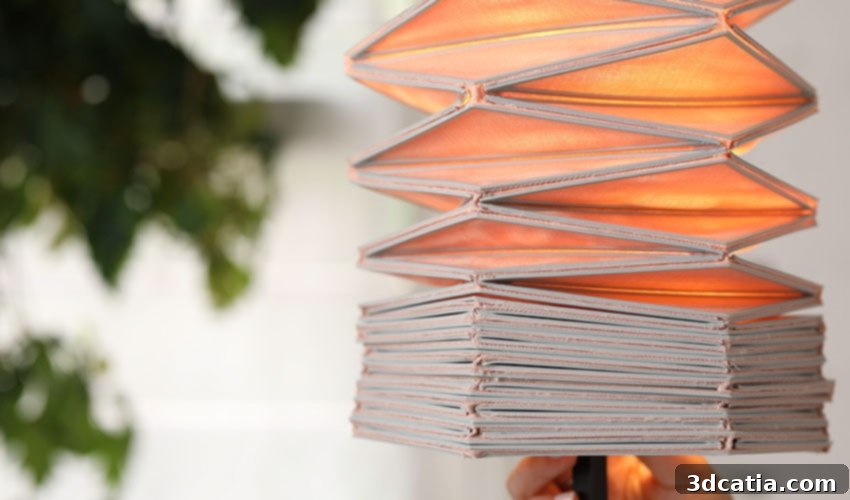
The landscape of design and manufacturing has been profoundly reshaped by the rapid advancements in 3D printing, ushering in an era of unprecedented material innovation and application. This transformative technology empowers artists and designers to explore novel creative frontiers, pushing the boundaries of what’s possible. A compelling example of this innovative spirit is found in the work of young industrial designer Yael Akirav, who harnessed the power of additive manufacturing to bring her visionary “Conductive Origami” project to life. This unique series features original lighting fixtures, meticulously crafted by directly 3D printing conductive materials onto various textile surfaces.
Drawing inspiration from the venerable and intricate art of ancestral origami, Yael Akirav conceived a groundbreaking approach to merge these time-honored folding techniques with additive manufacturing. The result is a collection of truly distinctive accessories that not only illuminate spaces but do so interactively, expanding and contracting to control their light. Remarkably, these innovative lamps forgo traditional switches; instead, the very materials they are made from function as electrical conductors. We recently had the opportunity to speak with Yael about her fascinating project, delving into the critical role 3D printing plays in driving design innovation and enabling such cutting-edge creations.
3DN: Can you introduce yourself and tell us about your experience with 3D printing?

I’m Yael Akirav, 27 years old, an industrial designer hailing from Jerusalem, Israel. I’m a recent graduate of the esteemed industrial design department at Bezalel Academy of Art and Design. It was during my academic journey that I first encountered 3D printing technologies, and I was immediately captivated. The potential it held for material exploration and complex form creation resonated deeply with my creative inclinations, quickly becoming a significant passion. Alongside this, I’ve always held a strong affinity for using textiles as a primary material in my designs. My previous projects, such as ‘Tiny Light’ and ‘Bloomiez,’ were instrumental in exploring and experimenting with textile integration. Therefore, it felt entirely natural to combine these two profound passions—3D printing and textiles—for my final project at Bezalel, which culminated in ‘Conductive Origami.’ This project represents a seamless fusion of advanced digital fabrication with the tactile and adaptable qualities of fabric, pushing the boundaries of what is conventionally understood as industrial design.
3DN: What is Conductive Origami and how did the idea come about?
Conductive Origami is a meticulously crafted series of lighting fixtures, distinguished by the innovative technique of 3D printing directly onto textile substrates. This method of rigid printing on textile allows for the creation of intricate and precise structural elements that would be incredibly challenging, if not impossible, to achieve through traditional textile manipulation. The true ingenuity, however, emerges when the printed material itself conducts electricity. In this scenario, the geometric intersections derived from the art of origami are transformed into a new kind of functional opportunity: the ability to turn the light on and off, or even dim it, simply by contracting and stretching the structure of the lamp. The conductive filament is not merely a conduit for electricity; it also serves as the integral structural skeleton of each lighting fixture, dictating its unique folding and opening mechanism.
The initial spark for this project was ignited by the timeless elegance and structural integrity of origami folding techniques. I began my exploration by folding paper in the traditional manner, pondering how these precise, architectural folds could be replicated and made effortless on fabric. My early experiments involved various methods of textile manipulation, including heading fabrics and ironing, but these proved to be either too cumbersome or insufficiently precise for the desired structural integrity. It was at this juncture that I turned my attention to 3D printing. I took the fundamental principles of origami — the concept of transforming a flat sheet into a complex three-dimensional object through strategic folds — and sought to apply them to my textile design objects using additive manufacturing. To my pleasant surprise, the 3D filament acted as an incredibly effective structural skeleton, granting the textile the ability to be folded and stretched repeatedly without losing its form or functionality. This breakthrough opened up a world of possibilities. During the subsequent phase of my research, I was introduced to a specialized conductive filament, uniquely formulated with conductive silver ink. The combination of this robust skeletal structure with the newly discovered conductive trait allowed me to devise an entirely new and interactive method of illuminating my lamps, making the act of interaction part of the lighting experience itself.
Credits: Ofek Avshalom
3DN: Why did you decide to use 3D technologies for Conductive Origami?
My journey into Conductive Origami necessitated a deep dive into the world of conductive materials. I systematically examined a variety of options, exploring different conductive inks, paints, and filaments. Many of these, while conductive to some extent, simply did not possess the specific conductivity and structural properties required for my lamps to function as envisioned. Their resistance was either too high, or they lacked the necessary flexibility and durability when integrated with textiles. It was a rigorous and often frustrating process of trial and error until I finally discovered this particular conductive filament, which is based on conductive silver ink. This material proved to be perfectly suited for my needs; it conducted electricity flawlessly, exactly as I had imagined, allowing for the precise control and interactive lighting effects I aimed to achieve. While this innovative material is currently still in its prototype phase, I am incredibly optimistic that in the near future, it will become widely accessible, opening up new avenues for designers and innovators globally.

Credits: Ofek Avshalom
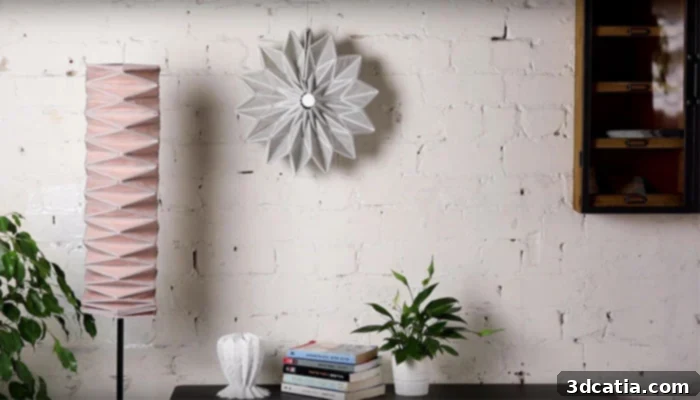
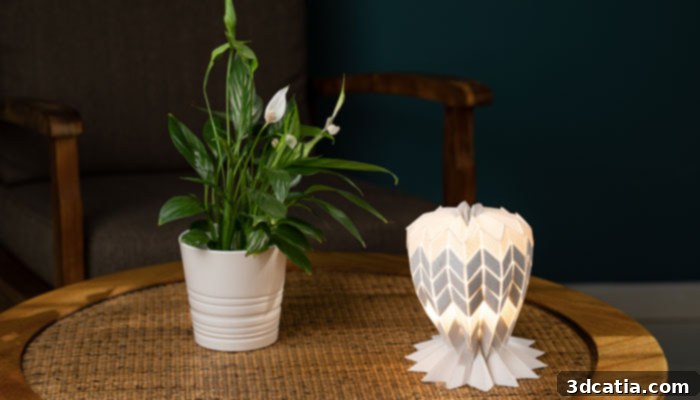
The Conductive Origami series currently encompasses three distinct lighting fixtures, each showcasing a unique folding mechanism and opening method. Each lamp is designed to present two visually distinct states: an ‘open’ or ‘stretched’ position, where the light is fully illuminated, and a ‘folded back’ or ‘closed’ position, where the light is dimmed or off. The remarkable properties of the conductive filament are instrumental in enabling this dynamic functionality, allowing me to ingeniously incorporate a dimmer switch directly into the structure of each object. As the structure is gently stretched, the light gradually intensifies, creating a soft, ambient glow. Conversely, when the structure is folded back into its compact form, the light slowly fades, offering a seamless and intuitive user experience that goes beyond a simple on/off switch. For this initial series, I developed two primary methods of opening: vertically opening lamps, which create a tall, elegant form when expanded, and round opening lamps, which unfurl into a more spherical or flower-like shape. The third lamp within the series also features a round opening, but its exceptional quality lies in its visual transformation. For this piece, I experimented with two different colors of the conductive filament, integrating them into the design in a subtle yet impactful way. When the lamp is in its closed or off state, the textile appears to be a uniform, pristine white. However, when the light is activated and the lamp is stretched open, an intricate black and white pattern, created by the interplay of the different colored filaments, is beautifully revealed through the fabric, adding an unexpected layer of visual depth and surprise. This demonstrates how 3D printing on textiles can create not just functional but also aesthetically transformative designs.
Credits: Ofek Avshalom
3DN: What are your future projects?
These days, my primary focus remains on pushing the boundaries of 3D printing directly onto textile. The potential of this hybrid technology is immense, and I am continuously investigating new applications and innovative ways to leverage the inherent benefits of 3D printing—precision, customizability, and the ability to create complex geometries—in conjunction with the flexibility and tactile qualities of fabric. My goal is to expand into even more diverse territories, exploring how conductive textiles and additive manufacturing can revolutionize not just lighting design, but also areas like interactive interiors, smart wearables, and adaptable architectural elements. This ongoing research aims to unlock new functional and aesthetic possibilities, demonstrating the transformative impact of integrated design and advanced material science. You can find more comprehensive information about my work and the Conductive Origami project on my website HERE.
*Cover Photo Credits: Ofek Avshalom
Yael Akirav’s Conductive Origami project stands as a shining example of how innovative design, combined with cutting-edge 3D printing technology and smart materials, can redefine everyday objects. It’s not just about creating a lamp; it’s about crafting an interactive experience, a piece of art that responds to touch and movement, seamlessly blending functionality with aesthetic beauty. This pioneering work highlights the limitless possibilities at the intersection of traditional craftsmanship and digital fabrication, inspiring a new generation of designers to think beyond conventional boundaries. We are excited to see the future directions Yael will take with her groundbreaking research into 3D printing on textiles.
What are your thoughts on the groundbreaking Conductive Origami project? We invite you to share your insights in a comment below or join the conversation on our Facebook and Twitter page! Don’t miss out on the latest advancements and stories in additive manufacturing—remember to sign up for our free weekly Newsletter, delivering all the essential 3D printing news straight to your inbox!