
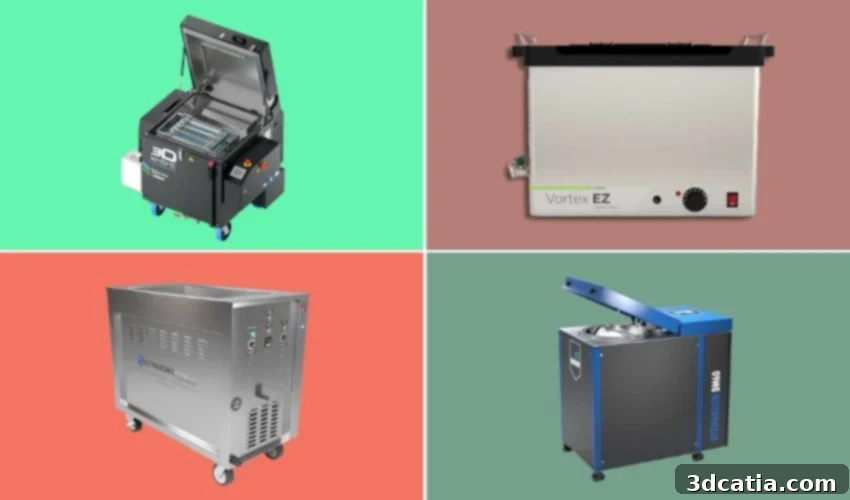
Achieve Flawless Finishes: A Comprehensive Guide to Industrial 3D Print Coloring Systems
Color is far more than just an aesthetic choice; it’s a critical functional element that influences perception, utility, and branding across diverse industries. From consumer goods and intricate interior designs to vital medical devices and advanced prototypes, the precise application of color can elevate a 3D-printed component from a simple part to a sophisticated, market-ready product. Achieving a perfectly colored 3D component can be approached in several ways: directly through advanced multicolor 3D printers, via meticulous hand painting, or most commonly, by utilizing specialized post-processing devices designed specifically for coloring prints. The optimal method for color application hinges significantly on the final intended use of the part, the material, and the required production volume.
While many of these cutting-edge dyeing systems are primarily engineered for parts produced using powder-bed fusion methods like Selective Laser Sintering (SLS) or Multi Jet Fusion (MJF), a growing number of innovative solutions also cater to components fabricated with other popular processes, including resin-based technologies such as Stereolithography (SLA) or Digital Light Processing (DLP), and even Fused Deposition Modeling (FDM) parts. These dedicated coloring systems are designed to deliver professional-grade finishes suitable for demanding industrial environments, ensuring consistent quality, durability, and a wide spectrum of color options. Below, we delve into a curated list of leading 3D print coloring systems currently available on the market, each offering unique features to meet the diverse needs of additive manufacturing professionals.
Why Color is Essential for 3D Printed Parts
In additive manufacturing, color is not merely a superficial attribute; it plays a pivotal role in both the functionality and market appeal of 3D printed objects. For consumer products, vibrant and consistent colors are crucial for brand identity and attracting customers. In sectors like interior design, color allows for seamless integration into existing aesthetics or the creation of striking new focal points. Medical applications often rely on color-coding for different components or instruments, enhancing safety and operational clarity. Furthermore, prototypes benefit immensely from accurate color representation, allowing designers to visualize and iterate on product appearance before mass production.
Achieving high-quality color can be challenging with conventional methods. Direct multicolor printing offers limited material options and can be costly. Manual painting, while flexible, is labor-intensive, time-consuming, and often struggles with consistency and scalability. This is where specialized dyeing systems become indispensable. They offer a controlled, repeatable, and often automated process to infuse 3D prints with permanent, uniform colors, overcoming the limitations of other techniques and enabling industrial-scale production of truly finished parts.
3DWAVE from Teknox: The Automated All-in-One Solution
The 3DWAVE system by Teknox stands out as an exceptional all-in-one solution for the comprehensive post-processing and coloring of 3D-printed components. Engineered specifically for additive manufacturing, this system ensures outstanding results with unparalleled precision, even when dealing with highly complex geometries and intricate surfaces. This remarkable capability is largely attributed to its innovative Rotowave system, which guarantees uniform treatment across all parts.
Designed for maximum efficiency and ease of use, the 3DWAVE operates with full automation, significantly reducing the need for manual intervention. It meticulously handles every critical step in the coloring workflow: from the initial pre-rinsing to ensure a clean surface, through the precise coloring process, followed by thorough rinsing to remove excess dye, and finally, efficient drying. This streamlined, automated sequence not only simplifies operation but also dramatically enhances productivity, with a complete cycle taking less than 60 minutes. Furthermore, the 3DWAVE offers extensive customization options, allowing users to tailor programs to their specific material requirements, desired color intensity, and application needs, making it a versatile asset for various industrial settings.
HAM-PD400 from HPRT: Intelligent Liquid-Dip Coloring for Nylon
HPRT’s HAM-PD400 is introduced by its manufacturer as an intelligent and comprehensive liquid-dip coloring system, specifically optimized to meet all coloring requirements for nylon 3D prints. Measuring 2000×1210×2000 mm, this robust device integrates innovative coloring technology to deliver exceptional results. A key feature of the HAM-PD400 is its extensive palette of Pantone color options, ensuring that users can achieve precise and vibrant hues. This system excels in providing an even, true-to-tone color application, which is crucial for high-quality finished parts.
The HAM-PD400 boasts an all-in-one operating system that intelligently manages the entire coloring process, from the initial dye application and efficient color changes to automated cleaning cycles. This level of automation significantly streamlines post-processing workflows. Its intelligent color detection capabilities are particularly advanced, allowing users to define and specify custom colors and materials with remarkable accuracy. This precision ensures that custom specifications are applied seamlessly and consistently across batches. With an impressively short processing time ranging from just 10 to 20 minutes per piece, the HAM-PD400 is an ideal choice for businesses seeking a fast, reliable, and high-quality comprehensive coloring system for nylon parts, perfectly balancing efficiency with superior finish quality.
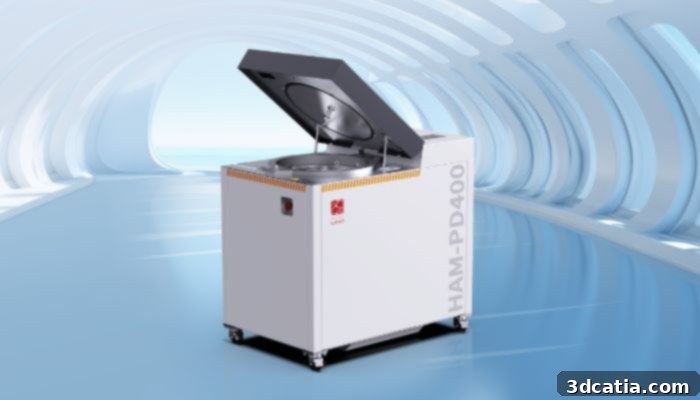
(Credit: HPRT)
eCOLOR Series: Textile Dyeing Expertise for Additive Manufacturing
The eCOLOR series represents a powerful synergy, born from the collaboration between CIPRES and the venerable German manufacturer Thies GmbH & Co. KG. This partnership ingeniously merges Thies’ decades of unparalleled expertise in textile dyeing with the dynamic world of additive manufacturing, delivering highly sophisticated coloring solutions. Designed with large-scale in-house production in mind, the eCOLOR product line offers three distinct models to cater to varying capacities and requirements: the eCOLOR Type 1/350/1, equipped with a 350 mm dye bath; the Type 1/550/1, featuring a larger 550 mm dye bath; and the eCOLOR Quattro, an advanced system capable of performing up to four independent dyeing processes simultaneously, maximizing throughput and efficiency.
Each eCOLOR system operates with full automation, ensuring consistent results while prioritizing both efficiency and environmental sustainability. This makes the series exceptionally well-suited for continuous industrial use, where reliability and repeatable quality are paramount. The systems demonstrate remarkable versatility in handling a wide array of materials, from popular polymers like nylon, TPU, and ABS to more specialized polypropylene and reinforced polymers. Crucially, they are compatible with parts produced by various additive manufacturing processes, including SLS, MJF, FDM, and SLA, offering broad utility. The eCOLOR machines are engineered to deliver consistently high color quality, meticulously preventing common issues such as oversaturation or color bleeding. For enhanced control and reproducibility, users can store an impressive up to 999 dyeing recipes, allowing for precise replication of desired finishes. Starting with a convenient set of five pre-loaded recipes and the flexibility to customize additional ones, the eCOLOR series provides manufacturers with a flexible, robust, and future-proof solution for dependable, large-scale dyeing in the modern additive manufacturing landscape.
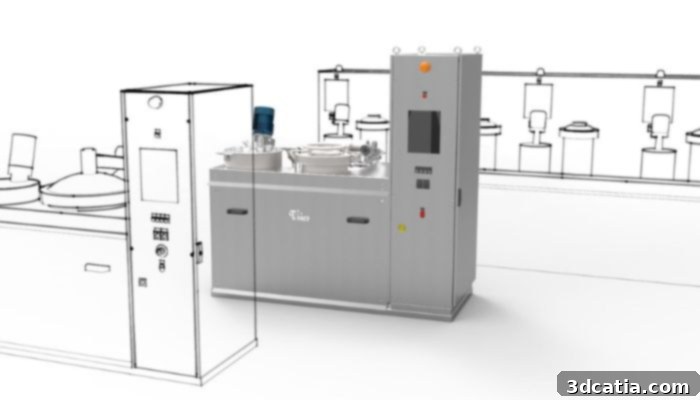
(Credit: CIPRES)
3DC Dyeformer: Streamlined Dyeing for Diverse 3D Prints
The 3DC Dyeformer, developed by 3DChimera (3DC), is a highly versatile and user-friendly system engineered for efficient coloring of a broad spectrum of 3D-printed parts. Its design allows it to cater to both powder-based additive manufacturing technologies, such as SLS, MJF, and SAF, as well as resin-based processes like SLA, DLP, and CLIP. This wide compatibility makes the Dyeformer an invaluable tool for varied production environments.
One of the Dyeformer’s key advantages is its ability to significantly simplify the dyeing process, effectively eliminating the guesswork often associated with achieving the perfect temperature, optimal timing, and precise dye composition. 3DC supports the Dyeformer with a proprietary range of eight distinct dyes, all of which are non-toxic and designed for reusability for up to 24 hours, enhancing both safety and cost-efficiency. The system is capable of coloring both large and small parts with equal proficiency. It features a spacious internal container measuring 1.5 × 19.5 × 6 inches, which can be further customized with a smaller 16 × 8 × 4-inch stainless steel basket for batch processing of smaller components. The operational principle is straightforward: users simply mix the proprietary dye with water, and the machine then precisely heats this solution to an exact temperature. This controlled heating process relaxes the polymer strands of the 3D print, allowing them to permanently absorb the color, resulting in a durable and consistent finish.
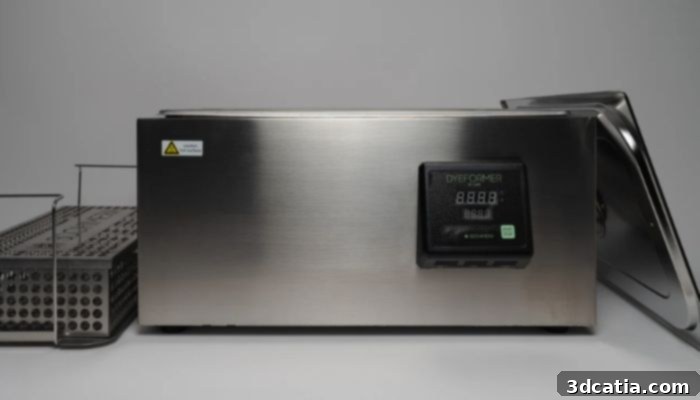
(Credit: 3DChimera)
Xioneer Vortex EZ: Compact Desktop Dyeing for Versatile Materials
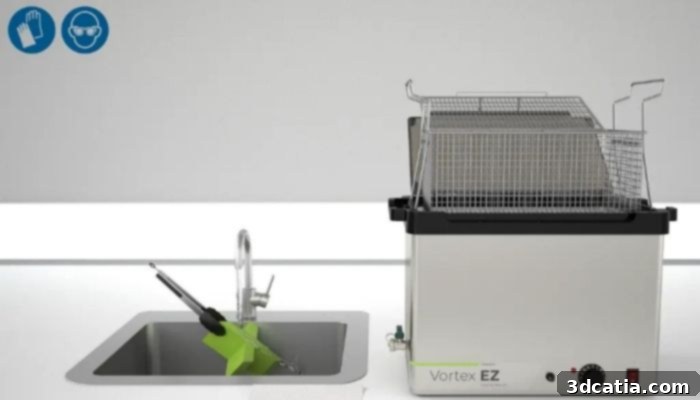
Xioneer, a reputable German company specializing in a diverse range of 3D printing products including washing stations, filament containers, and advanced materials, also offers an innovative dyeing solution: the Vortex EZ dyeing station. Unlike many larger industrial systems, the Vortex EZ is distinguished by its compact design, making it an ideal desktop device. With dimensions of 640 × 450 × 370 mm and a generous 38 L capacity, it offers a powerful dyeing solution in a surprisingly small footprint, complemented by a quiet motor for comfortable operation in various environments.
The construction of the Vortex EZ prioritizes both efficiency and durability. The tank itself is crafted from double-walled, heat-insulated stainless steel, which not only enhances its longevity but also contributes to more efficient temperature regulation, reducing energy consumption. This versatile dyeing station is suitable for parts produced using a wide array of 3D printing technologies, including SLS, SLA, FDM, MJF, and SAF processes. Users can precisely control the dyeing temperature via an intuitive dial, setting it anywhere between 30 and 85 °C. The liquid within the tank reaches its maximum set temperature in approximately one hour, allowing for efficient batch processing. The Xioneer Vortex EZ is an excellent choice for R&D departments, small to medium-sized businesses, or anyone requiring a high-quality, reliable, and space-saving solution for dyeing a variety of 3D printed materials.
(Credit: Xioneer)
DM60 from DyeMansion: Professional Post-Processing for Industrial Needs
DyeMansion, a leading German manufacturer renowned for its advanced post-processing machines in additive manufacturing, offers the DM60 as a key component in its lineup for adding high-quality color to 3D-printed parts. This system is celebrated for its intuitive design, ease of installation, and rapid operational speed, making it a highly efficient solution for industrial-scale coloring. The process is remarkably straightforward: users simply scan the cartridge of their chosen dye, insert it into the machine, carefully place their pre-cleaned parts into the integrated container, and then securely close the system. After a consistent processing time of approximately 150 minutes, the basket can be removed, and the perfectly colored parts are ready for immediate use, significantly accelerating the production workflow.
From a technical standpoint, the DM60 is designed for robust industrial performance. It measures 950 × 600 × 945 mm, offering a substantial capacity within a manageable footprint. The system is capable of heating up to 115 °C, ensuring optimal dye absorption and color permanence. It boasts broad compatibility with popular powder-based 3D printing technologies, including SLS, SAF, MJF, and HSS, catering to a wide range of industrial applications. For specific requirements, particularly in industries where black is a dominant color, DyeMansion also offers a specialized DM60 Black version, providing an optimized solution for achieving deep, consistent black finishes. The DM60 embodies DyeMansion’s commitment to delivering professional, reliable, and scalable post-processing solutions that meet the rigorous demands of modern additive manufacturing.
Dye Tank from Ultrasonic Power: High-Capacity Industrial Dyeing
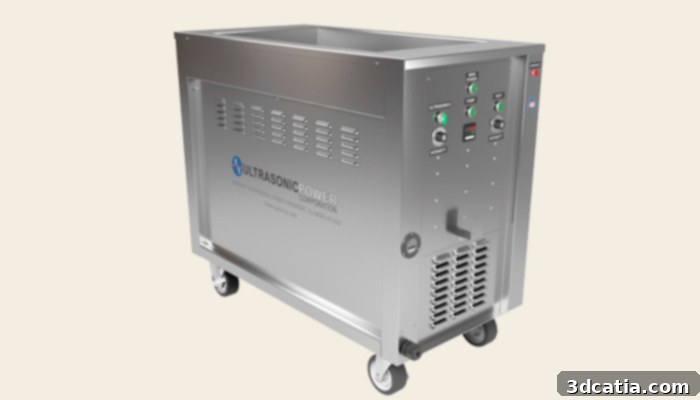
The Dye Tank solution, engineered and developed by Ultrasonic Power Corporation, is specifically designed for the efficient and robust coloring of 3D-printed parts within demanding industrial environments. This system excels in high-volume applications, featuring an impressive capacity of over 145 liters, capable of accommodating large batches and sizeable components. Its powerful 2000W heating element ensures rapid and remarkably even heating of the dye solution, which is crucial for achieving consistent color saturation and avoiding blotchiness across all parts in a batch.
With generous internal dimensions of 81 × 46 × 41 cm, the Dye Tank provides ample space for parts of varying sizes, enhancing its versatility. The construction of the tank is built for extreme durability and resilience; it is fabricated from double-welded 316L stainless steel, ensuring longevity and resistance to corrosion even under rigorous industrial conditions and exposure to various chemical dyes. The system is equipped with advanced programmable digital controls for both time and temperature, allowing operators to precisely manage the dyeing process for optimal and repeatable results. A practical removable lid helps to significantly reduce dye evaporation, conserving resources and maintaining a stable working environment. Furthermore, Ultrasonic Power offers a range of customizable options to further optimize the process, including a sparger-weir system for improved circulation, a motorized lift for ergonomic loading and unloading, or an additional rinse tank to ensure superior finish quality and efficiency. These options allow businesses to tailor the Dye Tank to their exact operational needs, boosting overall quality, efficiency, and repeatability in their 3D printing post-processing workflows.
(Credit: Ultrasonic Power)
SurfPro Steam Dyeing from IntegrAM: Eco-Friendly Mass Coloring
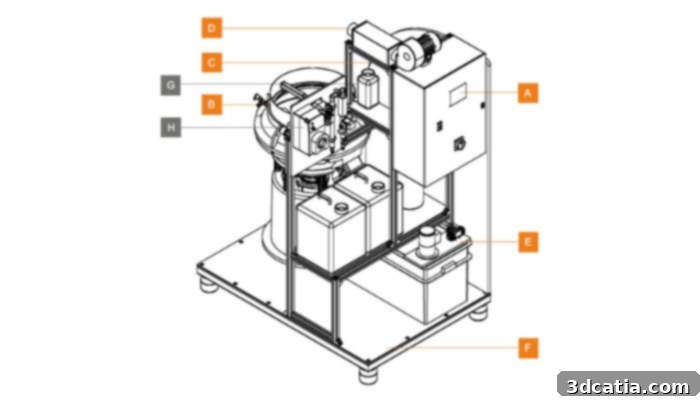
The SurfPro from the French-Italian group IntegrAM represents a relatively new and innovative approach to 3D print post-processing, offering an automatic, steam-based dyeing system specifically tailored for SLS and MJF prints. This solution is engineered with a strong focus on mass coloring while simultaneously aiming to significantly reduce environmental impact. IntegrAM proudly states that the SurfPro utilizes a remarkable 1/10 of the water and 1/20 of the dye compared to traditional conventional dyeing systems, making it an exceptionally eco-friendly option for sustainable manufacturing.
What truly distinguishes the SurfPro is its advanced high-temperature steam system. This unique mechanism precisely sprays the dye evenly onto 3D printed objects, ensuring excellent penetration into the part’s surface. This results in incredibly consistent and deep color saturation without imperfections, even on complex geometries. The SurfPro dyeing system is currently available in three different versions, offering flexibility with volumes of 60 L and 120 L to suit various production scales. While currently only the highly sought-after Extra-Black color is available, which is a staple in many industrial applications, the manufacturer has announced that many more colors will soon be introduced. A key design advantage is the quick-swap system for dye cartridges, allowing for color changes in just a few minutes, maximizing uptime and production flexibility. The SurfPro is an ideal solution for industries looking for high-quality, high-throughput dyeing with a reduced ecological footprint.
(Credit: IntegraAM Group)
Conclusion: Choosing the Right Coloring System for Your 3D Prints
The landscape of 3D printing post-processing offers a diverse array of advanced coloring systems, each designed to meet specific industrial demands and deliver professional-grade finishes. From all-in-one automated solutions like Teknox’s 3DWAVE and intelligent nylon-focused systems like HPRT’s HAM-PD400, to the textile-dyeing expertise integrated into the eCOLOR series, and the versatile desktop options such as the 3DC Dyeformer and Xioneer Vortex EZ – manufacturers have unprecedented choices. High-volume industrial applications can benefit from DyeMansion’s DM60 or Ultrasonic Power’s robust Dye Tank, while environmentally conscious operations might prefer IntegrAM’s innovative SurfPro Steam Dyeing system.
Selecting the ideal coloring system requires careful consideration of several factors: the type of 3D printing technology used (e.g., powder-based vs. resin-based), the specific materials being processed, desired production volume, the required color consistency and range, and budget constraints. These advanced systems not only enhance the aesthetic appeal of 3D prints but also significantly expand their functional applications, making them suitable for end-use parts in various industries. We hope this comprehensive guide assists you in navigating the options and finding the perfect solution to achieve flawless, professionally colored 3D prints.
Which dyeing systems appeal to you the most? Let us know in a comment below or on our LinkedIn or Facebook pages! Plus, don’t forget to sign up for our free weekly Newsletter to get the latest 3D printing news straight to your inbox. You can also find all our videos on our YouTube channel.