
Revolutionizing Foundries: ExOne’s S-Max Flex 3D Printer and the Future of Binder Jetting
The additive manufacturing landscape continues to evolve at an unprecedented pace, with strategic collaborations driving innovation forward. A pivotal moment occurred last year with the acquisition of ExOne by Desktop Metal, uniting two industry titans in the realm of binder jetting solutions. This strategic merger promised a synergy of expertise and resources, and now, we are witnessing the remarkable results of this collaboration with the highly anticipated launch of the S-Max Flex Sand 3D printer. Hailed as the most accessible and affordable sand 3D printer ever offered by ExOne, the S-Max Flex is engineered with a singular, ambitious goal: to democratize binder jetting technology, making it an indispensable asset for every foundry across the globe. To delve deeper into this groundbreaking innovation, its profound impact on the EMEA region, and its seamless integration into ExOne’s European Adoption and Application Center, we recently had the privilege of an insightful discussion with Eric Bader, the esteemed Managing Director of ExOne in Germany. His unique perspective sheds light on how the S-Max Flex is poised to redefine traditional manufacturing processes.
Introducing Eric Bader: A Leader in 3D Printing Innovation
Eric Bader
“My name is Eric Bader, and I currently serve as the Managing Director at ExOne GmbH, based in Germany,” he began, outlining his journey with the company. “I initially joined ExOne in April 2015, taking on the role of Chief Financial Officer for our European operations. My responsibilities expanded significantly, leading to my appointment as Managing Director in February 2017.” Before his tenure at ExOne, Bader amassed a wealth of experience across diverse leadership positions, including Financial Controller, General Manager for China and Europe, Business Unit Director, and Chief Financial Officer. His illustrious career has predominantly unfolded within an international engineering landscape, where he cultivated a deep understanding of global market dynamics. This included overseeing multiple facilities across Asia and Europe, managing extensive sales teams and representatives reporting to U.S. headquarters, and undertaking crucial overseas assignments in dynamic markets like Malaysia and China. “This extensive international exposure has been invaluable,” Bader explained, “as it has equipped me with a comprehensive understanding of the intricate needs and challenges faced by our diverse international client base at ExOne, allowing us to tailor our solutions effectively.” His leadership is instrumental in steering ExOne’s strategic direction, particularly in fostering widespread adoption of its cutting-edge binder jetting technologies.
Unveiling the ExOne S-Max® Flex Robotic Sand 3D Printer: A Paradigm Shift
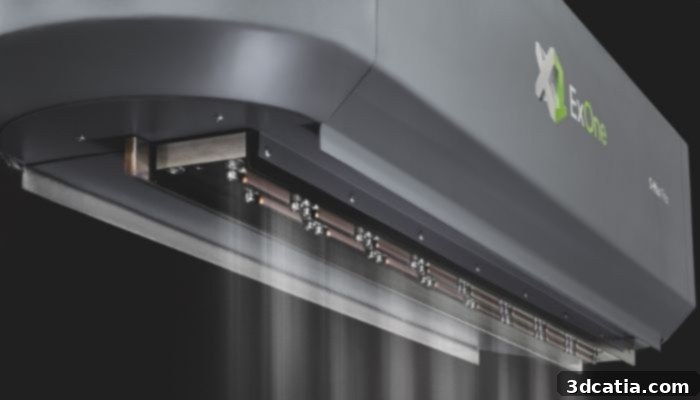
The S-Max Flex is more than just a new machine; it represents a significant leap forward in additive manufacturing accessibility and capability, particularly for the foundry industry. “As you’re aware, the S-Max Flex stands as ExOne’s latest innovation in additive robotic manufacturing 3D printers,” Eric Bader stated with enthusiasm. “What truly distinguishes this machine and makes it a game-changer is its remarkable combination of affordability, user-friendliness, and its consistent ability to produce high-quality parts with exceptional precision.” At its core, the system integrates a robust industrial robotic arm, meticulously engineered to carry an innovative printhead end effector. This printhead leverages Desktop Metal’s proprietary Single Pass Jetting (SPJ) technology, a revolutionary approach that facilitates impressive print speeds of up to 115 liters per hour. This speed not only boosts productivity but also makes the S-Max Flex a highly competitive solution for demanding production environments.
Explaining the mechanics behind this advanced technology, Bader elaborated, “The brilliance of Single Pass Jetting (SPJ) lies in its efficiency and precision. It orchestrates three distinct actions within each directional pass of the printhead: drop, spread, and print.” The process commences with the “drop” phase, where a precisely controlled amount of sand is released from the depositor trough. Following this, the “spread” step ensures that the sand is evenly distributed and flattened across the entire build table, creating a uniform layer for subsequent operations. Finally, during the “print” phase, the binder is precisely jetted onto the sand surface in predefined patterns, layer by layer, solidifying the intricate details of the desired part. “This technology was initially conceived and optimized by Desktop Metal as a method to achieve the fastest possible additive manufacturing of metal parts,” Bader revealed. “However, through the collaborative ingenuity and dedicated efforts of both Desktop Metal and ExOne, we have successfully adapted and integrated this cutting-edge SPJ technology into the S-Max Flex, specifically for rapid sand 3D printing. This strategic adaptation unlocks a vast array of new applications and market opportunities across numerous industries, bringing unparalleled speed and efficiency to sand-based additive processes.”
The impact of the S-Max Flex on the foundry industry is nothing short of revolutionary. For too long, the barrier to entry for binder jetting 3D printing machines has been prohibitively high, limiting access to only a select few, large-scale foundries capable of making such substantial capital investments. “The S-Max Flex, with its flexible robotic architecture and significantly reduced cost of ownership, fundamentally transforms this dynamic,” Bader emphasized. “It empowers foundries of all sizes, from small, agile operations to established industrial giants, to harness the power of this advanced technology, making it truly available to foundries around the world.” This accessibility fosters innovation, allowing more businesses to benefit from the speed, design freedom, and cost efficiencies of additive manufacturing. Indeed, it’s a testament to engineering excellence that the S-Max Flex emerges as a genuine innovation, meticulously crafted from the synergistic fusion of the best technological know-how and expertise contributed by both Desktop Metal and ExOne, setting a new benchmark for what’s achievable in sand 3D printing.
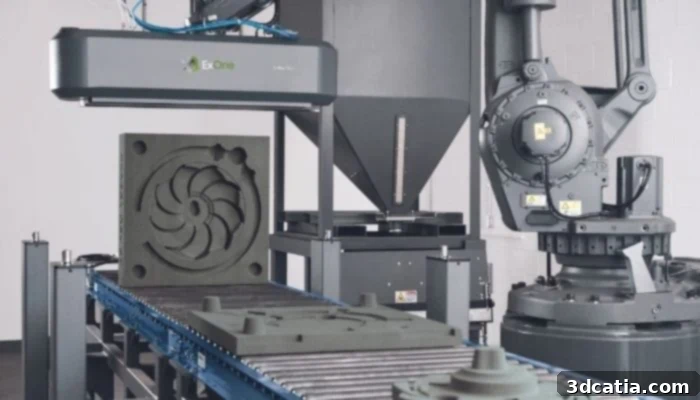
The S-Max Flex from ExOne
Synergies: Sand 3D Printing and Traditional Metal Casting & Beyond
Metal casting, a process dating back millennia, remains one of the foundational and most vital manufacturing techniques globally. It involves pouring molten metal into a pre-shaped cavity, allowing it to cool and solidify into a robust, finished part. This method is highly valued for producing strong metal components at a significantly lower cost compared to traditional machining processes, especially for complex geometries or large batch production. In today’s rapidly evolving industrial landscape, marked by increasing demand for customized parts and facing myriad global challenges, the imperative for foundries to maintain agility, embrace innovation, and prepare for a technologically advanced future has never been more critical. “By seamlessly integrating sand 3D printing into their operations, foundries and pattern shops gain a powerful competitive edge, enabling them to not only survive but truly thrive in this dynamic environment,” Bader asserted.
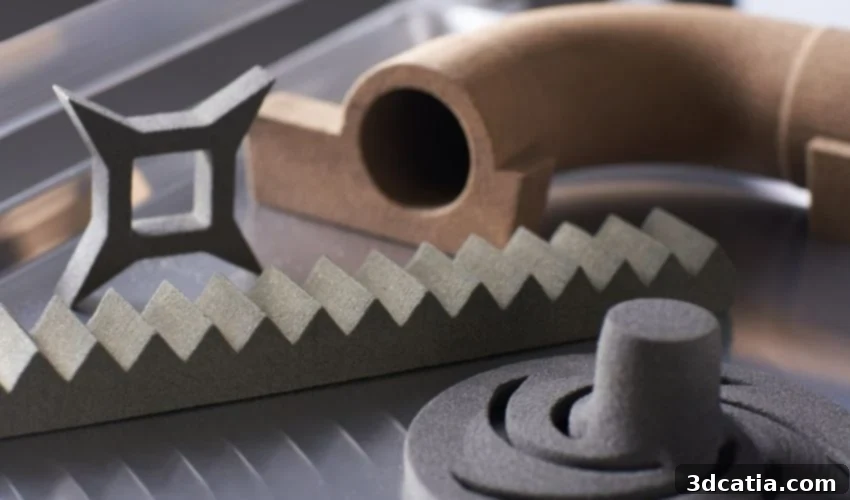
The question then arises: what makes sand 3D printing so transformative for this ancient craft? “The answer lies in its ability to empower foundries to create extraordinarily high-quality sand molds and cores, irrespective of their geometric complexity,” Bader explained. This capability entirely bypasses the need for conventional core production and assembly methods, which are typically fraught with labor-intensive steps, generate substantial scrap material, and introduce considerable complications into the manufacturing workflow. The elimination of these laborious stages translates directly into tangible benefits. With binder jetting, foundries can now produce cores that are not only more cost-effective but also possess superior precision, leading to a dramatic reduction in material waste and significantly faster turnaround times for finished parts. For instance, creating intricate internal channels or undercuts that would be extremely challenging and time-consuming with traditional methods becomes routine with 3D printing, enabling designers to optimize part performance and reduce material usage in the final metal component.
Furthermore, the utility of sand 3D printing extends far beyond its direct application in metal casting. The versatility of 3D printed sand opens doors to numerous other innovative applications. A prominent example is its use in innovative rapid tooling solutions. Here, 3D printed sand, often infiltrated with various resins or compounds to enhance its mechanical properties, serves as a highly efficient and cost-effective method for creating molds, dies, and fixtures. This is widely recognized as one of the quintessential applications for additive manufacturing in general, accelerating product development cycles across industries. Beyond industrial tooling, sand 3D printing also finds compelling uses in the creation of functional end-use designs. This includes diverse sectors such as consumer products, where intricate and customized designs can be brought to life, and architectural restoration, where complex, historically accurate components can be meticulously reproduced. A striking illustration of this versatility is the sustainable furniture developed by SANDHELDEN, an innovative company already utilizing ExOne’s advanced sand binder jetting solutions to produce aesthetically appealing and environmentally conscious products. These varied applications underscore the profound impact and adaptability of sand 3D printing in modern manufacturing and design.
The S-Max Flex at the German ExOne Adoption Center: Enhancing Capabilities
The strategic placement of the S-Max Flex 3D printer within the German ExOne Adoption Center (EAC) is a significant move that underscores ExOne’s commitment to customer education and technological advancement. “With the official installation of the S-Max Flex in our German ExOne Adoption Center (EAC), we will be able to proudly represent the full, comprehensive spectrum of our portfolio of sand binder jetting systems,” Bader articulated. This addition provides the EAC with unparalleled flexibility and substantially broadens its product range capabilities, particularly for the often-challenging task of printing with rough sands. Traditional sand printers can struggle with the varied particle sizes and characteristics of rough sand, leading to inconsistencies or slower print times. The S-Max Flex, with its advanced SPJ technology and robust robotic platform, is engineered to handle such materials efficiently, opening up new possibilities for foundries that utilize these more economical or specific types of sand.
The presence of the S-Max Flex in a dedicated adoption center is also crucial for customer engagement. “Many foundries, particularly those contemplating a significant investment in new technology, operate on a ‘see it to believe it’ basis,” Bader explained. “Once it is officially installed and fully operational in our EAC, we can offer our customers the invaluable opportunity to witness the machine in live action, observing its capabilities and output firsthand. Furthermore, we can provide in-depth explanations of the S-Max Flex’s operation during specialized training sessions conducted directly on the machine.” This hands-on experience and direct demonstration are vital for building trust and confidence among potential adopters, allowing them to understand the operational nuances, maintenance requirements, and the true production potential of the S-Max Flex within a controlled, expert-supported environment. It transforms theoretical understanding into practical application, accelerating the adoption of this cutting-edge technology.
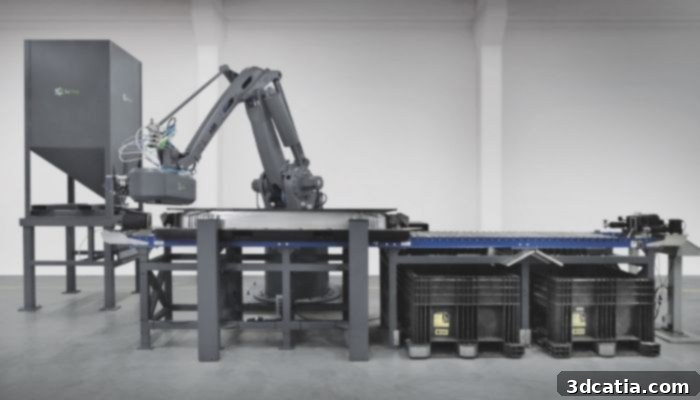
The full production line of the S-Max Flex
A Vision for the Future: Embracing Additive Manufacturing in Foundries
While metal 3D printing often captures the spotlight and generates numerous headlines, the equally transformative power of 3D printed sand frequently goes underappreciated. Yet, its contribution is profound. “3D printed sand is instrumental in enabling the creation of intricate and highly complex metal parts that fully leverage the myriad benefits of additive manufacturing, all while integrating seamlessly with a trusted and long-established production method: traditional casting,” Eric Bader highlighted in his concluding remarks. This synergy allows designers unparalleled freedom to conceive and realize organic geometries – shapes and forms that were previously impossible or prohibitively expensive to manufacture using conventional methods. These complex designs often translate into parts that operate with significantly enhanced efficiency, for instance, through optimized fluid flow channels, or achieve substantial weight reductions without compromising structural integrity, leading to improved performance in various applications, from aerospace to automotive.
Critically, these innovative designs can then be brought to life using the time-honored casting method, but with the crucial advantage of employing precision-engineered 3D printed sand tooling. This hybrid approach marries the best of both worlds: the design freedom and optimization of additive manufacturing with the proven reliability and material properties inherent in casting. When combined with other advanced analytical techniques, such as sophisticated flow analysis and solidification modeling, foundries gain unprecedented control over the casting process. These digital tools allow for the precise simulation of molten metal flow and solidification patterns, enabling engineers to predict and virtually eliminate common casting defects before any physical production begins. This predictive capability translates directly into the ability to achieve “done-in-one” high-quality pours, dramatically reducing scrap rates, minimizing costly rework, and ensuring unparalleled product consistency from the very first attempt.
The implementation of such advanced production systems also addresses pressing challenges faced by industries worldwide. “All this incredible innovation is underpinned by highly efficient production systems designed to operate relentlessly, 24/7,” Bader elaborated. Foundries, much like numerous other manufacturing sectors, are currently grappling with significant labor shortages and the increasing demand for skilled workers. In this context, 3D printing emerges as a supremely viable and strategic solution, empowering businesses to operate with enhanced efficiency, automate labor-intensive steps, and maintain agile, resilient supply chains in the face of market fluctuations and disruptions. “It is an incredibly exciting period to step into this next era of advanced manufacturing,” Bader concluded. “And here at ExOne, we are profoundly excited and committed to assisting companies globally in solving their most complex production challenges through the transformative power of 3D printing.” For those eager to explore further, comprehensive information about ExOne and the cutting-edge capabilities of the German ExOne Adoption Center is readily available HERE.
What are your thoughts on the groundbreaking launch of the S-Max Flex and its potential impact on the foundry industry? We invite you to share your insights and comments below, or engage with us on our Linkedin, Facebook, and Twitter pages! Don’t miss out on the latest advancements and news in the world of additive manufacturing; make sure to sign up for our free weekly Newsletter here, delivering the most current 3D printing insights straight to your inbox! Additionally, you can access all our informative videos and content on our dedicated YouTube channel.
*All Photo Credits: ExOne