

2020 3D Printing Trends: A Deep Dive into Additive Manufacturing’s Rapid Evolution
The landscape of global manufacturing is undergoing a profound transformation, significantly propelled by the remarkable advancements in additive manufacturing (AM). Offering crucial perspectives on this dynamic sector, the renowned online manufacturing service, 3D Hubs, recently unveiled its comprehensive 2020 3D printing trends report. This in-depth analysis not only meticulously chronicles the significant evolution of additive manufacturing over the past decade but also provides a clear, forward-looking assessment of where the AM market is unmistakably headed. Reflecting on the last ten years, it’s abundantly clear that the 3D printing market has matured dramatically, successfully transitioning from being primarily viewed as a prototyping technology to emerging as a robust and indispensable production technology. This pivotal shift has instigated numerous fundamental changes across the entire industry, impacting design, supply chains, and production methodologies globally. Specifically, 3D Hubs’ report highlights compelling statistics: there are now three times more professionals actively utilizing 3D printing solutions compared to just three years prior, underscoring a rapid and widespread adoption across diverse industries. Furthermore, the report forecasts an impressive average annual growth rate of 24% for the 3D printing market over the next five years, signaling a period of sustained and accelerated expansion that will undoubtedly reshape the future of production.
Unpacking the Core Drivers Behind Additive Manufacturing’s Explosive Growth
Naturally, one might inquire about the underlying forces that are propelling this remarkable growth within the 3D printing sector and the broader additive manufacturing industry. 3D Hubs’ extensive research meticulously pinpoints several critical drivers that are collectively fueling this rapid expansion. These include a heightened and increasingly sophisticated adoption of 3D printing for true serial production applications, a vibrant surge in entrepreneurship driven by the realization of innovative and complex applications, and a noticeable pivot by professionals towards leveraging the efficiencies, scalability, and diverse capabilities offered by online manufacturing platforms. At 3Dnatives, we also conducted our own retrospective, examining the key trends of 2019 that decisively shaped the world of AM. Our analysis unequivocally concurred with the overarching theme: the impressive proliferation of numerous 3D printing startups, many of which are now well-established, was impossible to overlook. Indeed, investment capital was generously flowing into the sector last year, evidenced by multiple successful funding rounds, each securing several million dollars and demonstrating significant investor confidence. The 3D Hubs report further corroborates this trend, revealing that in 2019 alone, 3D printing startups successfully raised an astounding sum exceeding $1.1 billion. This substantial influx of capital serves as a powerful testament to the growing confidence in, and perceived immense potential of, the additive manufacturing space.
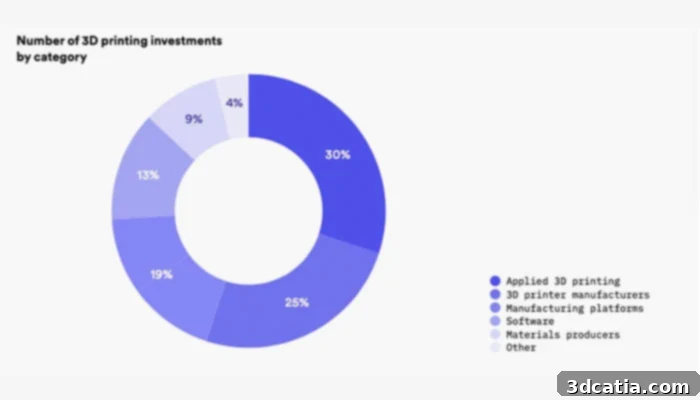
Image via 3D Hubs
The impressive list of companies attracting significant venture capital—such as Desktop Metal, renowned for its metal binder jetting technology aimed at high-volume production; Markforged, a pioneer in composite and metal 3D printing for strength and precision; Carbon, with its innovative Digital Light Synthesis (DLS) technology enabling rapid, mass customization; Xometry, a leading on-demand manufacturing marketplace that connects buyers with suppliers; and Relativity Space, which is revolutionizing aerospace manufacturing by 3D printing entire rockets—eloquently underscores venture capitalists’ profound and unwavering trust in both the underlying technology and the burgeoning market potential of additive manufacturing. A closer examination of these substantial investments reveals a crucial trend: a significant two-thirds of the 3D printing startups that successfully secured funding were, in fact, 3D printer manufacturers. This concentration of investment highlights the strategic importance placed on the development of more advanced, efficient, and diverse printing hardware as the foundation for market expansion. Looking at the global investment landscape, 3D printer manufacturers collectively captured a substantial 25% of the total investment, with funding predominantly centralized in the United States. This geographical concentration suggests that the US remains a formidable hotbed for innovation, research and development, and capital deployment within the AM sector. These substantial investments are, naturally, underpinned by the accelerating global adoption of 3D printing technologies across a multitude of industries. A comprehensive study delving into the market’s depth was previously published by EY in 2019, providing a foundational understanding of corporate adoption. The 3D Hubs report builds upon EY’s findings, further illuminating that the overall adoption of 3D printing has effectively tripled over the last three years. Indeed, of the 900 companies surveyed by EY, a significant 65% were already harnessing the power of 3D printing within their operations, while an additional 18% were actively considering its implementation for their specific applications in the very near future, indicating a strong and robust pipeline for continued growth and market penetration.
Segmented Growth: Metal AM Soars as Consumer Sector Navigates Challenges
A more granular analysis of the additive manufacturing industry reveals that not all segments are experiencing growth at the same pace or in the same manner. For instance, metal additive manufacturing has particularly distinguished itself, exhibiting a remarkably high growth trajectory when compared to other segments. This surge is largely attributable to metal 3D printing’s capacity to produce complex, high-performance parts for demanding applications in aerospace, automotive, and medical industries. It offers significant benefits such as lightweighting components, consolidating multiple parts into single, more efficient structures, and enabling customized geometries previously unattainable through traditional methods. These advantages translate into improved functionality, reduced material waste, and accelerated product development cycles. Conversely, the consumer sector, especially for small desktop 3D printers, has encountered notable challenges. Demand in this segment has not met initial expectations, grappling with issues such as the perceived complexity of use, limitations in material options compared to industrial counterparts, and the overall value proposition for general consumers who often seek simplicity and immediate gratification. In terms of market players and their distribution, 3D printer manufacturers still command the largest share, representing a substantial 38% of the overall market. However, they are closely trailed by online service providers, which account for a significant 34%. Critically, it is this latter segment—the online service providers—that is demonstrating the quickest growth, indicating a significant and accelerating shift in how manufacturing services are accessed, procured, and utilized by businesses and professionals worldwide.
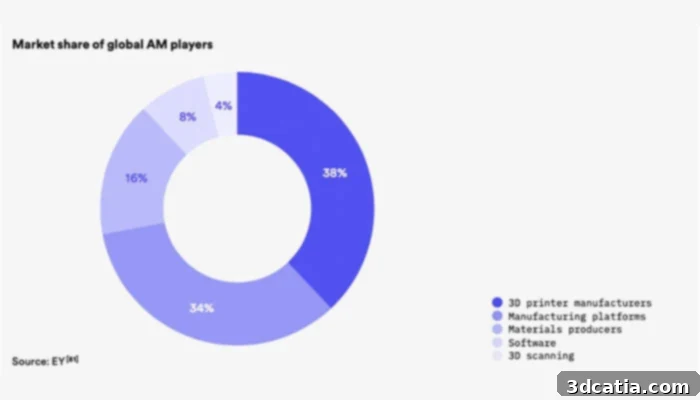
Image via 3D Hubs
The Ascendancy of Online 3D Printing Services: A New Paradigm for Manufacturing
As a prominent online 3D printing service provider itself, 3D Hubs possesses an intimate understanding of the intricate market dynamics and rapid proliferation within this particular segment. The company’s report therefore places a significant and well-deserved focus on dissecting the trends within online manufacturing services, offering valuable insights into its exponential growth. Their findings clearly indicate a growing and irreversible inclination among professionals to utilize online platforms for their diverse 3D printing needs. This extends well beyond merely quick prototyping, now encompassing sophisticated series production requirements and even complex, customized end-use parts. The allure of online platforms stems from their unparalleled accessibility, enabling companies of all sizes to tap into advanced manufacturing capabilities without prohibitive upfront costs. Furthermore, they offer remarkable cost-efficiency, the ability to scale production rapidly to meet fluctuating demands, and immediate access to a diverse range of technologies, materials, and expert knowledge without the need for significant capital investment in machinery or specialized staff. Geographically, North America and Europe stand out as the undisputed leaders in the adoption and demand for online 3D printing services, collectively representing an overwhelming majority – more than 95% – of the global demand. This dominance can be attributed to several factors, including advanced industrial bases, high levels of technological adoption, robust digital infrastructures, and a strong culture of innovation and agile manufacturing in these regions. Within the United States, the report highlights California as the epicenter of demand through the 3D Hubs platform, with metropolitan areas like Los Angeles and San Diego emerging as particularly substantial drivers. This regional concentration likely reflects California’s status as a global hub for technology, design, and innovation, fostering industries (from entertainment to aerospace) that are early and extensive adopters of advanced manufacturing techniques.
Image via 3D Hubs
Industry Adoption Patterns and the Continued Dominance of FDM Technology
Delving deeper into specific industries, the 3D Hubs report reveals distinct and fascinating patterns of adoption for additive manufacturing across various sectors. Over 65% of the demand for 3D printing services originates from professional users engaged in the development and production of Industrial, Electrical, or Consumer Goods. These sectors frequently benefit immensely from the rapid prototyping capabilities, unprecedented design flexibility, and high degree of customizability offered by 3D printing, enabling faster product iterations, streamlined design validation, and highly personalized solutions for end-users. The inherent ability to produce complex geometries and functional parts on-demand also significantly reduces lead times and inventory costs, making AM a highly attractive and economically viable solution for these industries seeking competitive advantages. In stark contrast, professionals operating within the highly regulated and specialized Aerospace, Automotive, and Medical industries tend to demonstrate a pronounced preference for producing parts in-house or relying on established, traditional supply chains for outsourcing. This preference is largely driven by stringent certification requirements, the imperative need for high-volume production with proven and validated materials, and critical quality control standards that are often easier to manage within vertically integrated operations or with long-standing, deeply trusted suppliers. While additive manufacturing is undoubtedly making significant inroads into these sectors, particularly for highly specialized, low-volume, or non-critical parts, widespread adoption for critical, high-volume components still faces substantial regulatory and validation hurdles. Finally, when examining the prevailing technologies utilized, Fused Deposition Modeling (FDM) continues to hold its position as the most widely utilized process for manufacturing parts. It corresponds to approximately two-thirds of the total demand, a testament to its accessibility, cost-effectiveness, material versatility (especially with plastics), and relative ease of use for a broad range of applications, from functional prototypes and tooling to end-use parts.
The Future of Additive Manufacturing: Decisively Beyond Prototyping
The overarching narrative emanating from the 3D Hubs 2020 report is undeniably one of a market rapidly maturing and moving decisively beyond its origins as a mere prototyping tool. The transition of additive manufacturing to a genuine production technology signals a fundamental paradigm shift, unlocking unprecedented opportunities for innovation, efficiency, and highly customized manufacturing across a myriad of industries. This maturity reflects advancements in hardware, software, materials, and post-processing, making AM a viable solution for demanding applications. As we look towards the future, the anticipation builds for the emergence of new, transformative applications that will further challenge conventional manufacturing paradigms, as well as innovative market players poised to capitalize on these evolving trends and carve out new niches. The year 2020 and beyond are set to witness continuous advancements in material science, improved printer capabilities (including speed and precision), and the seamless integration of additive manufacturing into broader digital workflows, making it an indispensable component of Industry 4.0. This increasing maturity translates into more robust solutions, greater reliability, and an expanding ecosystem of hardware, software, and services tailored specifically to industrial production requirements. For those seeking a deeper dive into these transformative trends, detailed analytics, and comprehensive market data, the full report is available for further information HERE.
What are your thoughts on the dynamic evolution of the 3D printing market? Do you foresee even greater shifts in the coming years, perhaps driven by new material breakthroughs or advancements in artificial intelligence? We invite you to share your perspectives and engage in the discussion in the comments section below or join the conversation on our Facebook and Twitter pages! Don’t miss out on the very latest developments, breakthrough innovations, and essential news in additive manufacturing – remember to sign up for our free weekly Newsletter, delivering all the critical updates straight to your inbox!