
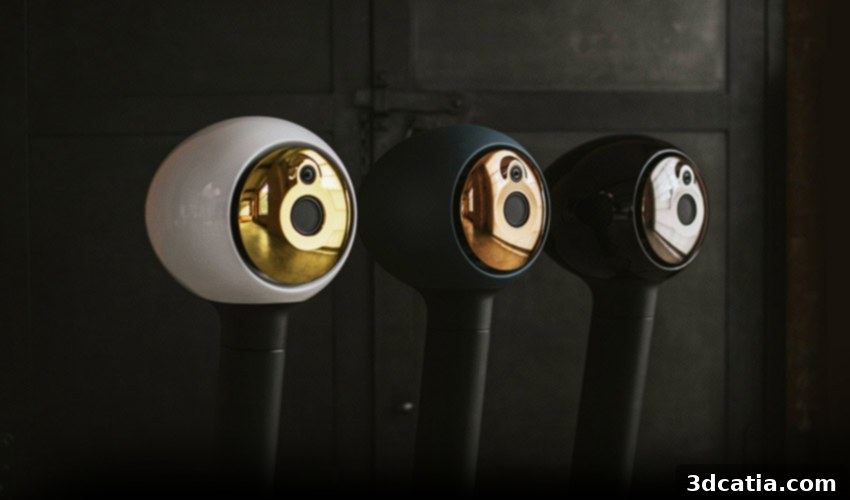
Revolutionizing High-End Audio: The HYLIXA 3D Printed Loudspeaker by Node Audio
In the dynamic world of high-fidelity audio, innovation is key, and Node Audio, a forward-thinking company, has truly pushed the boundaries with its groundbreaking HYLIXA loudspeaker. This remarkable audio device stands as a testament to the power of advanced manufacturing, specifically leveraging Selective Laser Sintering (SLS) 3D printing technology. Unlike conventional speakers that are often constrained by traditional manufacturing methods, the HYLIXA boasts a profoundly distinctive structure and an acoustic performance that defies its compact size. From its striking aesthetics to its unparalleled sound delivery, the HYLIXA challenges preconceived notions of what a loudspeaker can be.
Node Audio set out to achieve an ambitious goal: to create a loudspeaker that delivers the expansive, rich, and detailed performance typically associated with much larger, “box-type” speakers, but within a significantly smaller and more visually appealing form factor. This seemingly contradictory objective was made possible by embracing additive manufacturing. By relying on SLS 3D printing, Node Audio was able to design and construct a speaker cabinet with internal geometries and structural complexities that would be utterly impossible to achieve using injection molding, CNC machining, or traditional woodworking techniques. This freedom in design allowed them to meticulously optimize every internal component and acoustic pathway, resulting in a speaker that is as much a piece of art as it is a pinnacle of audio engineering.
The innovative design of the HYLIXA loudspeaker is the brainchild of industrial designers Ashley May and David Evans. Their vision led them to select a 3D Systems SLS machine for its precision and capability to build intricate, layer-by-layer structures. Selective Laser Sintering operates on the principle of using a powerful laser to selectively fuse powdered material, typically plastic or metal, in successive layers. This process allows for the creation of incredibly complex shapes, geometries, and internal features that are simply unattainable through conventional manufacturing. For instance, designers can integrate intricate internal bracing, non-parallel walls to mitigate standing waves, and optimized waveguides directly into the speaker cabinet’s structure, all of which are crucial for superior acoustic performance.
The resulting form of the HYLIXA is strikingly organic, characterized by a smooth, fluid aesthetic that culminates in a distinctive “head” at the top of the device. This organic shape is not merely for visual appeal; it is fundamentally integral to the speaker’s acoustic properties, helping to minimize internal reflections and resonances. Beyond the aesthetic and structural design, May and Evans recognized the critical role of scientific acoustic principles. They enlisted the expertise of an acoustic engineer early in the development process to guide the technical aspects of these pioneering 3D printed speakers. This collaborative approach ensured that every design choice, from material selection to internal geometry, was rigorously optimized for sonic excellence, harmonizing industrial design with advanced acoustic science.

Image via 3DSystems
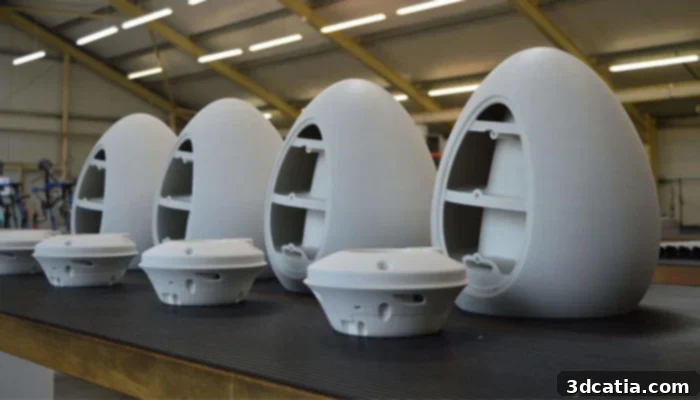
The manufacturing process for the HYLIXA speakers showcases the true versatility and efficiency of SLS 3D printing. Each speaker is individually printed within the substantial build volume of the 3D printer, measuring 381 x 330 x 460 mm. David Evans elaborated on a clever strategy employed to maximize this build volume and optimize production: they ingeniously 3D printed components inside one another. This technique, known as “nesting,” means that various parts of the speaker system, or even multiple speaker units, can be packed tightly within the printer’s chamber during a single print run. This not only significantly reduces material waste but also enhances production efficiency and lowers manufacturing costs, demonstrating smart application of additive manufacturing principles.
Regarding the choice of material, Evans shared crucial insights gained through extensive prototyping: “We learned through the prototyping process that DuraForm GF (a glass-filled engineering plastic) actually worked very well acoustically. It has almost a ceramic-like quality to the touch, which helped us both structurally and sonically. As designers, we could freely exploit SLS production to create the internal structure, but also design something that looked as beautiful as it sounds.” This choice of DuraForm GF was far from arbitrary. Glass-filled engineering plastics are renowned for their enhanced stiffness, strength, and thermal stability compared to unfilled polymers. The “ceramic-like quality” mentioned by Evans points to the material’s excellent damping characteristics and rigidity, which are paramount for speaker enclosures. A stiff, inert enclosure minimizes unwanted vibrations and resonances that can color the sound, ensuring that the drivers’ output is pure and unadulterated. This material property directly translates into superior sonic clarity, tighter bass response, and more accurate sound reproduction. The ability of SLS to handle such advanced materials, combined with the design freedom it offers, empowered Node Audio to perfect both the intricate internal acoustic pathways and the sleek, visually captivating exterior of the HYLIXA.
The application of 3D printing technologies in speaker manufacturing is steadily gaining traction, and the HYLIXA is a shining example of this burgeoning trend. It’s not the first instance of additive manufacturing being employed to redefine audio experiences; indeed, the previous year saw the emergence of DEEPTIME, a Prague-based company that garnered attention for its speakers 3D printed from sand. While DEEPTIME utilized a different material, the underlying philosophy was remarkably similar: to harness additive manufacturing to produce unique, exclusive audio systems that depart significantly in looks, feel, and sound from traditional speakers. These innovations signal a pivotal shift in the audio industry, moving away from mass-produced, standardized designs towards highly customized, performance-optimized, and aesthetically diverse products made possible by the unparalleled design freedom of 3D printing.
The integration of advanced manufacturing techniques like SLS allows companies to rapidly iterate designs, test various acoustic geometries, and bring highly specialized products to market with unprecedented speed and efficiency. This empowers designers and engineers to overcome the limitations of conventional manufacturing, enabling them to create speaker cabinets with complex internal structures that actively enhance sound quality by controlling resonances, optimizing airflow, and perfecting driver integration. The result is a new generation of loudspeakers that not only offer superior acoustic performance but also stand out as unique sculptural pieces, appealing to both audiophiles and design enthusiasts. We are incredibly excited to witness the continued developments and future breakthroughs in this fascinating intersection of additive manufacturing and high-end audio. For those eager to delve deeper into the specifics of the HYLIXA loudspeaker and Node Audio’s innovative approach, more detailed information can be found HERE.
What are your thoughts on the HYLIXA 3D printed speaker and the broader implications of additive manufacturing for the future of high-fidelity audio? We invite you to share your insights and engage in the conversation by leaving a comment below or joining us on our official Facebook and Twitter pages! Don’t forget to sign up for our complimentary weekly Newsletter to receive all the latest news, trends, and innovations in 3D printing delivered directly to your inbox!