
Weekly 3D Printing Showcase: Top 5 Videos Exploring Industry Innovations, Trends, and Critical Discussions
Welcome back to another exciting Sunday digest, where we bring you the week’s most compelling and informative 3D printing videos! This edition is packed with groundbreaking applications and crucial discussions that highlight the ever-evolving landscape of additive manufacturing. Join us as we take an exclusive Inside 3D Tour of XJet’s cutting-edge headquarters, explore how additive manufacturing is playing a vital role in paleontology to preserve prehistoric species, witness the world’s largest 3D printer in action building rockets, delve into the anticipated 3D printing trends for 2023, and engage in a thought-provoking discussion on the regulations surrounding 3D printed guns in America. Stay informed about the newest events, technological breakthroughs, and significant debates shaping the world of 3D printing. Happy Sunday, and we sincerely hope you enjoy this curated selection!
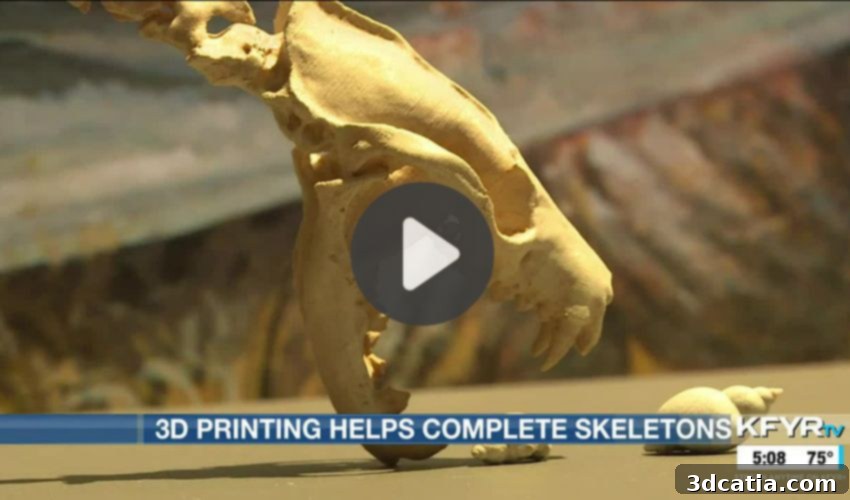
Top 1: Palaeontologists Use 3D Printing to Reconstruct Ancient Bear Skeleton
Palaeontology, one of the oldest and most fascinating sciences dedicated to studying prehistoric life, is undergoing a remarkable transformation thanks to 3D printing technology. Specifically, at institutions like the palaeontology library at the Heritage Center, additive manufacturing is now being utilized to meticulously reconstruct and complete animal skeleton specimens. This innovative approach offers significant advantages over traditional methods, such as manual sculpting with clay by artists, proving to be far more cost-effective, time-efficient, and accurate. The ability to scan existing bone fragments and digitally design missing pieces allows for precise replication, ensuring scientific integrity and anatomical correctness. These 3D printed components can then be seamlessly integrated into existing fossil structures, bringing ancient creatures back to life for study and public display.
A prime example of this pioneering work is the first partially 3D printed specimen now on display: a dawn bear. This ancient species, roughly the size of a modern-day raccoon, was previously only known from specimens discovered in southwestern North Dakota. The successful reconstruction using 3D printing not only provides a more complete visual representation of this rare animal but also offers invaluable insights for researchers. It allows paleontologists to study the animal’s morphology, posture, and potential behaviors in a way that was previously impossible with incomplete remains. Furthermore, the creation of durable, lightweight replicas means that delicate original fossils can be preserved, while the printed versions can be handled, studied, and exhibited without risk. This technology truly opens up new frontiers for scientific research, museum exhibits, and educational outreach in the field of paleontology. Watch the video to delve deeper into this incredible application!
Top 2: 3Dnatives Explores XJet’s Headquarters and Nano Particle Jetting Technology
Our journey into the forefront of additive manufacturing continues as the 3Dnatives’ team embarked on another insightful “Inside 3D Tour,” this time visiting the esteemed headquarters of XJet in Rehovot, Israel. This comprehensive visit included an in-depth look at their state-of-the-art additive manufacturing facility, providing a rare glimpse into the operations of a true industry innovator. Upon arrival, we were warmly welcomed by Yair Alcobi, the accomplished CEO of XJet, who graciously shared his perspectives on the company’s current standing, its strategic vision, and the key objectives driving its remarkable growth. Alcobi emphasized XJet’s commitment to pushing the boundaries of what’s possible with industrial 3D printing, particularly in high-precision applications.
Further enriching our understanding, we had the privilege of speaking with Hanan Gothait, the visionary President & Founder of XJet. Gothait provided an illuminating explanation of XJet’s proprietary and patented Nano Particle Jetting (NPJ) technology. He detailed how NPJ distinguishes itself by jetting liquid suspensions containing ceramic or metal nanoparticles, rather than powder or filament, allowing for the creation of incredibly fine features, smooth surfaces, and isotropic properties that are often challenging to achieve with other additive manufacturing methods. This unique process enables the production of complex geometries with exceptional detail and material integrity, opening doors to a multitude of demanding industrial applications.
To cap off our illuminating visit, we sat down for an engaging interview with Guy Zimmerman, Business & Marketing Executive at XJet. Zimmerman guided us through the company’s advanced manufacturing plant, showcasing their diverse range of solutions and highlighting some of the most outstanding applications of NPJ technology. From intricate medical devices and specialized aerospace components to high-performance tooling and custom industrial parts, XJet’s technology is demonstrating its versatility and reliability across critical sectors. The visit underscored XJet’s position as a leader in delivering superior part quality and enabling new levels of design freedom for engineers and manufacturers worldwide, promising a significant impact on various high-value industries. Discover more about their innovative technology and applications by watching the full video!
Top 3: U.S. Senators Address the Growing Dangers of Untraceable 3D Printed Guns
In a critical discussion that underscores the intersection of rapidly evolving technology and public safety, Senator Edward Markey (D-MA) and Representative Jared Moskowitz (D-FL) recently joined MSNBC reporter Andrea Mitchell to address the escalating concerns surrounding 3D printed guns. The lawmakers detailed their proposed legislation aimed at criminalizing the online posting, sharing, and downloading of “do it yourself” blueprints and instructions for 3D printers to create firearms or firearm accessories. This legislative initiative highlights the urgent need for a regulatory framework to contend with the unique and severe threats posed by these 3D printed weapons.
The potential dangers associated with 3D printed guns are manifold and represent a significant challenge to existing gun control measures. Firstly, a major concern is their inherent untraceability; these firearms often lack serial numbers, earning them the moniker “ghost guns,” which makes them virtually impossible for law enforcement to track if used in crimes. Secondly, the barrier to entry for acquiring a functional firearm has dramatically lowered. With an investment as modest as $200, an individual can purchase a 3D printer capable of producing components for a viable weapon, transforming a hobbyist tool into a potential instrument of harm. Furthermore, the material composition of some 3D printed guns, particularly those made predominantly from plastic, raises alarm bells about their detectability; they can potentially bypass standard metal detectors, posing a severe security risk in public spaces and during inspections.
Perhaps most critically, 3D printed guns are easily accessible to individuals who would ordinarily fail background checks due to criminal records, domestic violence orders, or other prohibiting factors. This circumvents established legal mechanisms designed to keep firearms out of the hands of dangerous individuals. Senator Markey powerfully emphasized that “ghost guns” represent an emerging and evolving threat, with unknown possibilities as 3D printing technology continues to advance and become more sophisticated. Representative Moskowitz echoed this sentiment, stressing the imperative for proactive legislative measures to address this rapidly changing landscape before the problem becomes unmanageable. The discussion highlights a vital debate on balancing technological freedom with the paramount need for public safety in the digital age. Watch the insightful video for the full debate.
Top 4: Relativity Space Pushes Boundaries with the World’s Largest 3D Printer for Rocket Production
Innovation in space exploration is being redefined by Relativity Space, a pioneering company that has ingeniously integrated additive manufacturing into the core of its rocket production process. Tim Ellis, the visionary CEO of Relativity Space, passionately underscores the transformative significance of 3D printing in their ambitious rocket development endeavors. Their groundbreaking approach leverages colossal, custom-built 3D printers, famously known as “Stargate” machines, which are capable of printing entire rocket structures from specialized aluminum alloys and other advanced materials.
The company’s initial launch vehicle, the Terran 1, stood as a monumental testament to this technology, being predominantly 3D printed. A staggering 85% of the rocket, including its engines and major structural components, was fabricated using their proprietary large-scale 3D printers. While specific elements such as sensitive electronics and critical seals still required traditional manufacturing methods, the vast majority of the rocket benefited immensely from additive manufacturing. This allowed for unparalleled speed in design iterations, rapid prototyping, and efficient data acquisition, significantly reducing lead times and manufacturing complexities compared to conventional rocket assembly lines. The ability to print complex geometries in a single piece also reduces part count, assembly time, and potential failure points.
Although the maiden launch of the Terran 1 did not achieve orbit, it provided invaluable data and served as a crucial stepping stone for Relativity Space’s next, even more ambitious undertaking: the construction of the larger, fully reusable Terran R Rocket. The Terran R is designed for multiple missions, further emphasizing the economic and logistical advantages of 3D printing in creating robust, repeatable, and cost-effective space launch solutions. Ellis also articulated his bold, long-term vision of leveraging this advanced 3D printing capability to establish a self-sustaining presence on Mars. Drawing clear inspiration from the ambitious missions of companies like SpaceX, Relativity Space aims to utilize on-site 3D printing for constructing habitats, tools, and infrastructure on other planets, fundamentally altering the future of off-world colonization. Check out more details on this incredible journey in the video below!
Top 5: Decoding the Key 3D Printing Trends Driving Additive Manufacturing in 2023
As the additive manufacturing (AM) industry continues its rapid expansion, understanding the key drivers shaping its future is crucial for businesses and enthusiasts alike. According to Materialise, a leading 3D printing company, four pivotal trends significantly propelled additive manufacturing forward in 2023, setting the stage for even greater adoption and innovation. These trends are not merely incremental changes but represent fundamental shifts that will allow companies to scale up their 3D printing operations and promote wider industrial integration. Delving into these trends provides a clear roadmap for the continued growth and impact of AM.
The first key trend is the **rise of smart, distributed manufacturing**. This paradigm shift moves away from centralized production hubs towards a more decentralized model, where manufacturing can occur closer to the point of need. Enabled by digital workflows and advanced connectivity, distributed manufacturing allows for localized supply chains, on-demand production, and greater resilience against global disruptions. Smart factories, integrated with IoT sensors and AI-driven analytics, optimize production processes, ensuring efficiency and flexibility across a network of interconnected 3D printers. This approach not only reduces logistics costs but also fosters greater customization and responsiveness to market demands.
Secondly, a relentless **focus on cost reduction** remained a central theme. While early additive manufacturing was often perceived as expensive, 2023 saw concerted efforts to make it more economically viable for mass production. This includes advancements in material science, leading to more affordable and high-performance resins and powders. Furthermore, innovations in printer design have resulted in faster print speeds, greater energy efficiency, and reduced post-processing requirements, all contributing to lower per-part costs. As competition in the AM market intensifies, the drive for cost-effectiveness will continue to accelerate, making 3D printing a more attractive alternative to traditional manufacturing methods.
The third significant trend is a profound **shift from process to workflow automation**. Beyond merely automating individual print jobs, the industry moved towards streamlining the entire AM pipeline—from initial design and material selection to printing, post-processing, quality control, and even final assembly. This involves sophisticated software integration, robotic handling, and AI-powered decision-making tools that minimize manual intervention and human error. By automating the end-to-end workflow, companies can achieve higher throughput, improve consistency, and reduce labor costs, thereby making 3D printing a more reliable and scalable solution for industrial applications.
Finally, **increased emphasis on data security and integrity** emerged as a critical concern. As 3D printing becomes more integrated into sensitive supply chains and produces high-value parts, protecting intellectual property, securing digital design files, and ensuring the integrity of print data are paramount. This trend encompasses robust cybersecurity measures to prevent unauthorized access and manipulation of blueprints, as well as blockchain technologies to ensure traceability and authenticity of printed parts. Maintaining data integrity throughout the entire additive manufacturing process is essential for building trust, meeting regulatory compliance, and protecting against counterfeiting, particularly in sectors like aerospace, defense, and medical devices. Watch the video below for more detailed insights into these transformative trends:
We hope you enjoyed this week’s dive into the fascinating world of 3D printing! What are your thoughts on these latest innovations and critical discussions, from the Inside 3D Tour series to the future of additive manufacturing? Share your insights and perspectives in a comment below or connect with us on our LinkedIn, Facebook, and Twitter pages! Don’t forget to sign up for our free weekly Newsletter here to get the latest 3D printing news delivered straight to your inbox. You can also find all our compelling video content on our YouTube channel, where new discoveries await every week.
*Cover photo credits: First News at Five