
Unlocking the Future of Construction: COBOD’s Vision for Automated 3D Concrete Printing
The global construction sector stands at the precipice of a monumental transformation, largely driven by the advent of robotic 3D printers capable of fabricating concrete buildings with unprecedented speed and efficiency. What was once considered a futuristic concept is now a tangible reality, with these advanced machines significantly accelerating building timelines from months to mere hours for structural elements. While a common misconception suggests that concrete 3D printers can construct an entire building in one go, it’s essential to clarify that their primary role is in creating the structural components, specifically the robust walls of a building. This specialized form of additive manufacturing is rapidly gaining traction, with a growing number of innovative companies dedicating their efforts to pushing its boundaries. Prominent players in this evolving landscape include industry pioneers like Apis Cor, WASP, and Be More 3D, alongside many others who are redefining traditional construction methodologies.
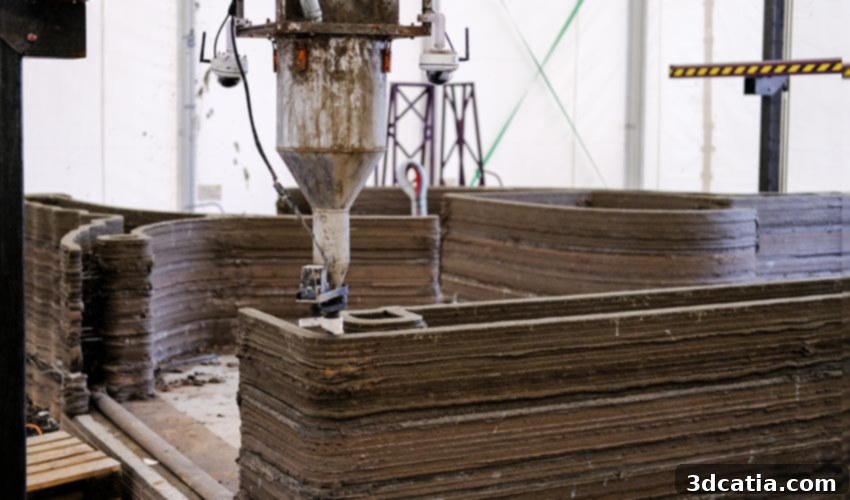
Among these visionary enterprises, COBOD, a Danish-based company, has emerged as a leader in the specialized field of 3D printed building construction. With a clear and ambitious mission, COBOD aims to spearhead the complete automation of the construction industry, fundamentally changing how structures are designed and built. Their commitment to this mission was strikingly demonstrated at the renowned Bautec construction exhibition not long ago. In a remarkable collaboration with PERI, a global leader in formwork and scaffolding, COBOD showcased its technology by 3D printing the walls of a small house every single day of the exhibition. Over the course of the four-day event, COBOD successfully 3D printed four distinct small houses, each featuring an impressive 64 m² of intricately printed wall structures. To gain deeper insights into COBOD’s cutting-edge technology and expansive activities, we had the privilege of speaking with Asger Almegaard Dath from COBOD.
3DN: Can you introduce yourself and elaborate on your journey and relationship with 3D printing?
My name is Asger, and my journey with 3D printing began almost eight years ago. At that time, two of my current co-founders and I shared a common vision: to democratize access to 3D printing technology. We believed that this groundbreaking technology should not be confined to academic institutions or specialized industrial labs but should be available to everyone. It was this conviction that led us to establish a 3D printing service business. Our initial goal was to provide widespread access to 3D printing for various applications, catering to diverse needs. Not long after, we forged a crucial partnership with our current CEO, a development that marked a significant turning point for our venture. This collaboration enabled us to expand our operations beyond just providing printing services; we ventured into selling and distributing 3D printing equipment directly. Concurrently, we continued to broaden the scope and capabilities of our print service offerings. The strategic intent behind this expansion was multifaceted: to firmly establish our presence in the nascent 3D printing market, to cultivate a robust market position, and crucially, to leverage that position as a launchpad for developing and implementing innovative new ideas, particularly within the construction domain.

Asger Almegaard Dath
3DN: What was the primary motivation behind your decision to establish COBOD?
COBOD was founded with a very specific and ambitious goal: to develop cutting-edge 3D construction printing machines that would revolutionize the building industry. The initial spark for this venture ignited after we completed an extensive and insightful study, conducted in close cooperation with some of the largest and most influential construction companies and leading material specialists in our country. This collaborative research effort was designed to rigorously test and prove the viability and practical application of 3D construction printing. Upon successfully demonstrating the immense potential of this technology, our next logical step was to bring it to life and showcase its capabilities to the world. We achieved this monumental feat by 3D printing the first building in Europe, an innovative structure famously known as The BOD (Building On Demand). The response to The BOD project was truly overwhelming; we were genuinely surprised by the sheer volume of press coverage and public interest it garnered globally. This incredible reception, coupled with the undeniable proof of concept, solidified our conviction that 3D construction printing was not just a niche technology but a burgeoning industry with massive potential. It was this profound interest and the evident demand that ultimately propelled us to formally create and establish COBOD as a dedicated entity, committed to advancing the frontier of automated construction.
3DN: Could you delve deeper into the core technology that powers COBOD’s operations?
The fundamental technology underpinning our 3D construction printers, particularly our flagship BOD2 machine, is rooted in the same core principles as conventional desktop Fused Filament Fabrication (FFF) 3D printing. However, the critical distinctions lie in the scale of the operation, the robust materials employed, and the specialized engineering required for large-format construction. Our BOD2 machine is ingeniously engineered around a modular gantry system. This modular design offers unparalleled flexibility, allowing our customers to custom-configure the printer size precisely to the dimensions and scope of their specific construction project, whether it’s a small residential unit or a larger commercial structure. Beyond the printer itself, a vital component of our system is the integrated mixer-pump. This unit is responsible for meticulously blending dry concrete with the exact required amount of water, ensuring optimal consistency and workability of the material. Once mixed, this specialized concrete is then efficiently pumped through a robust hose directly to the printhead hopper. The printhead, the final point of extrusion, then precisely deposits the concrete layer by layer, meticulously following the intricate digital 3D drawings of the building.
Numerous advanced features distinguish the BOD2 from both standard desktop 3D printers and its competitors in the construction printing space. Our sophisticated printhead is equipped with an array of integrated sensors for precise leveling, ensuring a consistent and accurate build surface throughout the printing process. It also incorporates sensors for real-time material status monitoring, preventing interruptions and ensuring a continuous flow of concrete. Video cameras are strategically placed for live monitoring, allowing operators to oversee the printing process remotely and identify any potential issues instantly. A particularly innovative feature is the tangential nozzle, which is designed to enable exceptionally smooth wall finishes, even when printing complex curves or intricate architectural designs. This capability significantly reduces the need for extensive post-processing and improves the aesthetic quality of the printed structures. Furthermore, the BOD2 boasts an outstanding print speed, capable of reaching up to 100 cm/s. This exceptional velocity dramatically accelerates construction timelines, making it possible to complete structural components in a fraction of the time required by traditional methods, significantly boosting productivity and reducing labor costs on site.
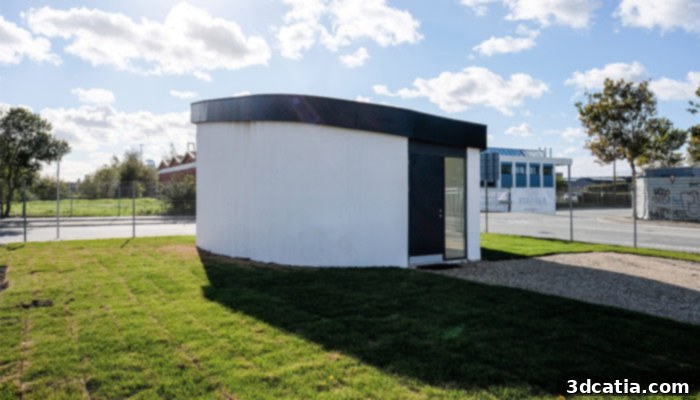
The BOD was Europe’s first 3D printed building, and what led the founders to create COBOD
3DN: Who typically constitutes your client base, and how are they leveraging your technology?
Our client base is incredibly diverse and spans across various sectors, primarily encompassing leading construction companies, prestigious universities, and pioneering research institutions situated across the globe. These organizations utilize our state-of-the-art technology for two main, yet distinct, strategic purposes. Firstly, many of our clients are at the forefront of architectural innovation, employing our 3D printers to realize highly unique and complex architectural designs that would be either prohibitively expensive, time-consuming, or outright impossible to construct using conventional building methods. The design freedom offered by 3D construction printing unlocks new possibilities for creative and sustainable building forms. Secondly, a significant portion of our clients, particularly universities and research institutions, are deeply engaged in exploring and advancing the frontiers of construction. They leverage our technology for intensive research into novel materials suitable for 3D printing, experimenting with new building methods, and assessing the structural integrity and performance of 3D printed components.
Looking ahead, we anticipate a significant shift in our client landscape, with a growing number of customers likely to deploy our solutions for large-scale, low-cost housing projects. The speed, efficiency, and reduced labor requirements of 3D construction printing make it an ideal solution for addressing global housing shortages and providing affordable, quality homes rapidly. Beyond these core segments, we are also actively collaborating with other specific industries, where our technology provides unique advantages. While we are unable to disclose the details of these particular collaborations at this time due to confidentiality agreements, these engagements further underscore the versatility and transformative potential of 3D construction printing across a wide array of specialized applications, potentially ranging from infrastructure projects to defense and disaster relief initiatives. The broad applicability of our technology positions COBOD as a crucial partner in the future of automated and sustainable construction worldwide.
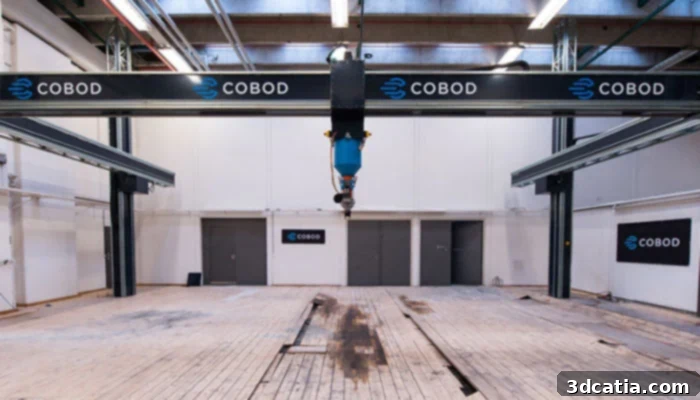
COBOD’s 3D printer: the BOD2. In March 2019, COBOD sold one of its construction printer to Saudi Arabia.
3DN: Projecting ten years into the future, what is your vision for COBOD?
In the next ten years, we envision COBOD’s equipment evolving dramatically to achieve even higher levels of automation across the entire construction process. Our goal is to move beyond just printing walls to integrating robotics for other building tasks, ultimately creating fully autonomous construction sites where human intervention is minimized. We foresee our technology enabling not just faster and more efficient building, but also fostering a safer work environment by taking over hazardous tasks. Furthermore, a key aspect of our future vision is to entirely eliminate size boundaries in 3D construction printing. This means developing machines capable of constructing structures of virtually any scale, from multi-story residential buildings and vast industrial complexes to large-scale infrastructure projects like bridges and wind turbine bases. The ambition is to unlock unprecedented design freedom and construction capability, making COBOD a pivotal force in shaping the built environment of tomorrow. This future will be characterized by highly flexible, on-demand construction, tailored to meet diverse global needs with sustainable and resource-efficient practices.
COBOD’s journey from a service business to a pioneering force in automated construction printing highlights the rapid evolution and immense potential of additive manufacturing in reshaping our built world. Their commitment to innovation, from the modular design of the BOD2 to its advanced printhead features, positions them at the forefront of a construction revolution. The ability to print complex structures with speed and precision, coupled with a vision for eliminating size constraints and achieving full automation, suggests a future where sustainable, efficient, and affordable construction is accessible globally. As the industry continues to embrace digital fabrication, companies like COBOD are not just building houses; they are laying the foundation for a more automated, flexible, and sustainable future for all.
What are your thoughts on COBOD’s vision and the future of 3D construction printing? Share your insights in a comment below or engage with us on our Facebook and Twitter pages! Don’t miss out on the latest advancements and news in 3D printing; sign up for our free weekly Newsletter and have all the breaking stories delivered straight to your inbox!