

Polypropylene 3D Printing: Unlocking the Versatility and Potential of a Challenging Material
The landscape of additive manufacturing is continuously expanding, driven by an impressive array of materials ranging from plastics and metals to ceramics and even concrete. Within the vast family of polymers, thermoplastics offer a spectrum of properties and printability, from incredibly user-friendly options to those demanding more meticulous process control. Among these, polypropylene (PP) stands out. As a semi-crystalline material and a member of the polyolefin family (also known as polyalkenes), PP boasts a compelling blend of characteristics that make it highly attractive for industrial applications. Its lightness, exceptional resistance to chemicals and fatigue, and superior electrical insulation properties have made it a staple in the plastic injection molding industry. However, its adoption in the 3D printing market has historically been limited due to specific processing challenges. Achieving successful PP prints requires rigorous control over thermal conditions and particular attention to material adhesion, both to the build plate and between printed layers.
Understanding Polypropylene: A Semi-Crystalline Polymer
Polypropylene’s unique characteristics stem from its classification as a semi-crystalline thermoplastic. Unlike amorphous materials that gradually soften across a temperature range, semi-crystalline polymers like PP possess an ordered molecular structure, leading to very precise melting points. This inherent molecular organization significantly influences its crystallinity and overall orientation during processing. Didier Fonta, Director of Operations at Pollen AM, succinctly explains this crucial aspect: “Polypropylene has very clear melting points and will be very demanding in terms of its transformation. This is why temperature fluctuations have to be limited in order to regain homogeneous properties.” The direct implication for 3D printing is that even minor temperature deviations can lead to significant issues in part quality and consistency. Furthermore, the specific polymerization conditions—including temperature, pressure, and the concentrations of reagents—can yield different grades of polypropylene. There are currently three distinct forms of polypropylene, distinguished by the spatial arrangement of the methyl groups relative to the main carbon chain of the polymer. This structural variation dictates subtle but important differences in their physical and chemical properties, influencing their suitability for various applications.

The arrangement of methyl groups significantly influences the type of Polypropylene (PP) obtained, leading to different grades.
The Enduring Characteristics and Widespread Applications of Polypropylene
Polypropylene stands as one of the most widely utilized thermoplastics across numerous industrial sectors globally, with projected demand expected to reach between 45 to 62 million tonnes annually. Its prevalence is evident across diverse industries: it dominates the packaging sector, accounting for approximately 30% of the total market, finds extensive use in the manufacturing of electrical products and equipment (13%), plays a crucial role in the automotive industry (10%), and is a common material for household appliances (10%).
The primary drivers behind PP’s widespread adoption are its compelling benefits. Notably, its low production cost makes it an economically attractive choice for high-volume manufacturing. It is also exceptionally lightweight, contributing to energy efficiency in transportation and consumer products. The material’s low friction surface provides a relatively slippery quality, which is beneficial for applications requiring smooth movement or reduced wear. In terms of performance, PP exhibits excellent resistance to a broad range of chemical products and is inherently hydrophobic, meaning it repels water. These attributes make it an ideal material for producing containers for cleaning agents, food packaging, medical devices, and other applications where chemical inertness and moisture resistance are paramount. Furthermore, PP boasts very good fatigue resistance, allowing it to maintain its shape and structural integrity even after repeated bending or torsion cycles. This characteristic is perfectly exemplified by its common use in producing living hinges, which are integral parts of many plastic containers and enclosures. Beyond fatigue resistance, PP offers good impact resistance, providing durability against sudden forces, and outstanding electrical insulation properties, making it suitable for various electrical components.
Navigating the Challenges of Polypropylene
Despite its numerous advantages, polypropylene is not without its drawbacks, particularly when considering advanced manufacturing techniques like 3D printing. One significant challenge is its inherent difficulty in adhesion; its surface is remarkably inert, meaning it doesn’t readily bond with many adhesives. This often necessitates special surface treatments to achieve reliable bonding in assembly processes. Furthermore, PP is classified as a highly flammable material, and its sensitivity to UV radiation and oxidation can lead to degradation over time if not properly stabilized. Another critical factor for engineers and manufacturers is its high coefficient of thermal expansion. This property means that PP experiences significant dimensional changes with variations in temperature, which can limit its application in high-temperature environments or precision parts where thermal stability is paramount. In 3D printing, this high thermal expansion contributes directly to issues like warping, making temperature control even more crucial.
However, even with these limitations, its overall value is undeniable. Didier Fonta from Pollen AM reinforces this sentiment, stating: “Despite its defects, polypropylene is an excellent material overall. It has a unique blend of qualities not found in any other material, making it an ideal choice for many projects.” This perspective underscores the industry’s drive to innovate and overcome PP’s challenges, especially in emerging fields like additive manufacturing, to fully leverage its unique combination of strength, chemical resistance, and cost-effectiveness.
Polypropylene’s Journey into Additive Manufacturing
While polypropylene has long been a workhorse in the traditional plastic injection molding industry, its integration into additive manufacturing has been a more gradual process. This slower adoption is primarily due to PP not being the easiest thermoplastic to 3D print. As a semi-crystalline material, the precise control of temperature throughout the entire printing process is absolutely imperative. Polypropylene exhibits very distinct and narrow melting points, often within a five-degree window, making it highly sensitive to thermal fluctuations. Inconsistent temperatures can lead to poor layer adhesion, internal stresses, and dimensional inaccuracies, ultimately compromising the mechanical properties of the printed part. To effectively tackle these complex processing demands and unlock PP’s potential in 3D printing, Pollen AM, in a strategic collaboration with the Total Group, has pioneered the development of new extruder technologies. These innovations are designed to process PP more efficiently and accurately, enabling the production of functional, high-quality parts that were previously difficult or impossible to achieve with standard equipment.
Innovations Driving PP 3D Printing: The Pollen AM Approach
The advanced extruders developed by Pollen AM, often referred to as “Hight Shear” extruders, represent a significant leap forward in processing semi-crystalline materials like PP. These extruders feature new functionalities and offer extensive customization options, including varying alloy compositions, specialized surface treatments, and adjustable shear/compression rates. Pollen AM has meticulously adapted the various components of their Pam extruders—such as new sheaths, augers, and extrusion dies—to optimize the processing conditions specifically for semi-crystalline polymers. These innovations are not merely mechanical; they integrate several software, mechanical, and electronic optimizations that collectively ensure unparalleled precision and control during the extrusion process. By harmonizing these elements with the manufacturer’s proprietary software and electronics, users of Pam technology gain access to a flexible solution that can be precisely tailored to meet the specific requirements of diverse projects and a wide range of material grades.
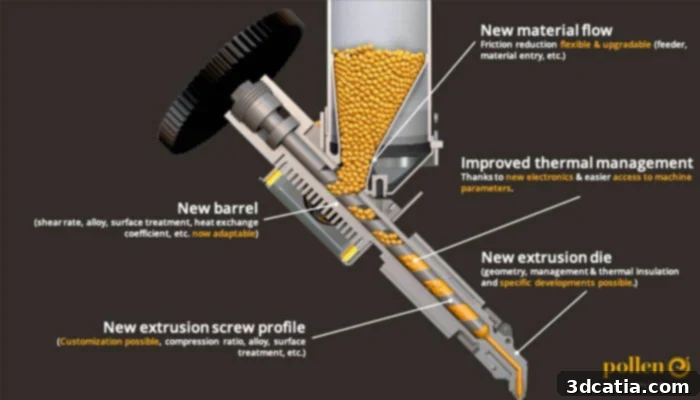
The advanced extruder developed by Pollen AM, optimized for semi-crystalline materials like PP.
Overcoming Adhesion and Warping in PP 3D Prints
Beyond precise temperature control, two other significant challenges in 3D printing with polypropylene are its tendency for high shrinkage and poor adhesion. Polypropylene exhibits an important degree of material shrinkage as it cools, which often leads to the notorious “warping” phenomenon. Warping occurs when internal stresses cause the edges of a printed part to lift away from the build plate, resulting in deformed and unusable prints. To mitigate this, the use of a heated build chamber is often necessary, maintaining a controlled ambient temperature around the print to reduce temperature gradients and slow down the cooling process, thereby minimizing shrinkage and stress. Pollen AM has further innovated in this area with their local radiant system, which actively reduces warping and simultaneously enhances interlayer adhesion, leading to stronger, more reliable parts.
Another critical issue is PP’s poor adhesion to most standard 3D printing surfaces. Its inert nature means it doesn’t readily stick to bare build plates, necessitating specialized adhesion solutions. To combat this, a substrate must typically be placed on the printing surface. Pollen AM, among other innovators, has developed specific PP films designed to be directly applied to the build plate. These films create a chemically compatible surface that significantly improves the adhesion of the printed polypropylene part, ensuring it stays firmly in place throughout the printing process. These specialized films offer a highly effective alternative to less reliable methods such as adhesive sheets or common tapes like Crystal type tape, providing a robust solution for consistent and successful PP prints.
Beyond Pure PP: Composite Formulations for Enhanced Performance
The versatility of polypropylene extends beyond its pure form, with various composite formulations available that significantly enhance its mechanical, thermal, or chemical properties. For instance, polypropylene combined with glass fiber reinforcement substantially increases its mechanical strength, stiffness, and dimensional stability, making it suitable for demanding structural applications. Similarly, incorporating fillers like calcium carbonate can improve PP’s fire behavior, reducing its flammability and enhancing its heat resistance. Other additives can target specific properties such as UV resistance, electrical conductivity, or even antimicrobial characteristics, further broadening PP’s applicability in additive manufacturing for specialized industrial parts.

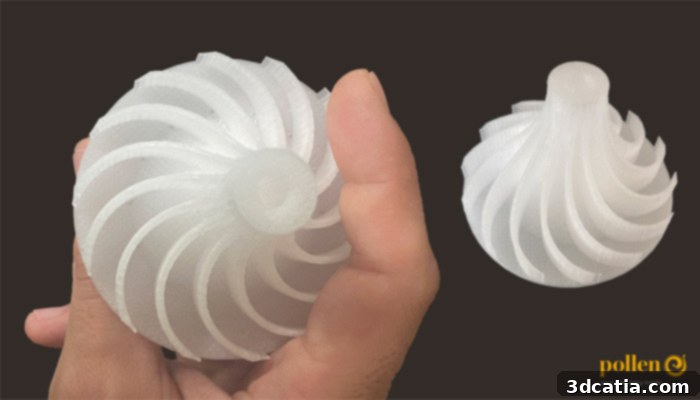
Examples of intricate 3D printed polypropylene parts produced using Pollen AM technology.
Economic Viability and Accessibility: Cost Considerations for PP 3D Printing
When evaluating the economic feasibility of 3D printing with polypropylene, it’s essential to consider the cost of the raw material in different formats. The average market price for PP in granular form typically ranges between €1.20 and €1.70 (excluding VAT) per kilogram. This relatively low cost makes it a highly attractive material for industrial applications, especially when compared to other high-performance polymers. However, when PP is processed into filament format for conventional Fused Deposition Modeling (FDM) 3D printers, the price significantly escalates, often oscillating between €30 and €50 (excluding VAT) per 500 grams. This substantial price difference is due to the additional processing, spooling, and quality control required to produce consistent filament. Furthermore, the cost climbs even higher for specialized loaded PP filaments (e.g., carbon fiber reinforced). Technologies like Pollen AM’s Pam system offer a distinct advantage by enabling users to directly process PP in its more affordable granular form. This allows industrial users to gain real control over material costs and utilize readily available, industrially qualified PP grades for their specific applications, making advanced additive manufacturing with PP more economically viable for a broader range of enterprises.
Conclusion: The Future of Polypropylene in Additive Manufacturing
Polypropylene, despite its initial complexities in additive manufacturing, is rapidly emerging as a material of immense potential. As Didier Fonta aptly concludes, “Once you control its temperature and adhesion, PP gives way to a large number of applications. At Pollen, we have combined this material with TPE and printed demonstrators for one of our customers. The adhesion between the materials is really good, resulting in parts with very interesting functionalities and properties.” This highlights the transformative impact of dedicated technological advancements and a deep understanding of material science. With innovations addressing its unique semi-crystalline nature, warping tendencies, and adhesion challenges, PP is now accessible for a vast array of 3D printing applications, from consumer goods to highly demanding industrial components. Its inherent properties—lightness, chemical resistance, fatigue resistance, and electrical insulation—make it an ideal candidate for creating functional prototypes and end-use parts across diverse sectors. The ability to combine PP with other materials like Thermoplastic Elastomers (TPE) further expands its utility, allowing for the creation of multi-material parts with customized properties, such as rigid structures with integrated flexible elements. This progress signifies a new era for polypropylene in additive manufacturing, promising cost-effective, high-performance solutions for complex engineering challenges. For more detailed information on Pollen AM’s innovative solutions, you can visit their official website HERE.
Have you explored the possibilities of Polypropylene in additive manufacturing? We invite you to share your experiences and insights in the comments section below or engage with us on our Facebook and Twitter pages. Stay informed about the latest breakthroughs in the 3D printing industry by signing up for our free weekly newsletter, delivered directly to your inbox!