
XYZBAG: Revolutionizing Fashion with Custom 3D Printed Handbags and Sustainable Design
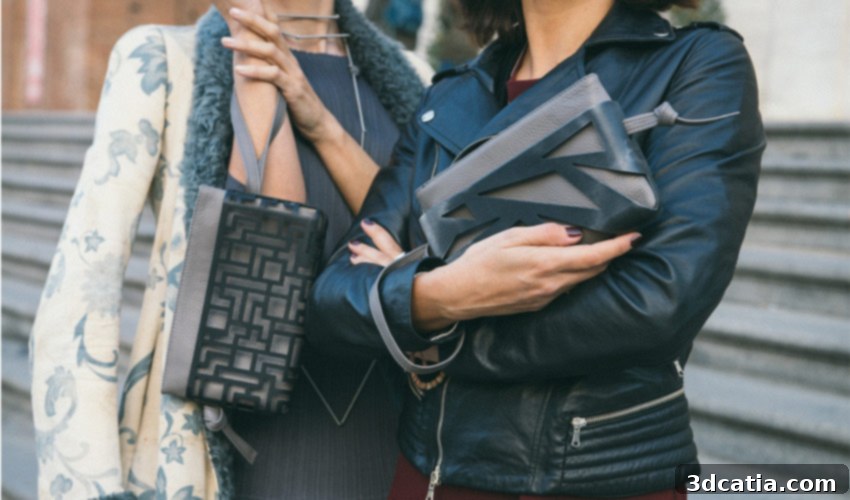
In an era where personal expression and sustainable practices are increasingly valued, XYZBAG, an innovative Italian brand based in Turin, stands at the forefront of a fashion revolution. This pioneering company champions digital craftsmanship, a unique approach that seamlessly blends traditional design methodologies with cutting-edge additive manufacturing technologies to create truly unique and personalized handbags. The fashion industry is rapidly embracing 3D printing, primarily for its unparalleled potential for customization. This technology empowers designers to craft bespoke items quickly and cost-effectively, catering to individual preferences like never before. While we have witnessed the emergence of 3D printed footwear and eyewear, XYZBAG is shifting the spotlight to another essential accessory: the handbag. To delve deeper into this fascinating convergence of technology and fashion, we sat down with Annalisa Nicola, the insightful co-founder of XYZBAG. Our discussion explored the pivotal role of 3D printing in the creation of their distinctive handbags and the growing significance of personalization in today’s dynamic fashion landscape.
3DN: Can you introduce yourself and share how you first encountered 3D printing?

Annalisa Nicola
My journey into the world of innovative manufacturing began with a strong entrepreneurial spirit, something I proudly inherited from my father, who was the co-founder of a prominent Italian plastic company. This early exposure to industry and material science deeply influenced my career path. After completing my degree in Ecodesign in Turin, I dedicated over 15 years to the expansive field of design, overseeing projects from initial concept to the final product, often navigating complex B2B communication channels. A significant portion of my professional focus has always been on plastic materials and their associated technologies. In this capacity, I’ve served as a crucial bridge, mediating between the creative visions of design departments and the technical expertise of engineers involved in bringing new products to life.
When I first explored 3D printing technologies, additive manufacturing was already a well-established tool within the business world, primarily used for developing prototypes. The truly novel and groundbreaking idea, however, was to shift this perspective and consider these technologies not just for prototyping, but as a viable method for direct manufacturing. My personal fascination with 3D printing was ignited by Chris Anderson’s illuminating book, “Makers: The New Industrial Revolution.” As I often recount, that book helped me realize the tangible possibility of creating something entirely new, something that hadn’t existed before. I was captivated by the ethos of the FabLab culture – these open-source digital workshops where passionate experts provide the necessary tools and knowledge to help individuals transform their innovative ideas into reality.
It was within this supportive FabLab environment that I conducted my initial experiments, working with the latest generation of Sharebot 3D printers. My very first handbag model was produced using FDM (Fused Deposition Modeling) technology. The process was utterly mesmerizing – watching the filament transform from a digital dimension into a physical object in a remarkably short time. The inherent additive layer effect introduced a captivating new aesthetic, a visual texture that was both modern and intriguing. Observing that filament being deposited layer by layer, I instinctively understood that something truly extraordinary, something with immense potential for the future of design and manufacturing, was unfolding before my eyes. This early hands-on experience solidified my belief in 3D printing’s transformative power, especially for creating bespoke fashion accessories.
3DN: What is XYZBAG, and how did the idea to develop the project with 3D printing originate?
XYZBAG is more than just a brand; it’s a vision for the future of product creation, aiming to seamlessly integrate innovation, advanced technology, and a unique concept we term “recoded manufacturing.” Our goal is to transform abstract ideas into “talking” physical items, each with a story and a purpose. In the face of pressing environmental concerns, we prioritize creating high-value plastic items – often symbolic, niche products designed for specific occasional events, situations, or as truly special gifts. Our core philosophy is built around imagining a future devoid of overproduction and the environmentally devastating waste that plagues traditional manufacturing. We achieve this by operating without holding inventory, adhering to the principle that the most effective way to eliminate waste is to simply not create it in the first place.
This approach fosters a genuine bond between customers and their products, significantly enhancing their sense of affection and value for the item. The ultimate outcome is a product designed for longevity, effectively combating the prevailing disposable culture. Our 3D printed bags serve as a unique fashion medium, providing an accessible and tangible entry point for people to experience the world of 3D printing through a wearable item that inherently embodies uniqueness. My vision for the future is one where the traditional “economies of scale” – efficient for high-volume, standardized production – will coexist harmoniously with what I call “economies of one.” This latter concept applies to highly customizable products, meticulously built layer by layer to meet individual specifications.
Within this evolving panorama, new professional skills will undoubtedly emerge, particularly in managing the increasing complexity of personalized production. By fostering greater interaction and collaboration between customers and the design process, every stage of product development, from the initial idea to final production, will demand an innovative and collaborative mindset, a level of synergy unprecedented in traditional manufacturing. XYZBAG is actively cultivating this new paradigm, demonstrating how additive manufacturing can empower both designers and consumers to participate in a more sustainable, personalized, and engaging fashion ecosystem.
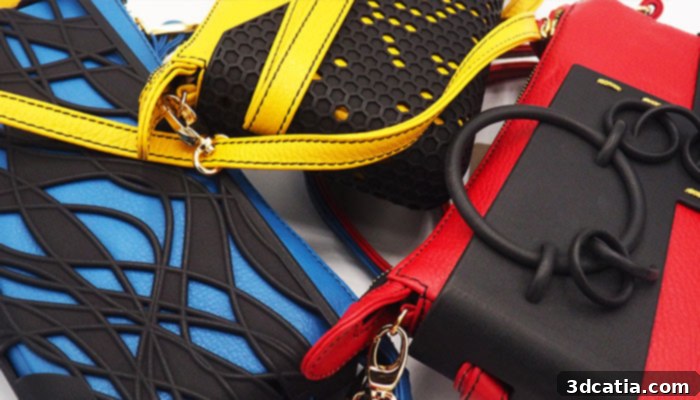
Photo Credit: XYZBag
3DN: Can you elaborate on the process of manufacturing a 3D printed bag?
At XYZBAG, we believe that every project, like every customer, is unique. This conviction forms the cornerstone of our manufacturing process, which always begins with a special, in-depth dialogue with our customer. Our 3D bags are conceived as a comprehensive “system product,” where the elegance of Italian traditional craftsmanship is ingeniously combined with the precision and innovation of advanced 3D printing technologies. The journey of each 3D printed cover starts in the digital realm, with the creation of a solid model using sophisticated computer-aided design (CAD) software.
Our clients are offered a range of creative possibilities. They can choose from various cloud-based design suggestions, which include themes like city skylines, corporate logos, personalized text, or different artistic styles. These options are typically adapted from our three master product lines: DADA, GRETEL, and TRADA. Alternatively, clients have the freedom to commission a completely bespoke design, tailored precisely to their vision. This initial design phase is arguably the most delicate and critical stage of the entire process. The art of digital personalization demands profound expertise in not only translating a customer’s imaginative concept into a viable digital file but also ensuring that this file is optimally suited for 3D printing. It requires a mastery that allows us to produce virtually anything the customer can imagine, rather than being constrained by conventional production limitations.
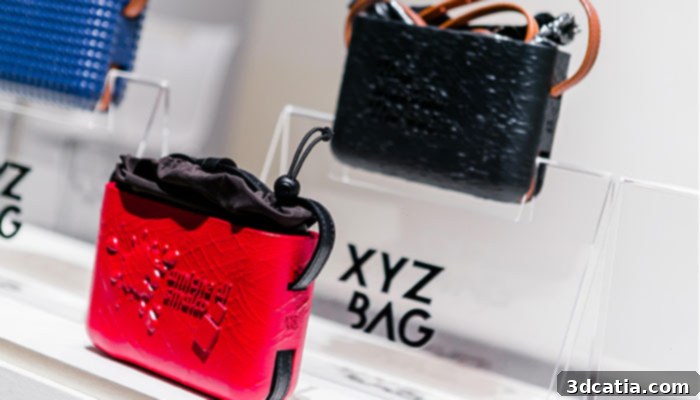
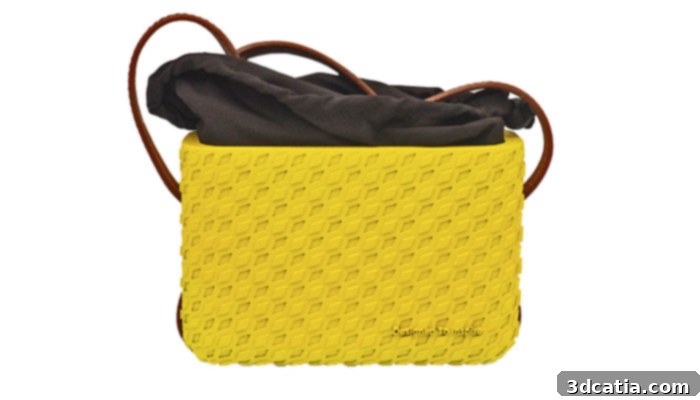
A significant strength of XYZBAG lies in our meticulously developed supply chain. We have cultivated robust relationships with specialized professional services, all deeply aligned with our unique business model and commitment to quality. For our additive manufacturing, we predominantly utilize powder-based technology, which offers superior design flexibility and material properties for our applications. Our most recent and intricate creations have been successfully produced using HP’s Multi Jet Fusion (MJF) technology, known for its precision and efficiency. Following the precise 3D printing process, each bag undergoes a meticulous hand-painting stage by professional artisans, adding an exquisite touch of traditional craftsmanship. Finally, the 3D printed cover is expertly assembled with an inner lining crafted from high-quality synthetic or genuine leather. While we offer a standard elegant black dyeing color, we also accommodate special color requests, ensuring every XYZBAG is a true reflection of its owner’s personal style.
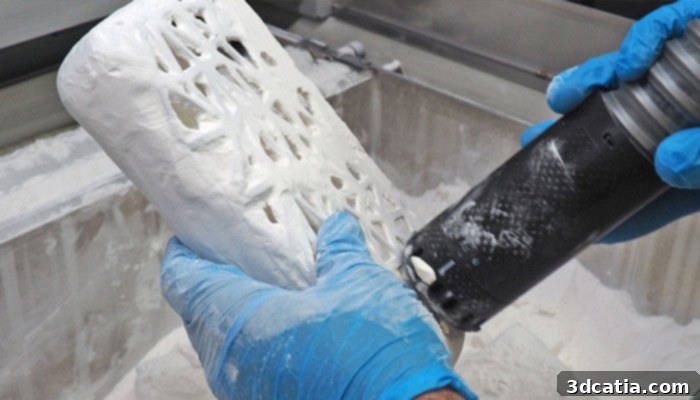
XYZBag uses powder based technology | Credits: XYZBag
3DN: What are the primary benefits of utilizing additive manufacturing for your products?
For XYZBAG, additive manufacturing is more than just a production method; it’s the very embodiment of our core vision. By embracing the revolutionary concept of considering a prototype as a finished product itself, we are fundamentally reshaping traditional manufacturing paradigms. This shift liberates designers from conventional constraints, opening up entirely new levels of design freedom. We can fabricate complex and intricate shapes, geometries, and internal structures that would be utterly impossible to achieve with traditional manufacturing techniques like molding or machining. This allows for unparalleled creativity and innovation in product aesthetics and functionality.
Furthermore, 3D printing is an unparalleled enabler of customization, which is central to the XYZBAG philosophy. By leveraging this technology, we empower our customers to acquire products that are not merely off-the-shelf items, but deeply personalized creations tailored precisely to their unique specifications and individual creative attitudes. This level of bespoke design fosters a stronger connection between the owner and their accessory, contributing to a more sustainable consumption model.
Beyond design freedom and personalization, additive manufacturing effectively dismantles the significant cost barriers typically associated with traditional equipment and tooling. It allows for an “experimental” production approach where initial investments are dramatically reduced, making it feasible to produce small batches or even single, unique items economically. This flexibility is crucial for our model. Technologies like Multi Jet Fusion (MJF) and Selective Laser Sintering (SLS) are particularly advantageous and enjoyable to work with. Their ability to “nest” hundreds of individual parts within a single build job allows for highly efficient batch production, even when each part is completely unique. This means we can simultaneously manage and personalize a large number of diverse items within the same production cycle, optimizing both speed and cost-efficiency while delivering truly individualized products to our discerning customers.
3DN: In your opinion, what is the importance of additive manufacturing technologies in the fashion field?
In the rapidly evolving landscape of the fashion industry, sustainability and co-creation are no longer mere buzzwords; they are becoming foundational pillars for future success. Sustainability, in our view, extends far beyond merely selecting eco-friendly materials for a product. It encompasses the creation of an entirely sustainable business model, one that addresses the entire lifecycle of a product. Additive manufacturing offers a groundbreaking alternative to traditional mold-making, which typically entails significant upfront costs and substantial energy resources that can only be justified and recouped through the mass fabrication of identical products in industrial volumes. This conventional model inherently promotes overproduction and waste.
Conversely, the interactive process of co-creation with the customer represents a truly disruptive value proposition in the fashion sector. This collaborative approach not only imbues each fashion item with a special, unique identity but also ushers in a new era of highly exclusive personalization. For the first time in the history of manufacturing, a single, unique creation does not need to be designed with the constraint of being replicable in a large number of identical products to be economically viable. This ability to produce true one-offs, tailored to individual desires, is the essence of real luxury in the modern age. Furthermore, additive manufacturing technologies offer remarkable possibilities for significantly shortening the time to market. This agility allows fashion brands to refresh collections rapidly, responding to new trends and consumer demands without the costly and time-consuming retooling processes required by traditional methods. As we move forward, the “contamination” – or rather, the harmonious integration – between digital design and physical manufacturing will only become more profound and fascinating, continuously unlocking new avenues for innovation in the fashion industry.
3DN: Do you have any final thoughts or words of advice for our readers?
Without a doubt, 3D printing is poised to fundamentally transform the way we approach production across various industries, and fashion is certainly no exception. However, realizing its full potential requires more than just access to the technology. It demands genuine expertise, cultivated through an open mind and a commitment to continuously learning as many tools and processes as possible. While the advancements in additive manufacturing have been remarkable, there is still a significant journey ahead before 3D printing becomes a universally solid, mainstream technology that can consistently be considered a direct, widespread alternative to all forms of traditional mass manufacturing. Each instance of seeing 3D printing successfully applied to a finished, consumer-ready product is a monumental achievement and a source of immense pride for us at XYZBAG.
We believe that innovation thrives on collaboration. Therefore, I am constantly seeking opportunities to connect and work with talented teams and passionate experts who share our vision to push the boundaries of this fascinating technology. Together, we can unlock even more possibilities, creating a future where design, customization, and sustainability are inextricably linked through the power of additive manufacturing. The potential is vast, and the journey is incredibly exciting.
You can find more information about XYZBAG and their innovative 3D printed handbags HERE.
What are your thoughts on these unique 3D printed, personalized bags and their potential impact on the fashion industry? We invite you to share your comments below or engage with us on our Facebook and Twitter pages! And don’t forget to sign up for our free weekly Newsletter to receive all the latest news and insights in the world of 3D printing directly in your inbox!