
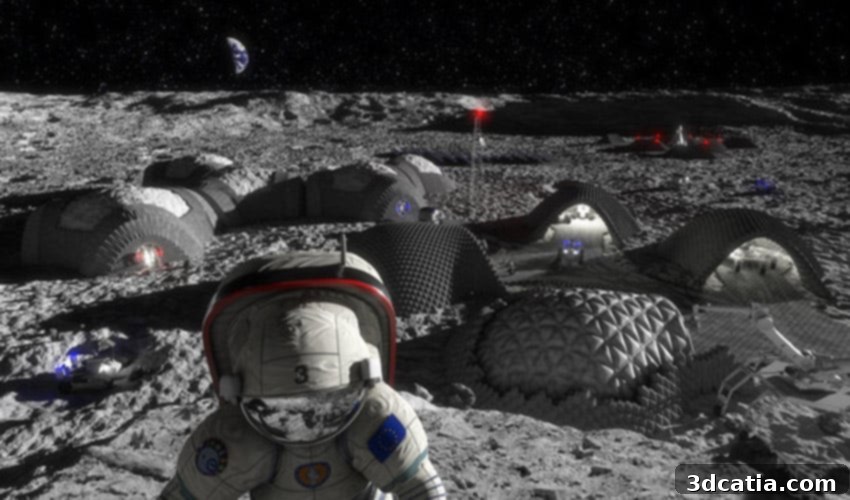
Making the Moon Feel Like Home: ESA’s 3D Printing Challenge Unveils Innovative Lunar Habitat Concepts
Humanity’s ambition to explore and settle beyond Earth has long captivated our imagination. As we inch closer to establishing a permanent human presence on the Moon, the European Space Agency (ESA) recently posed a compelling question: What would you 3D print on the Moon to make it truly feel like a home? This challenge wasn’t just about survival; it was about fostering psychological well-being and creating an environment where astronauts could thrive, not just exist. After sifting through a multitude of creative responses from around the globe, ESA has proudly announced two winning ideas that beautifully encapsulate this vision.
It comes as little surprise that both selected concepts were deeply rooted in the theme of nature, highlighting its profound absence on the desolate lunar surface. This conceptual exercise serves as a powerful mirror, reflecting what we inherently value and cherish on our verdant home planet today. Moreover, the competition underscored the immense potential of additive manufacturing technologies, demonstrating their ability to unlock diverse creative avenues, pushing the boundaries of what is possible, even if only conceptually for now, in future lunar settlements.
Nature-Inspired Innovations for Lunar Comfort
The drive to replicate the comfort and familiarity of Earth’s natural environments emerged as a dominant theme among the competition entries. The winners beautifully showcased how technology, specifically 3D printing, could bridge the psychological gap between a sterile lunar base and a comforting terrestrial home.
Helen Schell’s ‘Magic Moon Garden’: A Sensory Oasis
In the adult category, the esteemed prize went to Helen Schell from the UK, whose innovative concept, aptly named the ‘magic Moon garden,’ proposed a vibrant, interactive feature printed entirely from recycled coloured plastics. Helen articulated her vision, stating, “Colour and living plants. This is an idea for a colourful carpet of interchangeable colour and design, which can be moved and the scale changed wherever you want to site it in your lunar habitat.” This concept transcends mere aesthetics, addressing the critical need for visual stimulation and personalization in a potentially monotonous lunar environment.
Helen’s ingeniously designed 3D printed equivalents to plants would offer more than just visual appeal. They were conceived to be aromatic, adding a crucial sensory dimension to the lunar habitat, providing comforting scents that could evoke memories of Earth. Beyond this, her ‘garden’ would perform the vital function of an air recycling unit, actively converting carbon dioxide into oxygen, thereby contributing to a sustainable and breathable atmosphere within the lunar dwelling. The use of recycled plastics also highlights a forward-thinking approach to waste management and resource utilization on the Moon, an essential consideration for long-duration missions where resupply from Earth is costly and infrequent.
Judith de Santiago’s Dodecahedron Plant Pot: Nurturing Life on the Moon
The under 18 category saw 17-year-old Judith de Santiago from Madrid emerge victorious with her insightful design for a dodecahedron plant pot. Judith demonstrated a remarkable understanding of additive manufacturing principles by designing her concept specifically in a 3D printing compatible format, ensuring its practical feasibility. Her choice of a dodecahedron shape is not only aesthetically pleasing but also suggests a thoughtful consideration for modularity and efficient use of space, which are paramount in confined lunar habitats.
While Helen’s garden offered synthetic nature, Judith’s plant pot championed the idea of cultivating actual plant life. The ability to grow plants, even in a small capacity, could have profound psychological benefits for astronauts, providing a tangible connection to life and growth in an otherwise barren environment. It also points towards the future of lunar agriculture and closed-loop life support systems, where astronauts could potentially grow their own food, reducing dependence on Earth-based supplies and fostering a greater sense of self-sufficiency.
The Pivotal Role of 3D Printing in Lunar Settlement
The ESA competition was more than just a creative exercise; it was a strategic initiative to deepen understanding of human factors in lunar settlement and to explore the myriad ways 3D printing can enhance the quality of life for future lunar inhabitants. Many ideas were submitted during this competition, some even suggesting the radical concept of printing a 3D printer on the Moon itself, highlighting the transformative potential of in-situ manufacturing.
Advenit Makaya, who oversees ESA’s crucial lunar 3D printing study, commented on the competition’s success: “This competition was a very good initiative to connect our study to the public, and gain insight into human factors involved in lunar settlement.” This public engagement aspect is vital, as it allows space agencies to tap into a wider pool of innovative thought and align technological development with human needs and aspirations.
Indeed, 3D printing, or additive manufacturing, represents an indispensable building block for future space settlement. Global space agencies widely consider a lunar base as the very possible next step in human exploration, a critical stepping stone for future missions to Mars and beyond. In this ambitious endeavor, additive manufacturing will prove to be of immense help, offering unprecedented capabilities for construction, repair, and resource utilization in an extraterrestrial environment.
Beyond Survival: Enhancing Human Well-being on the Moon
Makaya further elaborated on the insights gained: “These entries give us an idea of what people living on the Moon would want from their everyday surroundings. Common themes that recur, such as to print items that resemble objects from nature, items linked to terrestrial hobbies and musical instruments, as well as reminders of loved ones back home – to help connect back to Earth and diminish any sense of isolation.” These observations highlight a critical aspect of long-duration space missions: the importance of psychological comfort and connection.
The stark reality of lunar living—isolation, extreme conditions, and separation from Earth—necessitates proactive measures to support astronaut mental health. The ability to 3D print personalized items, whether a replica of a beloved pet, a musical instrument, or a familiar piece of art, could significantly combat feelings of loneliness and disorientation. Such personal touches transform a mere scientific outpost into a genuine home, providing much-needed emotional anchors to terrestrial life. This emphasis on human factors is central to ESA’s comprehensive project, “Conceiving a Lunar Base Using 3D Printing Technologies,” which aims to develop sustainable and comfortable lunar habitats. More information about this groundbreaking project can be found HERE.
Additive Manufacturing: The Future of Lunar Construction and Resource Utilization
The applications of 3D printing for lunar settlement extend far beyond personal comfort items. It is seen as a game-changer for construction. By utilizing lunar regolith (Moon dust) as raw material, astronauts could 3D print entire habitats, landing pads, and radiation shields directly on the lunar surface, drastically reducing the need to transport heavy materials from Earth. This “in-situ resource utilization” (ISRU) is paramount for making lunar bases economically viable and sustainable.
Furthermore, 3D printing enables on-demand manufacturing of tools, spare parts, and specialized equipment, minimizing the logistical challenges and costs associated with space missions. If a component breaks, it can potentially be fabricated on-site, providing unprecedented levels of self-sufficiency and operational resilience. This adaptability and resourcefulness are precisely what will allow humanity to move from temporary outposts to permanent lunar settlements, paving the way for a multi-planetary future.
Conclusion: A Future Built on Innovation and Comfort
The ESA competition serves as a potent reminder that the future of space exploration is not solely about technological prowess, but also about the human spirit and our innate need for comfort, connection, and a sense of belonging. The winning ideas, centered around nature and personal well-being, underscore that even in the most alien environments, the desire for a ‘home’ remains paramount.
As we look towards establishing a robust human presence on the Moon, additive manufacturing will continue to play a transformative role. It offers the practical solutions needed for sustainable construction and resource management, while also providing the creative freedom to design environments that nurture the human psyche. The journey to making the Moon feel like home is a testament to human ingenuity, blending advanced technology with a deep understanding of what it means to be human, even light-years away from Earth.
What would *you* 3D print on the Moon to make it feel like home? Share your creative ideas in a comment below or join the conversation on our Facebook and Twitter page! Don’t forget to sign up for our free weekly Newsletter, with all the latest news and innovations in 3D printing delivered straight to your inbox!