
Aurora Labs’ High-Speed Metal 3D Printing Redefines Industrial Manufacturing with Rapid Manufacturing Technology (RMT)
Australian innovator Aurora Labs is making significant strides in the additive manufacturing sector, recently announcing groundbreaking successful test results for its proprietary Rapid Manufacturing Technology (RMT) in metal 3D printing. This remarkable achievement follows a substantial $5 million investment round (before costs) secured from a consortium of institutional and sophisticated investors. This funding infusion was specifically earmarked to accelerate the development and deployment of RMT, alongside fostering overall business growth throughout the coming year. The company’s recent announcements clearly indicate that these investments are already yielding impressive returns, positioning Aurora Labs at the forefront of high-speed metal additive manufacturing.
At the heart of Aurora Labs’ latest breakthrough is its Rapid Manufacturing Technology, which has demonstrated an unprecedented print speed of 113 kg of metal per day. This revolutionary process is seamlessly integrated into the company’s flagship large-format Alpha 3D printer, also known as the RMP (Rapid Manufacturing Printer). To put this speed into perspective, industry analyses have identified the typical market speed for metal additive manufacturing, particularly for materials like Titanium, at approximately 1.96 kg per day. Aurora Labs’ RMT, therefore, offers a staggering 55-fold increase in production speed, presenting a transformative potential for various industrial applications. This dramatic increase in output capacity is poised to disrupt traditional manufacturing paradigms, making on-demand production of large, complex metal parts a highly feasible and economically viable reality.
Accelerating Metal Additive Manufacturing and Transforming Industries
David Budge, Managing Director of Aurora Labs, emphasized the significance of these developments. “This critical step in the evolution of our technology represents the culmination of a long series of impressive advancements since Aurora Labs’ inception in 2014,” Budge stated. He further elaborated on the company’s ambitious vision: “Our ability to print on multiple levels simultaneously at exceptionally high speeds is what we believe will ultimately allow us to achieve our ambitious goal of printing up to 1000 kg of metal in a single day.” This level of production speed is not merely an incremental improvement; it signifies a monumental leap forward, holding the potential to fundamentally transform global industries, particularly the critical and often challenging spare parts sector worldwide. Imagine the implications for remote mining operations, offshore oil rigs, or even aerospace, where expedited part replacement can mean the difference between minimal downtime and significant operational losses.
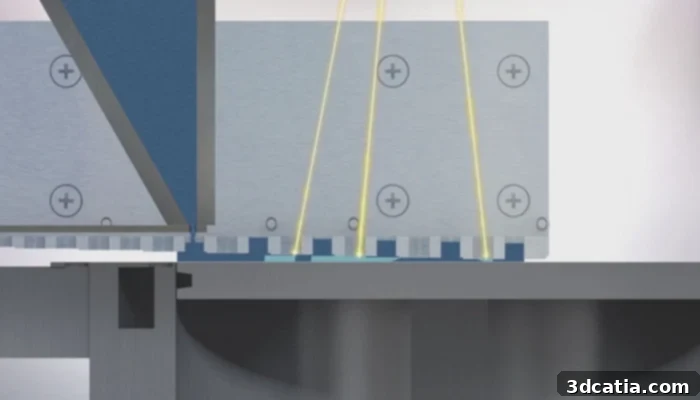
The Multi Concurrent Printing (MCP) process from Aurora Labs demonstrating its innovative capabilities. Credits: Aurora Labs
Aurora Labs’ breakthrough is largely attributed to its innovative Multi Concurrent Printing (MCP) process, a core component of the Rapid Manufacturing Technology (RMT). While sharing fundamental principles with established methods like Direct Metal Laser Sintering (DMLS) – by melting and fusing successive layers of metal powder to create complex 3D geometries – MCP significantly elevates the speed and efficiency of conventional metal additive manufacturing. The crucial distinction lies in its approach to powder deposition and layer processing. Unlike traditional methods that lay down and process one layer at a time, Aurora’s MCP technology simultaneously lays down multiple layers of powder. This parallel processing capability is enabled by a sophisticated design where each individual powder gate is followed by a distinct printing area. This means that multiple sections of the part can be printed concurrently, dramatically reducing the overall build time. This simultaneous, multi-level printing is the secret behind the extraordinary speed enhancements achieved by RMT, pushing the boundaries of what was previously considered possible in industrial metal 3D printing.
The implications of such high-speed, cost-effective metal 3D printing are profound, particularly for industries heavily reliant on durable and precisely engineered components. David Budge further elaborated on the market reception, noting, “A significant portion of the groups Aurora Labs is currently engaging with express keen interest in the potential for replaceable parts. They are looking at the capability of either directly replacing components using advanced additive manufacturing techniques or redesigning them entirely. Leveraging the inherent advantages of 3D printing, coupled with superior material properties, allows them to deliver a superior product at a highly competitive cost.” This interest highlights a shift in industrial thinking, moving away from conventional manufacturing constraints towards the flexibility and efficiency offered by advanced 3D printing solutions. The ability to produce bespoke or low-volume parts quickly and affordably addresses critical supply chain vulnerabilities and reduces inventory requirements.
Budge underscored the economic driver behind this innovation: “The primary factor in enabling an end product to be cost-competitive with traditional manufacturing methods is fundamentally the speed of the machine.” This focus on throughput and efficiency is precisely why Aurora Labs is strategically targeting sectors beyond the typical 3D printing markets, setting its sights on demanding industries such as mining, oil & gas, marine, and automotive. In these environments, component failure can lead to colossal losses in revenue and productivity, making rapid, on-demand manufacturing a game-changer. For example, in mining, a critical component failure can shut down an entire operation, making rapid repair or replacement invaluable. Similarly, in oil & gas, specialized parts are often needed in remote locations, where lead times for traditional manufacturing can be prohibitively long and expensive. Aurora Labs’ technology promises to mitigate these challenges, offering robust, high-performance parts with unprecedented speed and cost-efficiency. “The year ahead is looking extremely exciting as we continue to push the boundaries of what is achievable in industrial additive manufacturing and expand our footprint into these vital sectors,” Budge concluded, signaling a period of rapid expansion and innovation for the company.
The potential applications extend far beyond spare parts, encompassing new product development, rapid prototyping for large-scale components, and the creation of optimized designs impossible with traditional manufacturing. By reducing lead times and manufacturing costs, Aurora Labs’ RMT could democratize access to high-performance metal components, empowering businesses to innovate faster and respond more agilely to market demands. This could foster a new era of localized manufacturing, reducing reliance on complex global supply chains and enhancing industrial resilience. The ability to print complex geometries with internal structures can also lead to lighter, stronger, and more efficient parts, providing significant advantages in industries where weight and performance are critical, such as aerospace and defense.
The success of Aurora Labs’ Rapid Manufacturing Technology represents a pivotal moment in the evolution of industrial 3D printing. It demonstrates that metal additive manufacturing is moving beyond niche applications and into mainstream industrial production, offering tangible economic and operational benefits. As the technology continues to mature, and with the ambitious goal of reaching 1000 kg per day, Aurora Labs is poised to solidify its position as a key player in the global advanced manufacturing landscape, driving innovation and efficiency across multiple high-value sectors. This advancement not only showcases Australian technological prowess but also paves the way for a more agile, sustainable, and cost-effective future for manufacturing worldwide.
Are you excited for the future of high-speed industrial metal 3D printing and its potential to revolutionize manufacturing? Let us know your thoughts in a comment below or connect with us on our Facebook and Twitter pages! Don’t miss out on the latest advancements and insights in the world of 3D printing. Sign up for our free weekly Newsletter to get all the cutting-edge news delivered straight to your inbox!