
Revolutionizing Dairy Farming: 3D-Printed Sensor for Early Milk Fever Detection
Milk fever, scientifically known as periparturient hypocalcemia, stands as one of the most pervasive and economically detrimental metabolic diseases afflicting dairy cattle worldwide. This debilitating condition, characterized by a sudden and severe drop in blood calcium levels around the time of calving, poses significant health risks to cows and substantial financial burdens on farms. Studies indicate a staggering prevalence, with estimates suggesting that up to 50% of mature dairy cows and 25% of first-calf heifers can be affected. The physiological consequences are profound: calcium is vital for numerous bodily functions, including muscle contraction, nerve impulse transmission, and hormone secretion. When calcium levels plummet, these essential processes are severely impaired, leading to a cascade of negative effects that compromise the animal’s well-being and productivity. Beyond the immediate health concerns, milk fever drastically reduces milk production, translating into considerable economic losses that can reach up to $290 per cow. For a typical dairy farm housing 100 cows, these losses could escalate to around $8,000, underscoring the urgent need for effective diagnostic and preventive strategies.
Historically, the early diagnosis of milk fever has presented a formidable challenge for farmers. The insidious nature of the disease means that typical clinical symptoms, such as an inability to stand, loss of appetite, or cold extremities, often only manifest in its advanced stages. Before these overt signs appear, cows may be suffering from subclinical milk fever, a less apparent but equally damaging form of the condition where blood calcium levels are low but not low enough to cause obvious physical symptoms. This diagnostic gap has long hindered timely intervention, often resulting in more severe health complications and greater economic impact. However, a groundbreaking innovation from a dedicated team of scientists at Virginia Tech is poised to transform this landscape. Leveraging the power of advanced additive manufacturing, they have developed a sophisticated sensor capable of detecting milk fever with unprecedented speed and accuracy – in a mere ten seconds. This technological leap promises a sustainable and efficient solution for agriculture, significantly enhancing animal health monitoring and farm productivity.
The Science Behind the Sensor: Precision Detection for Dairy Health
At the core of this revolutionary diagnostic tool is its ability to precisely measure the concentration of critical biomarkers: calcium and phosphate, directly from milk samples. The choice of manufacturing technology played a pivotal role in the sensor’s design and functionality. The Virginia Tech team opted for polymer resin 3D printing, a specific type of additive manufacturing renowned for its exceptional cost-effectiveness, flexibility in design, and capacity for intricate detailing. This method allows for the creation of complex geometries and micro-scale features that are essential for the sensor’s high sensitivity.
The manufacturing process involves a meticulous layer-by-layer printing technique, where liquid polymer resin is selectively hardened by UV light. This precise curing process enables the formation of microscopic surface structures, which are crucial for enhancing the sensor’s analytical performance. Following the initial 3D printing, the sensor undergoes a gold coating process utilizing e-beam evaporation. This thin, uniform layer of gold is not only biocompatible but also provides the necessary electrical conductivity for accurate electrochemical measurements. The microscopically corrugated surface, meticulously crafted through 3D printing, plays a critical role in achieving the sensor’s remarkable sensitivity by maximizing the active surface area for ion interaction. The entire sensor structure is ingeniously designed with a total of three electrodes, two of which function as working electrodes, specifically engineered for the detection process.
These working electrodes are then coated with highly specialized ion-selective membranes, tailored to specifically bind and detect calcium and phosphate ions. The true brilliance of this sensor lies in its extraordinary detection capability: it can identify ion concentrations in the attomolar range. To put this into perspective, for calcium, it can detect concentrations as low as 138 attomoles (aM). This unparalleled sensitivity is a game-changer because it enables the detection of even the most minute fluctuations in calcium and phosphate levels – signs that are indicative of nascent milk fever – long before any severe or visible clinical symptoms begin to manifest. This early warning system provides farmers with a crucial window for intervention, allowing them to initiate preventive or therapeutic measures promptly, thereby safeguarding cow health and mitigating potential losses.
Unlocking New Potential: Advantages for Farmers and Animal Welfare
The introduction of this 3D-printed sensor marks a significant leap forward in agricultural technology, offering a multitude of advantages over conventional diagnostic methods. One of its most compelling benefits is its remarkably low cost. Traditional diagnostic solutions for metabolic diseases in livestock are often prohibitively expensive, involving complex laboratory equipment and requiring specialized personnel. In stark contrast, the new sensor can be produced efficiently and affordably, leveraging the streamlined nature of additive manufacturing. The entire production process for a single sensor takes merely two hours, consuming minimal resources, which significantly drives down the unit cost. Furthermore, its user-friendly design means that no specialist knowledge or extensive training is required for its operation, making it accessible to virtually any farmer or farm worker. This ease of use translates into reduced labor costs and faster turnaround times for critical health assessments.
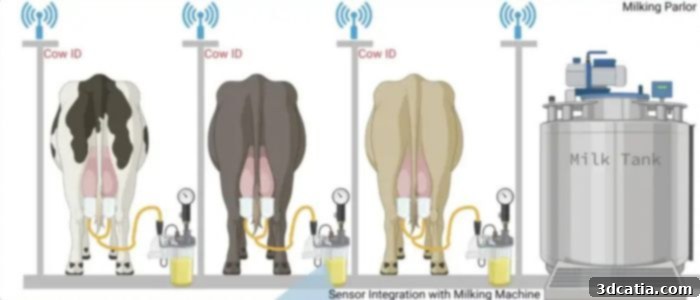
The 3D-printed sensor can be easily integrated into milking systems and offers fast and accurate analysis of calcium and phosphate levels in milk samples to detect milk fever at an early stage (photo credits: School of Animal Sciences, Virginia Tech, Blacksburg, USA)
Beyond its economic benefits, the sensor makes a profound contribution to sustainable animal husbandry practices. By enabling quick and accurate on-the-spot diagnoses, it facilitates proactive cow health monitoring. This early detection capability allows farmers to intervene before the disease progresses, reducing the need for more intensive and costly treatments, and minimizing the use of antibiotics or other medications. Improved animal welfare is a direct outcome, as cows suffer less, recover faster, and maintain higher productivity. The reduction in disease incidence and severity directly translates into minimized economic losses, not only from reduced milk yield but also from decreased veterinary expenses, lower culling rates, and improved reproductive performance.
The potential applications of this sensor extend far beyond milk fever detection. Its modular design offers a significant possibility for expansion, allowing for the integration of capabilities to measure various other biomarkers in milk samples. This adaptability means the same core technology could be leveraged to detect a wide array of other animal diseases, transforming it into a comprehensive health monitoring platform for dairy herds. Such a system could usher in an era of true precision livestock farming, where individual animal health is continuously monitored, and data-driven decisions are made to optimize feed, breeding, and overall farm management. The Virginia Tech project, detailed further HERE, represents a beacon of innovation, demonstrating how advanced technologies like additive manufacturing can deliver practical, impactful solutions to real-world agricultural challenges.
The Future of Dairy Farming: Smarter, Healthier, More Sustainable
The development of this 3D-printed sensor for early milk fever detection is more than just a technological advancement; it signifies a paradigm shift in how dairy farms can manage animal health. By making sophisticated diagnostic capabilities accessible and affordable, Virginia Tech’s innovation empowers farmers with the tools needed to prevent debilitating diseases rather than merely reacting to them. This proactive approach fosters healthier herds, enhances animal welfare, and ultimately leads to more sustainable and profitable farming operations. The ability to integrate such sensors directly into existing milking systems further streamlines the process, making daily health checks seamless and non-intrusive. As the world moves towards more efficient and ethical food production, technologies like this sensor will be instrumental in ensuring the long-term viability and success of the dairy industry.
We’d love to hear your thoughts on the transformative potential of 3D printing in the production of such vital sensors for agriculture! Share your insights in a comment below, or connect with us on our LinkedIn, Facebook, and Twitter pages! Don’t forget to sign up for our free weekly Newsletter here to receive the latest 3D printing news straight to your inbox! You can also find all our videos on our YouTube channel.