
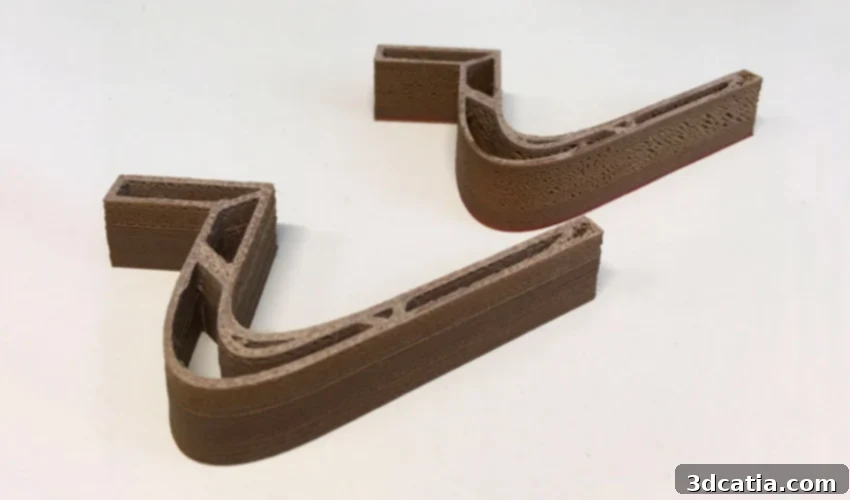
Pioneering Sustainable 3D Printing: Aalto University’s ValueBioMat Project and Bio-Based Polymer Innovations
The field of additive manufacturing, commonly known as 3D printing, is rapidly evolving, with an increasing number of companies developing advanced composite materials to design lighter, stronger, and more intricate parts. While these innovations offer remarkable engineering possibilities, many traditional composites rely on plastic matrices that can have a significant and negative impact on the environment. Recognizing this critical challenge, Aalto University in Finland has embarked on groundbreaking research through the ValueBioMat project, aiming to devise novel, sustainable bio-based polymer materials. These innovative materials are designed to directly replace conventional fossil-based plastics and composites, paving the way for a truly sustainable and circular future in 3D printing. The ultimate goal is to enable additive manufacturing processes that are not only efficient and versatile but also environmentally responsible. We had the privilege of speaking with Professor Jukka Seppälä, a leading expert who, alongside Aalto University’s renowned additive manufacturing lab, is spearheading this transformative research within the ValueBioMat initiative. His insights shed light on the project’s vision, methodologies, and the promising future of eco-friendly 3D printing.
Could you briefly introduce yourself and your connection to 3D printing?
 My name is Jukka Seppälä, and I serve as a Professor of Polymer Technology at Aalto University in Finland. My laboratory’s core focus revolves around polymer synthesis and polymer reaction engineering. We are deeply invested in unraveling the intricate structure-property relationships of polymers, and subsequently, adapting these plastic materials to meet the demands of critical and challenging applications. For many years, our team has been at the forefront of developing advanced bio-based polymers and plastics. This foundational work naturally led us to explore and leverage emerging, advanced processing techniques, with additive manufacturing being a prime example. These innovative techniques present immense opportunities to fabricate highly optimized structures in ways that are both novel and exceptionally material-efficient. Consequently, the synergy between additive manufacturing and new sustainable, bio-based polymeric materials represents a monumental step towards achieving more environmentally responsible material solutions across various industries. At Aalto University, the leading expert in the broader field of additive manufacturing is Professor Jouni Partanen, and we maintain a close collaborative relationship with him and his dedicated manufacturing laboratory, known as ADDLAB. This collaboration is crucial for integrating our material science expertise with cutting-edge manufacturing processes.
How was the ValueBioMat project born? What is its mission?
The ValueBioMat project emerged from a critical need to address the environmental challenges posed by conventional materials in advanced manufacturing, particularly in the realm of 3D printing. Its overarching mission is to actively promote sustainability through a multi-faceted approach, encompassing legislative and policy actions. This involves developing appropriate frameworks that not only encourage significant advancements in biomaterials production and associated services but also proportionately regulate the protection of and access to vital industry data and innovative design files. Furthermore, a core tenet of our mission is to foster robust cooperation among all stakeholders by developing innovative models of innovation and governance for business networks. This holistic approach ensures that the development of sustainable materials is supported by a conducive ecosystem.
Beyond policy and collaboration, ValueBioMat is deeply engaged in fundamental research. We are actively investigating and developing viable, high-throughput synthesis routes to transform fatty acids into polymerizable monomers, such as di-carboxylic acids. This work is crucial for establishing a sustainable supply chain for our bio-based polymers. Concurrently, we are exploring the possibilities of synthesizing biologically derived long-chain polyamides, polyesters, and polyurethanes, meticulously examining their structure-property correlations with the resulting material properties. This deep understanding allows us to tailor materials for specific applications. A key technological focus involves synthesized biopolymer-reinforced composites with chemical compatibilization. This is the cornerstone for discovering optimal long fiber-containing composite materials suitable for various printing processes and for developing the appropriate processing techniques for these advanced composites. Ultimately, a critical component of our mission is to rigorously evaluate the environmental, social, and ethical impact of all our developed solutions, ensuring that they truly benefit society and contribute to a more sustainable future.
What are the main benefits of turning bio-oils into composites for 3D printing?
Bio-oils represent a transformative and rapidly emerging source of renewable feedstock, offering immense potential for the sustainable production of both fuels and, more importantly for our work, polymeric materials. While commercial bio-oils based on polyamides are starting to become available, our research pushes the boundaries by focusing on the development of long-chain polyamides with optimized properties. These properties are particularly enhanced when combined with other bio-based fillers and reinforcing fibers, allowing us to create advanced thermoplastic biocomposites. One of the significant challenges we have successfully addressed concerns the degradation of heat-sensitive bioparticles during processing. Conventional methods can often compromise the integrity of these valuable bio-components. To circumvent this, we have developed specific low-melting polyamides that are predominantly derived from biological raw materials. These innovative polyamides require lower processing temperatures, thus protecting the integrity of the heat-sensitive bioparticles and enabling their effective incorporation into composites. These significant advances have empowered us to formulate new, exciting, and highly functional bio-based composites that can directly replace conventional fossil-based plastics and composites, leading to a substantial reduction in environmental footprint. The benefits extend beyond sustainability, offering materials with unique property profiles, potentially leading to lighter, more durable, and performance-enhanced components for diverse 3D printing applications.
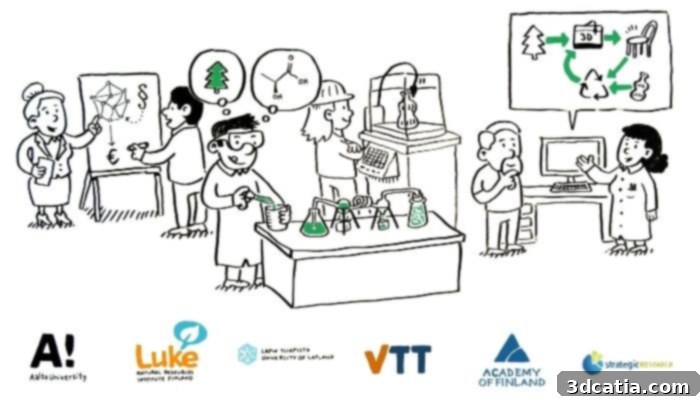
The ValueBioMat project includes several partners, highlighting a collaborative approach to innovation.
Could you tell us a little more about the 3D printing process you use?
Our team has primarily been working with stereolithography (SLA) in the realm of additive manufacturing. In SLA, a crucial parameter is ensuring the correct and rapid chemical curing of the photopolymer resin. Equally important is achieving robust chemical bonding between successive layers, which is essential for forming a truly seamless 3D network. Our ultimate goal is to produce a final result that is effectively “layer-free” in its structural integrity. We utilize advanced devices specifically engineered for this purpose. Unlike traditional layer-by-layer SLA, where the printing plate moves upwards in discrete height intervals (e.g., 50 µm) after each layer is cured, these specialized systems allow the plate to move slowly and continuously. This continuous movement, synchronized with the ongoing photo cross-linking process, results in a homogeneous, layer-free structure, eliminating the stair-stepping effect often seen in conventional additive manufacturing. This continuous process not only enhances the mechanical properties of the printed objects but also improves their surface finish and aesthetic appeal.
Another innovative approach we have implemented involves 3D printing pre-designed molds. These molds are then used in a subsequent step to cast the final objects using different, often higher-performance, materials. In this scenario, the actual end object, which is cast into the 3D printed mold, also exhibits no visible layers. This method offers several advantages, including the ability to utilize materials that are not directly suitable for current 3D printing processes, achieve superior material properties, and potentially scale up production for larger or more complex components while maintaining the design flexibility inherent in 3D printing. Both these approaches highlight our commitment to pushing the boundaries of what is possible with sustainable materials and advanced manufacturing techniques, aiming for optimal structural integrity and performance.
How does ValueBioMat see the future of renewable and circular plastics in 3D printing?
At ValueBioMat, we are profoundly convinced that 3D printing offers unprecedented possibilities for achieving optimized product design, which in turn leads to a significant reduction in material consumption. This capability to create complex geometries with minimal waste is a cornerstone of sustainable manufacturing. Furthermore, the advent of digital manufacturing, facilitated by widely distributed 3D printers, inherently supports on-demand production right at the point of use. This model dramatically reduces the need for large inventories, minimizes transportation costs and emissions, and enables efficient customization, all of which are vital aspects of a circular economy. We also recognize that 3D printing operates across various scales. From compact desktop 3D printers used for rapid prototyping and small-batch production to sophisticated robotic additive manufacturing systems capable of fabricating very large objects, the technology’s versatility means it can cater to diverse industrial needs. This scalability, coupled with the potential for localized manufacturing, allows for greater resource efficiency and adaptability. By integrating renewable and circular plastics into these processes, we envision a future where 3D printing not only creates innovative products but also fundamentally transforms manufacturing into a more environmentally benign and resource-efficient enterprise, closing material loops and minimizing waste throughout the product lifecycle.
Any last words for our readers?
New materials and their associated processing techniques are undeniably in a pivotal position to unlock and enable true sustainability and circularity in the near future. To effectively translate this potential into practical, widespread implementation, we require more than just technical solutions. We need a comprehensive, science-based understanding of the entire life cycle value chain, extending all the way to the end-of-life patterns of products. This holistic perspective is crucial for designing materials that can be easily recycled, reused, or responsibly biodegraded. In this regard, developing new business models that are inherently aligned with circular economy principles is essential. These models need the right incentives and supportive regulations to thrive and scale. I am confident that both producers and consumers are increasingly willing to embrace these changes and contribute to a more sustainable world. This commitment from all stakeholders is precisely what drives the main mission of the ValueBioMat project: to provide the scientific foundation, material solutions, and strategic frameworks necessary to make circularity in manufacturing a tangible reality. By combining innovation with responsibility, we can collectively build a future where technological advancement and environmental stewardship go hand in hand.
What are your thoughts on the groundbreaking ValueBioMat project and its efforts to revolutionize sustainable 3D printing? We’d love to hear your insights! Share your comments below or connect with us on our LinkedIn, Facebook, and Twitter pages. Don’t forget to sign up for our free weekly Newsletter here to get the latest 3D printing news delivered straight to your inbox! You can also find all our compelling videos on our YouTube channel for more in-depth content.
*Cover Photo Credits: Aalto University