
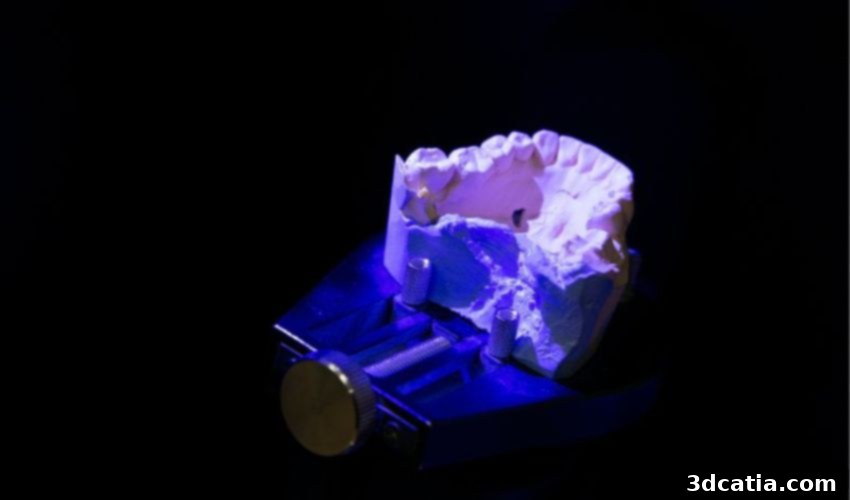
Revolutionizing Dentistry: How 3D Printing is Shaping the Future of Oral Healthcare and Aesthetics
The landscape of modern dentistry is undergoing a profound transformation, with 3D printing technology emerging as a pivotal force in its evolution. This innovative approach is not merely supplementary but is rapidly becoming indispensable, driving significant growth across the entire dental sector. A comprehensive report from BlueWeave Consulting meticulously details the projected trajectory of the global dental 3D printing market, anticipating an astonishing valuation of $12.18 billion USD by 2028. This robust expansion is fueled by a confluence of critical factors, prominently including the escalating healthcare demands of an aging global population and the relentless pace of technological advancements within the medical field. Essentially, as the need for effective and efficient patient treatments intensifies, 3D printing stands ready to deliver cutting-edge solutions.
However, it is crucial to recognize that the burgeoning demand for dental services extends far beyond the traditional scope of addressing debilitating conditions or essential restorative procedures. A significant and continuously expanding segment of the market is now driven by the pursuit of aesthetic enhancements. Patients are increasingly seeking sophisticated dental treatments designed not just for function, but primarily to improve their appearance, boost self-confidence, and achieve a more youthful, vibrant smile. This dual demand – encompassing both functional necessity and cosmetic desire – positions 3D printing as an exceptionally versatile and powerful tool, capable of meeting a broad spectrum of patient needs with unparalleled precision and customization.
The Rising Tide of Aesthetic Dentistry and 3D Printing’s Role
The undeniable drive towards enhanced dental aesthetics is a primary catalyst for the widespread adoption of 3D printing in dentistry. The distinction between purely esthetic and purely practical dental procedures has become increasingly blurred, if not entirely artificial. As one insightful contributor to the British Dental Journal succinctly put it, “there is no such thing as a non-cosmetic dentist.” This perspective underscores the intrinsic connection between oral health and visual appeal. The profound impact of dental imperfections – such as misaligned, discolored, chipped, or missing teeth – on an individual’s self-esteem, social interactions, and overall confidence is extensively documented by psychological and sociological studies. In an era increasingly focused on personal presentation and self-image, the tolerance for visually imperfect teeth has diminished significantly compared to previous generations.
Contemporary society, heavily influenced by media and social platforms, places a premium on a radiant smile. Visible dental treatments, once perhaps discreetly undertaken, are now openly embraced and even celebrated by public figures. From Hollywood luminaries maintaining their on-screen perfection to high-profile political figures presenting a polished, youthful image – even a 77-year-old serving president having observable dental work – these examples set a powerful precedent. They demonstrate how modern dental interventions can contribute to a healthy, vibrant, and confident appearance. Consequently, a vast and growing segment of the general public is inspired by these visible transformations, proactively seeking out similar aesthetic solutions for themselves. This escalating patient demand for cosmetic improvements, alongside essential functional repairs, creates an expansive market where advanced dental technologies, particularly 3D printing, are perfectly positioned to thrive.
The capability of 3D printing to produce highly customized, patient-specific prosthetics, aligners, and models with unprecedented accuracy makes it an ideal technology for both functional restoration and complex aesthetic cases. Whether it’s crafting perfectly shaped veneers, designing precise orthodontic aligners for subtle tooth movement, or creating natural-looking crowns, additive manufacturing provides the tools necessary to meet these diverse and evolving patient expectations. This technological synergy ensures that dentistry can not only restore oral health but also dramatically enhance the quality of life through improved aesthetics.
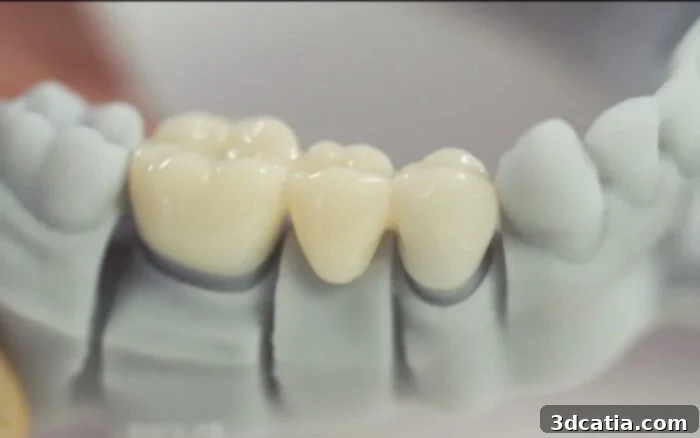
3D printed dental arch model. Photo credit: dentalnews.com
The Digital Revolution in Dentistry: From CAD/CAM to 3D Printing
The foundation for modern dental 3D printing was meticulously laid by the pioneering work in Computer-Aided Design (CAD) and Computer-Aided Manufacturing (CAM). These revolutionary technologies found their initial champion in dentistry through the visionary efforts of Dr. François Duret. In 1980, Dr. Duret secured his first patent for CAD/CAM technology, a monumental step that would forever alter dental practice. Just five years later, in 1985, he achieved another historical milestone in Paris by successfully crafting the world’s first dental crown using this innovative method. His early breakthroughs demonstrated the immense potential for digital tools to transform the fabrication of dental restorations.
The core principle behind CAD/CAM and its evolution into 3D printing in dentistry revolves around what is now widely known as the “digital workflow.” This workflow begins not with plaster models or physical impressions, but with the precise collection of non-digital, real-world patient data. Traditionally, this involved taking physical impressions, which were then cast into plaster models. However, with modern advancements, intraoral scanners capture highly detailed 3D digital impressions of a patient’s teeth and gums directly. This raw data is subsequently converted into a sophisticated digital format, typically a 3D model, within specialized computer software. Dental professionals can then design, manipulate, and refine the desired dental appliance or restoration with unparalleled accuracy and flexibility.
Once the digital design is finalized, it serves as the blueprint for manufacturing a physical model or final product. This is where 3D printing seamlessly integrates into the digital workflow. Instead of traditional subtractive manufacturing (milling), additive manufacturing (3D printing) builds the object layer by layer, directly from the digital file. This shift from physical to digital, and then back to a precise physical output, has ushered in an era of unprecedented accuracy, speed, and customization in dental care. From these foundational beginnings laid by CAD/CAM, 3D printing has not only grown exponentially but continues to deliver a multitude of advantages, revolutionizing how dental professionals approach diagnostics, planning, and treatment delivery.
Versatile Applications of Additive Manufacturing in Modern Dentistry
As the digital workflow continues to gain traction, the role of 3D printing (additive manufacturing) in delivering rapid, highly accurate, and patient-specific dental solutions has become indispensable. The comprehensive market report confirms that this technology is now central to numerous dental specialties. Among its most prominent applications, prosthodontics – the intricate science and art of creating artificial teeth and prosthetic devices – leads the market in terms of popularity and volume. However, the influence of 3D printing is far-reaching, with significant market shares also held by orthodontics and implantology, signaling a broad and deep integration across various facets of dental care.
The capability of 3D printing to produce patient-specific models of extraordinarily complex geometries is a game-changer. These models are not merely illustrative; they serve as crucial diagnostic tools, aid in surgical planning, and allow for precise customization of prosthetics. Dentists and dental laboratories leverage additive manufacturing for an extensive range of applications, including:
- Prosthodontics: This includes the creation of highly accurate crowns, bridges, dentures, and veneers. 3D printing allows for custom shading and morphology, matching the patient’s natural dentition flawlessly. Temporary restorations can also be rapidly fabricated, improving patient comfort and reducing waiting times.
- Orthodontics: A major driver in this segment is the production of clear aligners, which have revolutionized orthodontic treatment by offering a discreet and comfortable alternative to traditional braces. Additionally, 3D printing is used to create precise molds for thermoforming aligners, custom brackets, and retainers that are tailored to the individual’s oral structure, ensuring optimal treatment outcomes.
- Implantology: For dental implant procedures, surgical guides printed in 3D are invaluable. These guides ensure that implants are placed with meticulous precision, enhancing success rates and minimizing patient recovery time. The ability to plan the exact depth, angle, and position of an implant digitally and then execute it physically with a custom guide significantly reduces risks associated with freehand surgery.
- Diagnostic and Educational Models: Beyond direct patient treatment, 3D printed models are extensively used for diagnostic purposes, allowing dentists to better visualize complex cases. They also serve as excellent educational tools, helping patients understand their conditions and proposed treatment plans more effectively.
The advantages of additive manufacturing over traditional fabrication methods are multifaceted. Firstly, it offers unparalleled speed in production, dramatically shortening turnaround times for custom devices. Secondly, the precision afforded by CAD-driven 3D printing ensures that the final product exactly matches the digital design, minimizing errors and the need for adjustments. Furthermore, 3D printing is inherently a low-waste process compared to subtractive techniques, as it only uses the material necessary to build the object layer by layer. This efficiency translates into significant benefits for both practitioners and patients. For instance, increased efficiency can consolidate multiple dentist visits into fewer, more streamlined appointments, which is a considerable convenience for busy individuals and a particular comfort for anxious patients.
In terms of specific 3D printing technologies employed within dentistry, the report highlights VAT photopolymerization as the most popular technique in terms of market share. This category encompasses technologies like Stereolithography (SLA) and Digital Light Processing (DLP), known for their exceptional accuracy, fine detail resolution, and smooth surface finishes, making them ideal for dental applications requiring high precision. However, other technologies such as Fused Deposition Modeling (FDM) and Selective Laser Sintering (SLS) are also commonly utilized, each offering unique advantages depending on the specific application and material requirements. FDM, for instance, is often used for less critical models, while SLS can produce strong, biocompatible metal components for certain prosthetics.
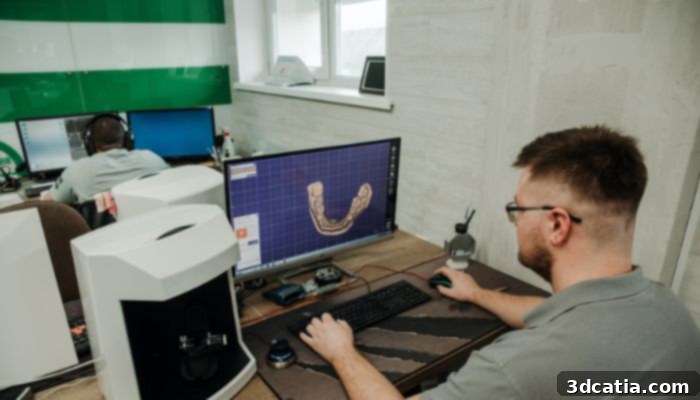
Scan of mouth has been converted into a 3D model of dental arch
Navigating the Challenges: Limitations and Future Outlook for Dental 3D Printing
Despite its transformative potential, the widespread adoption of 3D printing in dentistry is not without its inherent challenges and limitations. Addressing these hurdles is crucial for the continued growth and accessibility of this advanced technology. One significant impediment highlighted in the BlueWeave Consulting report is the discernible shortage of a skilled workforce proficient in 3D printing technologies within the dental sector. For a dental clinic or laboratory to effectively implement additive manufacturing, personnel must possess a unique blend of medical understanding and technical expertise.
Individuals operating these sophisticated machines must not only grasp the intricate medical requirements – the precise patient demand for a crown, an aligner, or a surgical guide – but also be thoroughly trained in the operation, maintenance, and material science specific to additive manufacturing. This dual competency is essential to ensure that the digitally designed solutions are translated into physical products of the highest quality and clinical efficacy. The recent global events, particularly the COVID-19 pandemic, exacerbated these labor shortages. Lockdowns, travel restrictions, and reduced opportunities for specialized training programs inevitably curtailed the influx of newly skilled professionals, thereby imposing temporary but significant limitations on market growth and technological diffusion.
Another substantial barrier to entry is the initial capital investment required for high-quality 3D printing machinery and associated software. While the long-term cost-effectiveness and efficiency gains of 3D printing are well-documented, the upfront expenditure can be considerable. This often means that advanced 3D-printed treatments may initially be more accessible to patients who can afford premium dental services. Consequently, those seeking optional cosmetic treatments, who typically have greater financial flexibility, are more likely to frequent clinics that have already invested in and integrated these cutting-edge 3D solutions. This creates a potential disparity in access to the most advanced dental care.
However, this situation is rapidly evolving. As 3D printing technology matures, manufacturing costs are gradually decreasing, and the range of affordable yet highly capable dental 3D printers is expanding. This trend suggests that while initial costs are currently a hurdle, the technology is poised to become significantly more widespread and economically viable for a broader spectrum of dental practices in the near future. Continuous research into new, more cost-effective materials and streamlined workflows will further democratize access to these advanced solutions. Investing in specialized training programs and integrating additive manufacturing curricula into dental education will also be critical to overcoming the workforce shortage, ensuring a steady supply of skilled professionals ready to harness the full potential of dental 3D printing.
The future of dental care is undeniably intertwined with the ongoing advancements in additive manufacturing. As these technologies become more accessible, efficient, and cost-effective, they promise to elevate patient care standards, enhance treatment outcomes, and expand the horizons of what is possible in reconstructive, restorative, and aesthetic dentistry. For a deeper dive into these market dynamics and projections, a comprehensive overview of the full report is available HERE.
Engage with the Future of Dental Innovation
The rapid integration of 3D printing into dental practices marks a pivotal moment in the industry, promising a future where precision, customization, and efficiency are paramount. We’ve explored how this technology is not only meeting essential functional needs but is also profoundly influencing the booming demand for aesthetic dental treatments. The ability of 3D printing to craft perfectly tailored solutions, from intricate prosthetics to invisible aligners, undeniably plays a significant role in empowering dental professionals to deliver results that exceed patient expectations in both form and function.
What are your thoughts on this dynamic intersection? Do you believe the growing emphasis on aesthetic procedures is the single most influential factor driving the phenomenal growth of the dental 3D printing market, or are there other technological and demographic forces at play that hold equal or greater sway? We invite you to share your perspectives and engage in this vital discussion. Please leave a comment below with your insights, or join the conversation on our social media platforms – you can find us on LinkedIn, Facebook, and Twitter. Don’t miss out on the latest advancements and breaking news in the additive manufacturing world; subscribe to our free weekly Newsletter here to have cutting-edge 3D printing updates delivered directly to your inbox. For a visual exploration of these innovations, be sure to visit and subscribe to our YouTube channel for all our videos.