
Revolutionizing Biotechnology: 3D Bioprinting Living Microbes for Advanced Environmental and Industrial Applications
Scientists at the Lawrence Livermore National Laboratory (LLNL), a prominent U.S. federal research institution renowned for its groundbreaking scientific advancements, have unveiled a pioneering method for precisely controlling and 3D printing living microbes in intricate, predefined patterns. This innovative development marks a significant leap forward in biotechnology, promising to unlock unprecedented potential for bacterial communities to undertake a myriad of critical tasks. The research aims to enhance the capabilities of microbes in areas such as the recovery of valuable rare-earth metals, the efficient purification of wastewater, and the sophisticated detection of hazardous substances like uranium. By enabling scientists to bioprint highly optimized microbial structures directly onto biofilms, this technology paves the way for vastly improved performance in these and many other applications. To achieve this remarkable feat, the LLNL team harnessed a novel resin-based process in conjunction with their custom-built Stereolithographic Apparatus for Microbial Bioprinting, aptly named SLAM 3D printer.
For years, bioprinting has captured considerable attention within the medical field due to its immense and transformative possibilities. Prior research and commercial endeavors, for instance, have extensively explored how bioprinting could facilitate the precise printing of live human cells, ultimately leading to the creation of functional organs for transplantation or the development of more accurate models for critical cancer research. However, the LLNL breakthrough pivots the focus of bioprinting towards a different yet equally impactful domain. Instead of primarily addressing human medical challenges, these visionary scientists have ingeniously adapted bioprinting technology to craft more optimized patterns and sophisticated structures using living bacteria. This novel approach significantly broadens the scope of microbial applications, transforming how we might leverage these microscopic powerhouses for a diverse array of environmental and industrial purposes, moving beyond the traditional constraints of biological research.
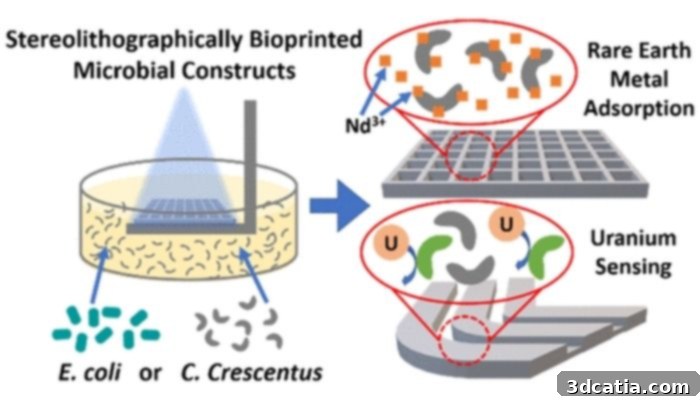
Unlike many bioprinting projects which use extrusion, this technology is based on stereolithography, or more specifically it uses LED lights like LCD printing
The Innovative SLAM 3D Bioprinting Technology: Precision at the Microscopic Level
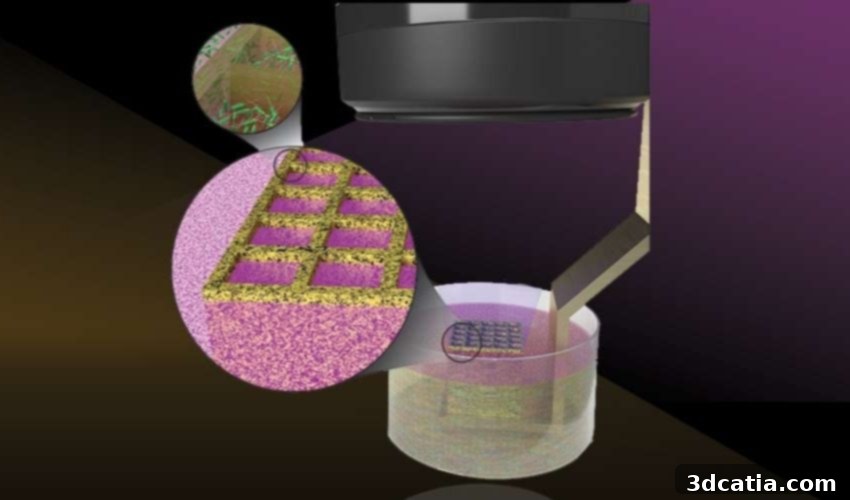
The methodology developed by the LLNL team showcases a remarkable fusion of advanced 3D printing techniques and microbial biology. At its core, the process involves using light to cure a bacteria-infused resin, thereby creating precisely structured, three-dimensional microbial patterns. This technique bears a striking resemblance to conventional LCD or Digital Light Processing (DLP) 3D printing. The team utilized photosensitive bioresins, specially formulated to be biocompatible and curable by light without harming the embedded microbes. Through the projection of LED light, akin to how a projector displays an image, these microbes were meticulously trapped within appropriate 3D structures. The accompanying image vividly illustrates this intricate process of light-patterned polymerization.
A cornerstone of this breakthrough is the custom-built SLAM 3D printer, which stands for Stereolithographic Apparatus for Microbial Bioprinting. Unlike traditional extrusion-based bioprinting methods that push out bio-ink through a nozzle, the SLAM system leverages the principles of stereolithography (SLA). This allows for exceptionally fine detail and intricate geometries. Thanks to the advanced capabilities of the SLAM 3D printer, the researchers were able to achieve an impressive printing resolution of approximately 18 microns – a dimension comparable to the diameter of a typical human cell. This unprecedented level of control over the physical arrangement of microbial communities is transformative. By meticulously designing and creating diverse patterns of microbes, the researchers have discovered a direct correlation between the spatial organization of these communities and their functional performance, allowing them to effectively tailor microbial communities to specific tasks. This newfound ability, facilitated by 3D printing, empowers scientists to develop sophisticated tools for investigating how microbes behave under a myriad of geometrically complex yet highly controlled conditions, ultimately enabling them to translate these fundamental insights into robust, real-world applications across various sectors.
Insights from the Lead Bioengineer: Pushing the Boundaries of Microbial Culturing
Principal investigator and esteemed LLNL bioengineer, William “Rick” Hynes, emphasized the profound significance of this research, stating, “We are trying to push the edge of 3D microbial culturing technology. We think it’s a very under-investigated space and its importance is not well understood yet. We’re working to develop tools and techniques that researchers can use to better investigate how microbes behave in geometrically complex, yet highly controlled conditions. By accessing and enhancing applied approaches with greater control over the 3D structure of the microbial populations, we will be able to directly influence how they interact with each other and improve system performance within a biomanufacturing production process.” Hynes’ statement underscores a critical point: while microbes are ubiquitous and vital to countless natural and industrial processes, our ability to precisely control their behavior at a micro-architectural level has been limited. This new additive manufacturing method provides the tools necessary to bridge this gap, opening up new avenues for fundamental biological research and paving the way for advanced biomanufacturing. For those interested in delving deeper into the scientific details, the comprehensive study is available for download HERE.
Transformative Applications Across Industries
The implications of being able to precisely control microbial patterns extend far beyond theoretical research, promising to revolutionize numerous industrial and environmental sectors. One compelling application lies in the **recovery of rare-earth metals**. These vital elements are indispensable for modern technologies, from smartphones to electric vehicles, but their extraction is often environmentally intensive. By engineering specific microbial communities to selectively bind and extract these metals, and then organizing these microbes into optimized 3D structures, their efficiency and throughput can be dramatically increased, offering a greener and more sustainable recovery method.
Another critical area is **wastewater treatment**. Traditional methods can be energy-intensive and often leave residual pollutants. Bioprinted microbial biofilms, designed with tailored structures, can significantly enhance the degradation of organic pollutants, remove heavy metals, and even convert waste into valuable byproducts. The precise spatial arrangement ensures optimal nutrient and oxygen exchange within the biofilm, maximizing the metabolic activity of the wastewater-treating microbes. Similarly, the technology holds immense promise for **environmental remediation**, such as the detection and remediation of uranium. Microbes are known for their ability to immobilize or detoxify various contaminants, and with 3D bioprinting, we can create custom-designed microbial “bio-factories” to target specific pollutants with unprecedented accuracy and efficiency.
Furthermore, the ability to control microbial communities at this resolution opens doors for advanced **biosensors** capable of detecting minute quantities of specific compounds in real-time, whether in environmental monitoring, medical diagnostics, or industrial quality control. In **biomanufacturing**, this technology promises to optimize the production of biofuels, pharmaceuticals, enzymes, and other biochemicals. By creating ideal micro-environments and interaction pathways for microbial consortia, processes can become more productive, predictable, and scalable, leading to more efficient and cost-effective production methods. This represents a significant paradigm shift from bulk microbial cultures to intelligently designed and spatially organized biological systems, offering a new frontier in sustainable technological development.
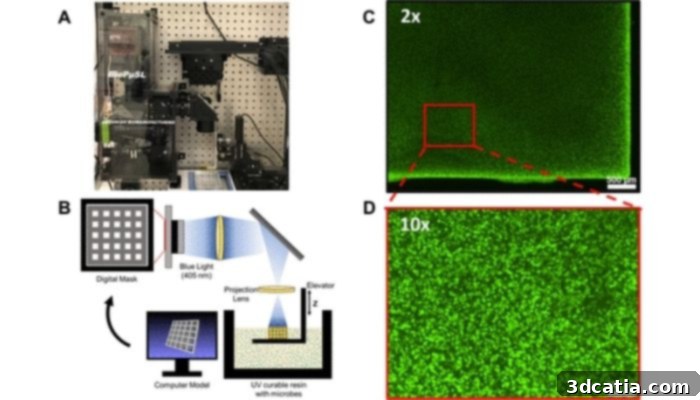
The researchers have published their findings showing how 3D printing can create these unique structures
The Future of Microbial Bioprinting: A New Era for Biotechnology
This pioneering research from LLNL heralds a new era for biotechnology and environmental science. The capacity to 3D print living microbes in geometrically defined, functional patterns provides scientists and engineers with an unprecedented level of control over biological systems. This control is not merely about placing cells; it’s about engineering microbial ecosystems at a microscopic scale, mimicking and improving upon natural structures to enhance their specific functions. As this technology matures, we can anticipate more sophisticated designs for microbial structures, potentially integrated with artificial intelligence and machine learning algorithms to autonomously design and optimize these living systems for even more complex tasks. The potential for creating self-sustaining, highly efficient biological systems to address some of humanity’s most pressing challenges – from environmental sustainability to resource management and advanced manufacturing – is now within closer reach than ever before.
What are your thoughts on this groundbreaking study regarding the use of 3D printing for microbes? We invite you to share your insights in a comment below or engage with us on our Linkedin, Facebook, and Twitter pages! Don’t miss out on the latest advancements in additive manufacturing – remember to sign up for our free weekly Newsletter here, delivering the most up-to-date 3D printing news straight to your inbox! You can also explore all our informative videos and content on our YouTube channel.
*All Image Credits: Thomas Reason/LLNL