
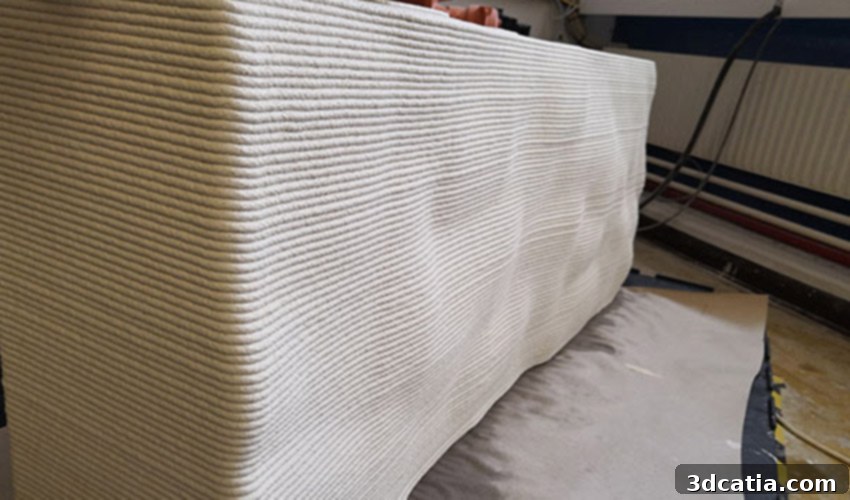
PrintStones: Pioneering On-Site 3D Concrete Printing for Sustainable Construction
In the dynamic landscape of modern construction, innovation is key to addressing challenges of efficiency, sustainability, and design flexibility. One pioneering startup, PrintStones from Vienna, is at the forefront of this evolution, dedicated to automating construction operations through groundbreaking technology. Their core focus lies in the development of advanced 3D printing technology for concrete and similar robust construction materials. What sets PrintStones apart is their commitment to on-site application, directly bringing additive manufacturing capabilities to the construction site. This ingenious approach fundamentally transforms traditional building processes by largely eliminating the need for cumbersome and labor-intensive formwork elements, paving the way for more streamlined, cost-effective, and environmentally friendly construction. We recently had the invaluable opportunity to delve deeper into PrintStones’ vision and technological advancements through an insightful interview with their co-founder, Herwig Hengl, who shared his journey and the company’s ambitious goals.
3DN: Can you briefly introduce yourself and your connection to 3D printing?
My background is rooted in structural engineering, a field where I spent many years focusing on the fundamental mechanics of materials and structures. Interestingly, my direct connection to additive manufacturing is a relatively recent development, dating back about five years. This discovery occurred during my tenure as a university assistant at the Institute of Mechanics of Materials and Structures, where my research primarily involved finite element simulations. It was during this period that I became captivated by the concept of topology optimisation. This fascinating design methodology involves an iterative computational process to identify and remove weakly stressed zones within an object under specific load conditions. The ultimate goal is to create highly efficient, organic-looking structures that exhibit exceptional stiffness while significantly reducing overall material volume. As I sought practical methods to physically realize these complex, optimized geometries, I naturally gravitated towards additive manufacturing technologies. The ability of 3D printing to create intricate shapes layer by layer proved to be the perfect solution for translating theoretical designs into tangible prototypes.
Our venture into concrete 3D printing, specifically, began approximately two years ago. This crucial phase was significantly bolstered when our project was accepted and subsequently supported by INITS, the highly respected high-tech business incubator of the City of Vienna. Their early backing provided the essential resources, mentorship, and network opportunities that were instrumental in transitioning our academic research into a viable startup, propelling PrintStones from concept to concrete reality. This journey has been a testament to the transformative power of combining structural engineering principles with cutting-edge additive manufacturing techniques, aimed at disrupting traditional construction paradigms.
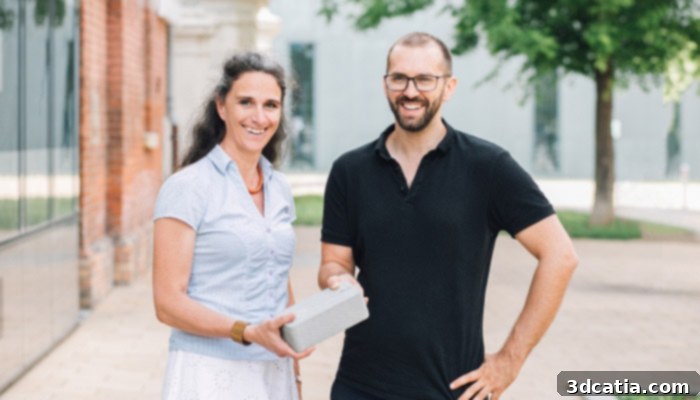
Herwig Hengl, here with Irene Fialka, CEO of INiTS | Credits: INiTS.
3DN: Can you tell us more about the 3D concrete printing technology you developed?
Certainly! At the heart of our innovation is the “PrintStones X1,” an early yet highly capable prototype of our mobile construction site concrete 3D printer. This machine represents a significant step forward in on-site additive manufacturing for the construction industry. Currently, the X1 is engineered to print concrete elements with a volumetric capacity of up to approximately one cubic meter. This size range allows for the creation of various structural and aesthetic components directly where they are needed. In terms of operational speed, the nozzle currently achieves a maximum web speed of about 0.2 meters per second, a performance metric that we are continuously optimizing for future iterations. A key advantage of the PrintStones X1 is its versatility; it can be deployed and operated effectively in both outdoor and indoor construction environments, adapting to diverse project requirements.
The fundamental principle behind our printing process is analogous to Fused Deposition Modeling (FDM), a widely known additive manufacturing technique. In our method, each layer of the concrete structure is meticulously built up, typically consisting of an outer contour that defines the shape and an internal filling pattern that provides structural integrity and material efficiency. A crucial aspect of our system is the fully automatic material preparation, managed by an integrated mini-concrete plant. This intelligent system ensures precise mixing and delivery of the concrete, guaranteeing consistent material quality throughout the printing process. Moreover, the material recipe is not fixed; it can be dynamically varied during printing. This capability is particularly beneficial for creating functionally graded structures, where, for instance, heavily loaded zones can be printed with high-strength material, while less critical areas might use a standard mix, optimizing both performance and resource utilization.
By strategically employing infill patterns, we achieve a significantly lower material consumption compared to conventional formwork construction methods. This reduction in material usage is not only an economic benefit but also carries profound ecological advantages, especially pertinent to concrete. The production of cement, a primary component of concrete, is known to be responsible for approximately 8% of global CO2 emissions. Therefore, by minimizing concrete waste and optimizing its use through 3D printing, PrintStones contributes directly to more sustainable construction practices, reducing the environmental footprint of building projects and promoting a greener future for the industry.
3DN: What kind of applications do you want to realise? What are your future projects?
Our initial and immediate application focus is on the 3D printing of concrete paving elements. We strategically chose this segment as our entry point because it allows us to bring our technology to market faster, achieving tangible impact without the complexities associated with larger-scale structural additive production of entire buildings. The benefits of 3D printing paved surfaces are multifaceted and compelling. Environmentally, it’s a more ecological approach due to reduced material waste and optimized material use. From a labor perspective, it significantly enhances worker health and safety by automating repetitive and physically demanding tasks, minimizing exposure to hazardous conditions and strain injuries. Beyond these practical advantages, our technology unlocks entirely new creative possibilities for landscape architects, enabling them to design intricate, custom, and previously unachievable paving patterns and urban furniture, truly transforming public and private outdoor spaces.
While the current printing speed, around 30-60 minutes per square meter for paving, might seem a disadvantage when compared to mass-produced, standardized pavers, our core philosophy is not centered on maximizing throughput of generic elements. Instead, PrintStones is profoundly interested in pushing the boundaries of design and functionality. Our focus is on creating entirely new types of paving surfaces that not only meet but significantly exceed the technical performance and aesthetic appeal of currently available solutions. This emphasis on “quality before quantity” drives our research and development. We envision highly customized, durable, and visually striking paving installations that offer enhanced drainage, integrated lighting, or even tailored thermal properties, delivering unique value propositions that traditional manufacturing cannot match. Our future projects will continue to explore these unique applications where customization, complexity, and performance are paramount, rather than just raw speed of production for simple, repetitive items.
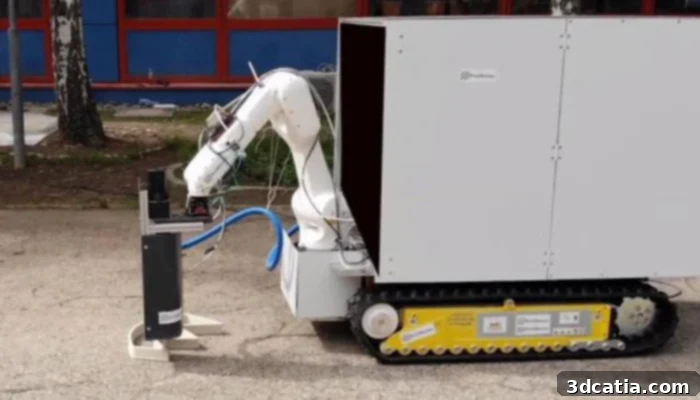
Prototype of the mobile concrete 3D printer | Credits: ArtCoreDesign.
3DN: What are the technical challenges of (mobile) concrete 3D printing? What are the benefits?
The most significant technical challenge facing concrete 3D printing today, especially for load-bearing structures, revolves around the issue of reinforcement. Concrete, while exceptionally strong in compression, possesses a relatively low tensile strength. This inherent characteristic means that components subjected to bending or tension – which is common in many structural applications – traditionally require reinforcement, typically in the form of steel elements like rebar. Integrating this reinforcement seamlessly and effectively into an additive manufacturing process presents a complex engineering hurdle. Numerous companies and universities worldwide are dedicating substantial research efforts to developing viable solutions for reinforced concrete 3D printing. These diverse approaches include methods such as the manual insertion of reinforcement bars during pauses in printing, the automated unrolling of wire coils directly into the fresh concrete layers, the incorporation of various types of fibers (steel, polymer, basalt) into the concrete mix to enhance its tensile properties, and even additive production of reinforcement bars through advanced build-up welding techniques. Each method has its own set of advantages and challenges concerning automation, material compatibility, and structural performance, making this a vibrant and critical area of ongoing research.
Despite these challenges, the advantages of concrete 3D printing are compelling and transformative for the construction industry. Foremost among these benefits is the unparalleled freedom of form it offers. Designers are no longer constrained by the limitations of traditional formwork, allowing for the creation of highly complex, organic, and aesthetically innovative structures that were previously impossible or prohibitively expensive to build. This freedom extends to cost-effectiveness, particularly for the production of individual, unique pieces or small batches, where traditional molding techniques would incur significant setup costs. Furthermore, 3D concrete printing drastically reduces the need for storage space on construction sites, as there are no bulky shuttering panels or pre-fabricated molds to store and manage. The entire process is simplified and centralized within the printer.
Another substantial advantage is the principle of “On Demand” production. This means components can be printed precisely when and where they are needed, minimizing logistical complexities and potential waste from over-ordering or improper storage. While an object cannot be immediately shipped upon completion – it typically requires approximately 24 hours to cure sufficiently – it achieves about 40% of its final strength within this timeframe, making it robust enough for handling and further assembly. With the added benefit of mobile concrete printing, these advantages are amplified. The elimination of extensive installation processes and a significant portion of the logistics chain is paramount, as objects are printed directly at their final place of use. This drastically reduces transportation costs, site footprint, and the overall environmental impact associated with moving heavy materials and finished components, marking a significant leap towards more efficient and localized construction practices.
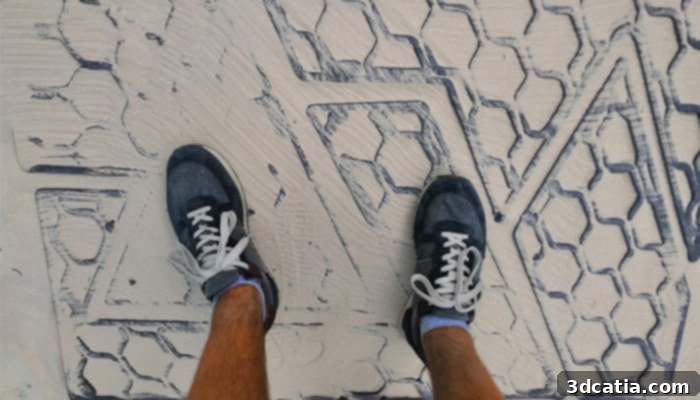
Additively manufactured concrete paving stones (without top layer) | Credits: PrintStones.
3DN: How do you see the future of 3D concrete printing?
In the immediate future, I foresee significant advancements and applications primarily in the production of non-load-bearing architectural shells, intricate facade elements, and components that are predominantly subjected to compressive stress. These areas leverage the inherent strengths of concrete and the geometric freedom of 3D printing without immediately running into the more complex challenges of tensile reinforcement. We will see increasingly complex and customized wall structures, acoustic panels, and decorative elements created with unparalleled speed and design flexibility. This will enable architects to realize previously impossible designs, pushing aesthetic boundaries in construction.
Looking further down the line, into the long term, a number of critical problems still need to be comprehensively addressed before 3D concrete printing can achieve widespread adoption for primary structural elements in large-scale building projects. Beyond the aforementioned and formidable challenges related to integrating effective and automated reinforcement, there are also significant regulatory issues within the established construction industry. Building codes and standards, which are inherently conservative and designed for traditional methods, need to evolve to accommodate and validate these new additive manufacturing processes and materials. Furthermore, continuous research into material science will be essential to develop novel concrete mixes that are specifically optimized for 3D printing, offering enhanced printability, faster curing times, and improved long-term durability. Tackling these interwoven technical, material, and regulatory hurdles will be crucial for realizing the full transformative potential of 3D concrete printing in the global construction landscape.
3DN: A few last words to our readers?
We are incredibly excited about the future of 3D concrete printing and its potential to revolutionize construction. As a testament to our commitment to innovative design and making this technology accessible, we will be offering limited 3D printed concrete design elements for sale on a monthly basis. These pieces will showcase the aesthetic and functional possibilities of additive manufacturing in concrete, allowing enthusiasts and early adopters to experience the unique qualities of our creations firsthand. We invite you to stay updated and find more information on these exclusive offerings, as well as our ongoing projects and technological advancements, by visiting our official website HERE.
We hope this interview has provided a fascinating glimpse into the world of PrintStones and the promising future of mobile 3D concrete printing. We are eager to hear your thoughts and perspectives on PrintStones’ innovations and the broader implications for the construction industry. Do you believe this technology will fundamentally change how we build? Share your insights and join the conversation by leaving a comment below or engaging with us on our social media platforms, including our Facebook and Twitter pages! For all the latest news, trends, and breakthroughs in the exciting realm of 3D printing, don’t forget to sign up for our free weekly Newsletter, delivering cutting-edge information straight to your inbox every week!