
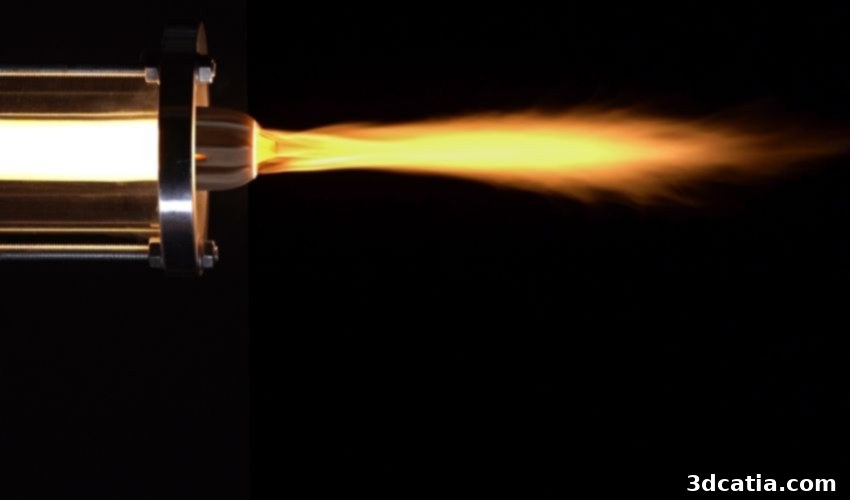
Ceramic 3D Printing in Aerospace: Revolutionizing Space Exploration with Advanced Materials
The future of manufacturing is rapidly evolving, and one sector poised for monumental transformation is ceramic 3D printing. Projections indicate that the global ceramic 3D printing market will reach an impressive $4.8 billion by 2030, with the aerospace industry emerging as a pivotal customer. This growth is driven by the industry’s incessant demand for materials and manufacturing processes that can withstand extreme conditions while offering enhanced performance and efficiency. Vienna-based Lithoz, a notable pioneer in this field, has positioned itself at the forefront of ceramic 3D printing for aerospace applications. Through its groundbreaking lithography-based ceramic manufacturing (LCM) technology, Lithoz is enabling the widespread adoption of advanced ceramics in an industry where precision and reliability are paramount. This article explores the specific capabilities and diverse applications of ceramic 3D printing and the innovative materials developed by Lithoz, illustrating how they are significantly contributing to meeting and exceeding the rigorous requirements of modern aerospace engineering.
Spaceships Take Off With 3D Printed Ceramic Parts: Overcoming Extreme Conditions
The aerospace sector operates under a principle of continuous improvement: faster, simpler, and more cost-effective. Yet, few industries face such extraordinarily high demands and expectations for additively manufactured parts. Components used in aerospace must endure not only immense mechanical loads but also extreme thermal fluctuations, ranging from scorching heat to freezing cold. Consider, for instance, turbine blades that spin at speeds so high they generate temperatures exceeding the melting point of conventional metals. This pushes traditional manufacturing processes to their absolute limits. Furthermore, in the vacuum of space, temperatures can plummet to below –200 °C. Aerospace components must maintain uncompromised performance across this vast thermal spectrum, ensuring continuous stability and precise porosity—attributes critical for mission success.
The precise sizing of components, such as catalysts, is also vital. If parts are manufactured too large, it can lead to inefficient heat loss. Conversely, if they are too small, they may fail to achieve maximum decomposition of propellants. Both scenarios result in reduced performance and increased operational costs, highlighting the critical need for a forward-thinking alternative in manufacturing processes for aerospace. The quest for materials that can consistently perform under these unforgiving conditions makes ceramic 3D printing an indispensable technology, offering a solution to challenges that conventional methods struggle to address.
Ceramic 3D printing effectively addresses these profound obstacles. Ceramics are inherently known for their exceptional properties, including superior heat resistance, remarkable mechanical strength, and the ability to produce incredibly fine components with the highest quality. Additive manufacturing further amplifies these advantages, allowing for the design and creation of intricate, complex geometries that are impossible to achieve with conventional manufacturing methods, all while significantly reducing costs and lead times. This combination of material excellence and manufacturing flexibility positions ceramic 3D printing as an ideal solution for an industry as relentlessly demanding as aerospace.
Lithoz has swiftly established itself as a leader in this specialized market, particularly through its development of a revolutionary silicon nitride (Si3N4) material. This advanced ceramic material boasts an optimal combination of properties: tremendous strength even at extremely high temperatures, outstanding resistance to sudden and severe temperature changes (thermal shock), and impressive hardness. To rigorously validate these properties and test the material’s resilience under real-world extreme conditions, Lithoz conducted a comprehensive stress test. A nozzle made from their proprietary Si3N4 was subjected to intense thermal cycling, yielding excellent and conclusive results.
During the pivotal test, the Lithoz team aimed to evaluate the thermal shock resistance of their 3D-printed silicon nitride nozzle. The nozzle was first heated to a scorching 900 °C, then immediately plunged into water to cool it rapidly back to room temperature—a process designed to induce severe thermal stress. Remarkably, despite this extreme thermal cycling, the 3D-printed nozzle emerged completely undamaged, showcasing the material’s extraordinary robustness. Lithoz further asserts that their silicon nitride can endure even higher temperatures than 900 °C, confirming its superior performance capabilities for high-temperature applications.
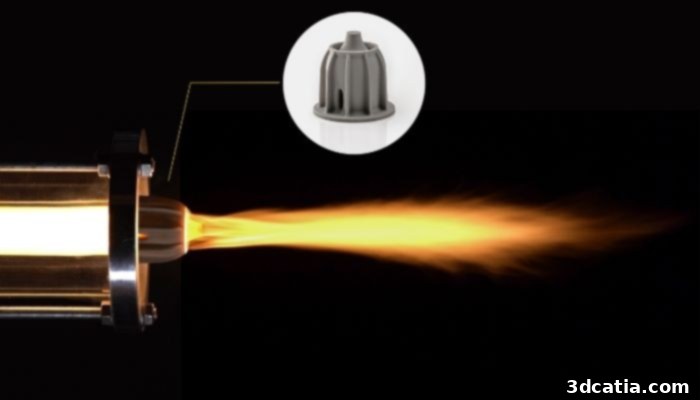
This Lithoz nozzle can withstand the highest temperatures (photo credits: Lithoz GmbH)
The implications of this for the aerospace industry are profound. The combination of additive manufacturing with silicon nitride enables the production of 3D-printed parts that possess exceptional thermal shock resistance, immense strength, and remarkable toughness. Crucially, it allows for the fabrication of complex ceramic components with intricate internal structures, such as advanced cooling channels, that are impossible to create using traditional methods. For the aerospace sector, this means the rapid and precise production of critical parts like microturbines, impellers, and cutting tools, which can then be deployed in environments reaching up to 1200 °C. These manufacturing feats would be prohibitively time-consuming and costly, if not entirely unfeasible, with conventional processes.
Beyond aerospace, the versatility of Si3N4 extends to other vital industries. The medical field, for instance, significantly benefits from silicon nitride’s unique properties, particularly its antibacterial and antiviral surface chemistry, coupled with its excellent biocompatibility. This makes Si3N4 an ideal material for various biomedical applications, including dentistry, orthopedics, and craniomaxillofacial implants. Its surface characteristics even make it highly effective in combating pathogens, proving particularly valuable in the ongoing fight against viruses and bacteria, including those responsible for the coronavirus.
3D Printing on the Moon: Fact or Fiction? The Future of Lunar Manufacturing
The concept of manufacturing directly on the moon using lunar resources might sound like a scene from a futuristic science fiction movie, but with ceramic 3D printing and Lithoz’s technology, it is rapidly becoming a tangible reality. The company is already demonstrating the feasibility of using moon dust, or lunar regolith, as a raw material for 3D printing. This development sparks an exciting question: could this be the crucial next step towards establishing sustainable human habitation in space? While the full scope of human life beyond Earth is still being explored, one certainty is clear: Lithoz’s LCM technology empowers the high-precision manufacturing of aerospace components directly from lunar regolith. For upcoming deep-space missions and potential lunar bases, this capability translates into the unprecedented ability to produce necessary spare parts and specialized tools on-site and on-demand, drastically reducing reliance on costly and logistics-heavy resupply missions from Earth.
Harnessing lunar resources, which are abundant and considered non-toxic for human interaction, through ceramic 3D printing involves several intricate steps and ongoing research. Lithoz’s close collaboration with the European Space Agency (ESA) is instrumental in facilitating continuous research and advanced development concerning the viability and optimization of lunar dust for 3D printing applications. This partnership has already yielded significant breakthroughs. For example, as part of the EU Horizon 2020 project RHEFORM, researchers have been investigating solutions to replace hydrazine, a carcinogenic substance that has been a staple propellant in space travel since the 1960s. Utilizing Lithoz’s CeraFab 7500 3D printer, a Digital Light Processing (DLP)-based additive manufacturing system, along with its proprietary photocurable binder, the team made substantial progress in developing improved space applications. Their work demonstrates how terrestrial technology can be adapted for extraterrestrial manufacturing, offering safer and more efficient alternatives for future space endeavors. Several other projects involving Lithoz are currently underway, all dedicated to exploring and expanding the possibilities of manufacturing with moondust, paving the way for truly self-sufficient space missions.
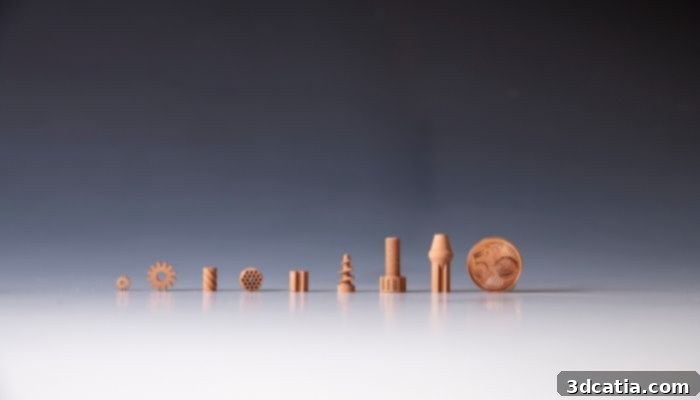
Parts 3D printed from lunar dust can take on different sizes and shapes (photo credits: Lithoz GmbH)
The Production of Lighter Aircraft Turbines Thanks to Lithoz’s Innovative Materials
Aircraft turbines are the heart of every flight, making their design and manufacturing critically important. Within these complex engines, turbine blades are among the most crucial components, traditionally produced through investment casting. However, this conventional approach presents a significant limitation: with standard injection-molded cores, the ability to incorporate highly intricate, multi-blade, and narrow cooling elements is severely restricted. Over time, these limitations can lead to not only escalating operational costs but also potential safety risks due to inefficient cooling and suboptimal performance. The challenge then becomes: how can modern turbines be manufactured more efficiently and innovatively without incurring prohibitive costs?
Lithoz provides a compelling solution with its proprietary LithaCore 450, a silica-based material specifically engineered for the production of cast iron cores using LCM technology. This advanced material boasts a unique combination of low thermal expansion and very high porosity, making it exceptionally well-suited for the additive manufacturing of precise ceramic cores. These cores can feature highly intricate internal details, essential for creating complex cooling channels within aerospace turbine blades. The tool-less nature of additive manufacturing not only eliminates the need for expensive, specialized tooling but also drastically reduces overall costs and production effort. Moreover, Lithoz’s LCM technology accelerates the manufacturing process, allowing for quicker turnaround times for both prototypes and full-scale series production. This significantly shortens the time-to-market for critical aerospace components. The casting cores produced with LithaCore 450 can achieve an astonishing fineness of at least 200 µm, even for complex geometries featuring intricate elements like trailing edges, and can be scaled up to sizes of 30 cm. Demonstrating its superior capabilities, Lithoz has utilized its CeraFab system to produce multiple cast cores measuring an impressive 500 mm—a feat previously unachieved in this form, solidifying Lithoz’s position as a provider of forward-thinking solutions for prototyping and large industrial turbine core production.
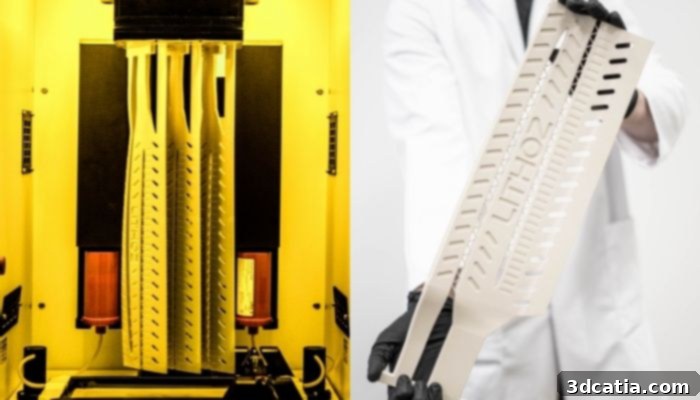
Ceramic cores printed on CeraFab S230 with LithaCore 450 for industrial gas turbines (photo credits: Lithoz GmbH)
The Latest Materials Developed by Lithoz: Expanding the Horizons of Ceramic 3D Printing
Building upon its established success with materials like silicon nitride, Lithoz continuously innovates, expanding its selection of advanced ceramic materials to address new industrial challenges. Among their latest developments are Silicon-Infiltrated Silicon Carbide (SiSiC) and Aluminum Nitride (AlN).
Silicon-Infiltrated Silicon Carbide (SiSiC) is a remarkable ceramic material known for its unique combination of lightweight properties and exceptional hardness. It offers very good thermal conductivity and minimal thermal expansion, making it highly suitable for applications where thermal stability and efficient heat transfer are critical. Consequently, SiSiC ceramics are frequently employed in demanding environments as high-performance heat exchangers, durable nozzles, or robust end pieces for various types of burners. Its ability to maintain structural integrity under extreme thermal gradients opens up new possibilities for aerospace components requiring superior heat management.
On the other hand, Aluminum Nitride (AlN) is developed using Lithoz’s advanced DLP-based manufacturing technology. Similar to SiSiC, aluminum nitride exhibits high thermal conductivity, which is crucial for dissipating heat efficiently in electronic and thermal management systems. During research samples, the flexural strength of AlN was measured to vary robustly between 320 and 498 MPa, indicating its excellent mechanical performance. In summary, these combined properties—high thermal conductivity and significant flexural strength—enable the production of highly complex, crack-free parts. This capability creates entirely new application possibilities, particularly in the critical field of thermal management within aerospace and other high-tech industries, allowing for more compact and efficient component designs.
Silicon carbide enables shapes and sizes beyond imagination (Image: Lithoz GmbH)
This extensive and diverse range of materials, coupled with Lithoz’s continuous technological advancements, clearly demonstrates the profound progress ceramic 3D printing has achieved within the aerospace sector. It underscores the myriad new possibilities this technology unlocks. Beyond merely enabling the production of components with immensely complex internal and external structures, Lithoz and its advanced materials offer unparalleled design freedom. This freedom is combined with the highest levels of precision and quality, ensuring that every 3D-printed part meets the stringent standards of aerospace applications. Whether a component needs to be just a few millimeters in size or as large as half a meter, the first-class material quality and the consistent, pixel-precise exposure achieved uniformly across the entire build platform using a CeraFab system mean that even high-volume series production of intricate parts is no longer a challenge, but a standard capability.
What Projects is Lithoz Currently Working on in the Aerospace Sector? Driving Innovation Forward
Lithoz’s significant involvement in various collaborative projects further intensifies its impact on the aerospace sector. In a notable partnership with researchers from the University of Poitiers (France), FOTEC Forschungs- und Technologietransfer GmbH (Austria), and the University of Applied Sciences Wiener Neustadt GmbH (Austria), Lithoz has presented a comprehensive comparison of 3D-printed monolithic ceramic catalysts against traditionally produced catalysts and those with different washcoat layers. This research focused on the decomposition of highly concentrated hydrogen peroxide, a critical process in many propulsion systems.
A key finding from this comparative study was the significant role of porosity. The measured porosity of the 3D-printed ceramic structures was found to be immensely greater than that of conventionally extruded structures. This enhanced porosity directly translates into an improved transient temperature behavior, meaning the catalysts can manage and respond to rapid temperature changes more effectively and predictably. Such results represent crucial steps forward for the increased and optimized use of ceramic 3D printing in various aerospace applications, from propulsion systems to thermal management units. By pushing the boundaries of material science and additive manufacturing, Lithoz continues to provide innovative solutions that enhance performance, efficiency, and safety in space exploration. For more information regarding Lithoz’ activities and their ongoing research, click HERE.
Which Lithoz material do you think adds the most value to the aerospace sector? Let us know in a comment below or on our Linkedin, Facebook, and Twitter pages! Don’t forget to sign up for our free weekly Newsletter here, the latest 3D printing news straight to your inbox! You can also find all our videos on our YouTube channel.
*Cover Photo Credits: Lithoz GmbH