
The Future of Fabrication: Exploring 3D Printing’s Transformative Impact on Construction, Robotics, and Rapid Prototyping
This week, we delve into the transformative world of 3D printing and its profound influence across various industries. From constructing sustainable, affordable homes to revolutionizing automotive design and even developing advanced robotics, additive manufacturing is pushing the boundaries of what’s possible. We’ll start by examining ICON’s ambitious project to build a community of 3D-printed homes in Texas, showcasing the tangible benefits this technology brings to the housing sector. Next, we’ll explore how innovative software and digital prefabrication are streamlining construction processes and tackling industry waste. We’ll then shift gears to the exciting realm of motorsports, highlighting a student team that’s leveraging 3D printing for high-performance electric vehicles. Our journey continues into advanced robotics, where 3D printing enables the creation of complex, bio-inspired machines. Finally, we’ll uncover the versatility of vacuum formers as a powerful tool for rapid prototyping and diverse manufacturing projects. Join us as we explore these groundbreaking developments that are shaping the future of fabrication and engineering.
ICON Leads the Way: Building the Largest 3D-Printed Home Community in Austin, Texas
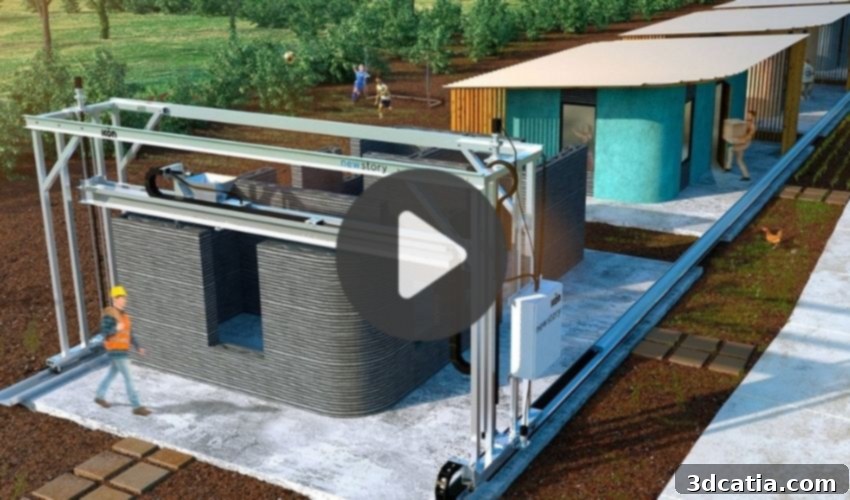
In a landmark collaboration poised to redefine modern housing, ICON, a pioneer in advanced construction technologies, has partnered with Lennar, one of the United States’ leading homebuilders. Their ambitious joint venture aims to construct an unprecedented 100 3D-printed homes in Austin, Texas, with completion targeted for the coming year. This initiative represents a monumental leap forward for additive manufacturing in the residential sector, demonstrating its scalability and practical application for large-scale development. ICON leverages its proprietary Vulcan construction system, a robotic gantry printer that precisely extrudes a specialized concrete-like material called Lavacrete. This innovative approach allows for the rapid construction of resilient, energy-efficient home structures that are built to last. The potential implications are vast and timely: in an era marked by increasing global scarcity of construction materials and persistent labor shortages, 3D printing offers a compelling and sustainable solution. By utilizing precise, on-demand manufacturing directly on-site, waste is significantly minimized, and material usage is optimized, leading to more environmentally friendly building practices. Furthermore, the inherent efficiency of the 3D printing process drastically reduces construction timelines, paving the way for the development of high-quality, durable, and significantly more affordable residences. This project not only addresses the pressing global need for accessible housing but also sets a new benchmark for sustainable and efficient building practices, heralding a future where advanced technology makes homeownership more attainable for a broader population and transforms the traditional construction landscape.
Revolutionizing Construction: Digital Prefabrication and 3D Printing for a Sustainable Future
The construction industry faces immense environmental challenges, not least of which is its substantial contribution to global waste streams. Astonishingly, nearly 30% of the materials ending up in landfills originate from construction activities. Addressing this critical issue, Branch Technology introduces its groundbreaking Cellular Fabrication (C-Fab®) process, a digital prefabrication solution specifically designed to drastically reduce waste and transform traditional building practices. C-Fab® goes beyond conventional construction methods by utilizing a unique free-form additive manufacturing process to create complex, lightweight architectural components with unparalleled precision. This innovative method not only significantly minimizes material consumption through optimized, custom geometries but also unlocks unprecedented design freedom and facilitates true mass customization in the built environment. Architects and designers are no longer constrained by conventional limitations, enabling the creation of intricate, structurally efficient, and aesthetically striking structures that were previously impossible or prohibitively expensive to build. Furthermore, C-Fab® offers a strategic answer to the persistent labor shortages plaguing the construction sector worldwide. By automating much of the fabrication process and allowing for the off-site production of large, complex modules, Branch Technology aims to attract and empower a new generation of technologically skilled workers, fostering innovation and efficiency across the industry. This shift towards digital prefabrication represents a paradigm change, moving construction towards a more sustainable, adaptable, and technologically advanced future, where waste is minimized, resources are conserved, and creative possibilities are maximized for future generations.
Accelerating Innovation: Formula Student Green Team Leverages 3D Printing for Electric Race Cars
The world of motorsports is a powerful crucible for innovation, consistently pushing the boundaries of engineering, design, and material science. At the forefront of this evolution is the Green Team from the University of Stuttgart, a group of exceptionally talented students participating in the prestigious Formula Student competition. Renowned for their relentless pursuit of performance and sustainability, this team has consistently broken records and achieved top speeds in global competitions with their cutting-edge all-electric racing cars. Their remarkable success is significantly bolstered by their strategic collaboration with industry leaders in additive manufacturing (AM). By integrating advanced 3D printing techniques into their design and production workflow, the Green Team can rapidly prototype, test, and iterate critical components for their high-performance vehicles. This encompasses everything from lightweight aerodynamic parts and intricate intake manifolds to specialized housing for complex electronics and custom suspension elements. Additive manufacturing allows them to create parts with optimized geometries that are impossible or impractical to achieve with traditional manufacturing methods, leading to crucial advantages such as reduced weight, improved strength-to-weight ratios, and enhanced functional integration. The ability to quickly produce custom parts in advanced, high-performance materials means they can fine-tune their race car for unparalleled agility and speed, giving them a significant competitive edge. This project brilliantly exemplifies how 3D printing is not just for industrial applications but is also revolutionizing bespoke engineering in demanding, high-stakes environments like professional motorsports, fostering a new generation of engineers fluent in the most advanced manufacturing techniques available today.
Bio-Inspired Robotics: ETH Zurich Develops Autonomous Feline Robots with 3D Printing
The burgeoning field of robotics is undergoing a dramatic transformation, largely driven by continuous advancements in material science and sophisticated manufacturing techniques. Researchers at ETH Zurich, a world-renowned institution for science and technology, are at the vanguard of this revolution, having successfully leveraged additive manufacturing to create highly agile, autonomous feline-like robots. This pioneering project showcases the unparalleled capabilities of 3D printing in producing complex, multi-material structures with integrated functionalities that mimic biological systems. To bring their vision to life, the researchers employed a synergistic combination of advanced 3D printing processes. These included Selective Laser Sintering (SLS) for robust, high-strength parts, Fused Deposition Modeling (FDM) for specific geometric requirements and lower-cost iterations, and Multi Jet Fusion (MJF) for intricate details and efficient production of functional prototypes. The robot, aptly named ‘Dyana,’ is engineered primarily from advanced polymers, allowing for a lightweight yet incredibly durable construction. Its most remarkable feature is its ability to mimic the fluid, dynamic movements of real felines, largely thanks to its innovatively designed shock-resistant leg and thigh joints. These bio-inspired joints, meticulously crafted through multi-material 3D printing, are capable of absorbing impact and providing the precise flexibility needed for agile locomotion, realistic jumping, and stable landing maneuvers. Andrina Grimm, a key researcher responsible for Dyana’s sophisticated mechanics and aesthetic design, highlights how additive manufacturing enabled the rapid iteration and optimization of these complex components, which would be exceedingly difficult or nearly impossible to produce with traditional manufacturing methods. This breakthrough not only pushes the boundaries of robotic design but also offers profound insights into bio-mechanics and potential applications in challenging environments such as exploration, search and rescue operations, and even advanced prosthetics, demonstrating the powerful synergy between cutting-edge 3D printing and the future of advanced robotics.
Unlock Creativity: Rapid Prototyping and Manufacturing with Vacuum Formers
When envisioning desktop manufacturing with plastics, conventional thought often gravitates towards processes like 3D printing, which involve heating and extruding filament layer by layer to build an object. However, a highly efficient and versatile alternative for working with plastic, particularly for rapid prototyping, batch production, and creating shells, is vacuum forming. This method, often overlooked in the context of “additive manufacturing” due to its inherently subtractive nature (as it relies on a pre-existing mold), is a powerful and accessible tool for quickly creating precise plastic parts and casings. Vacuum forming involves a straightforward yet effective process: a sheet of plastic is heated until it becomes pliable and flexible, then it is draped over a mold. Subsequently, a vacuum is applied, drawing the heated plastic tightly around the mold’s contours, faithfully reproducing its intricate shape. This process is remarkably fast and cost-effective, especially for producing multiple copies of a design once the initial mold is created. The real power of vacuum forming lies in its adaptability and the speed with which it can transform concepts into tangible products. Creating unique molds, which can themselves be efficiently produced using 3D printers, allows for an incredible range of applications. From custom packaging solutions tailored to specific products to intricate food design molds for culinary arts, and from realistic cosplay costumes and detailed props for entertainment to protective casings for electronics and consumer goods – the possibilities are extensive and diverse. This video offers a compelling demonstration of how vacuum formers can streamline your next project, offering a rapid, accessible, and economical way to bring complex designs to life in plastic, serving as an excellent complementary or even alternative technique to other advanced manufacturing methods.
This week’s compilation truly highlights the expansive and ever-evolving landscape of 3D printing and advanced manufacturing. From transforming the construction industry with affordable, sustainable housing and digital prefabrication techniques, to revolutionizing high-performance electric vehicles and developing cutting-edge bio-inspired robots, additive manufacturing is undeniably a driving force of innovation. We also saw how versatile tools like vacuum formers can rapidly prototype and produce a wide array of plastic products, proving that rapid fabrication techniques are accessible and impactful across diverse applications. What are your thoughts on these incredible advancements and their potential to shape our future? We invite you to share your insights in the comments section below or join the vibrant conversation on our social media platforms. Connect with us on LinkedIn, Facebook, and Twitter to stay updated with the latest in 3D printing news and trends from around the globe. For a convenient summary of all major developments delivered directly to your inbox, don’t forget to sign up for our free weekly Newsletter here. You can also explore our comprehensive video library, featuring all our latest features and insights, on our dedicated YouTube channel. Happy reading, and enjoy exploring the future of innovation!