
Revolutionizing FDM 3D Printing: Unleashing Multi-Material Capabilities with Blended-FDM
Fused Deposition Modeling (FDM) has long been celebrated for its inherent advantages, particularly its remarkable accessibility and user-friendly operation, making it a cornerstone technology in both industrial and home-based additive manufacturing. Its simplicity and relatively low cost have propelled FDM into countless applications, from rapid prototyping to educational tools. However, a significant limitation has persisted: the extrusion nozzle’s inherent design typically restricts the printer to processing only one type of filament at a given time. This fundamental constraint severely hampers the precise, spatial control required for seamlessly blending different materials within a single print, thereby limiting the functional complexity and material diversity of FDM-printed objects.
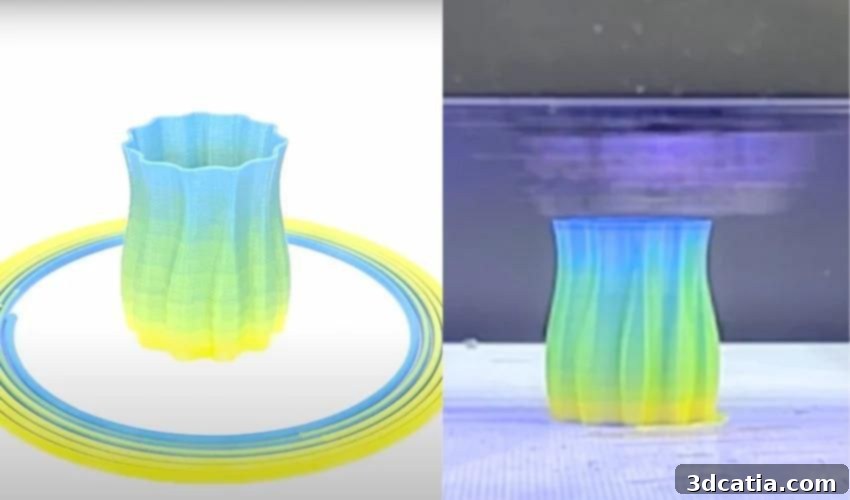
Addressing this critical bottleneck, an innovative team of researchers – Sang-Joon Ahn, Howon Lee, and Kyu-Jin Cho – from the prestigious Seoul National University has unveiled a groundbreaking solution. They have pioneered a unique two-step process specifically engineered for FDM 3D printing, which dramatically expands the technology’s capabilities. This innovative methodology, termed Blended-FDM (b-FDM), enables the sophisticated combination of disparate material properties within a single, unified base material. To vividly demonstrate its potential, the researchers successfully printed a singular FDM filament capable of producing an astonishing 36 different colors, all derived from just four primary color filaments. This initial achievement underscores the profound implications of b-FDM for advanced material customization and functional integration in 3D printing.
The b-FDM process itself is elegantly designed, consisting of two distinct yet interconnected stages that circumvent the traditional single-material extrusion challenge. The first step involves the creation of what the team refers to as a “digital material” (DM). This is achieved by meticulously layering various distinct base materials, with manual intervention to switch between them as the DM filament is fabricated. Imagine a miniature assembly line where different raw materials are sequentially deposited and consolidated into a continuous strand. This resulting multi-layered filament, the DM, then serves as the primary base material for the actual final object in the second step of the process. During this crucial second stage, as the DM filament is extruded through the FDM printer’s nozzle, the previously layered materials are dynamically mixed. This mixing occurs at the point of extrusion, creating a homogeneous blend that results in the desired composite properties directly within the final product. This ingenious two-step approach grants unparalleled control over the material composition, effectively enabling the printing of objects with diverse and customizable material properties by encapsulating several base materials into a single, specialized DM filament.
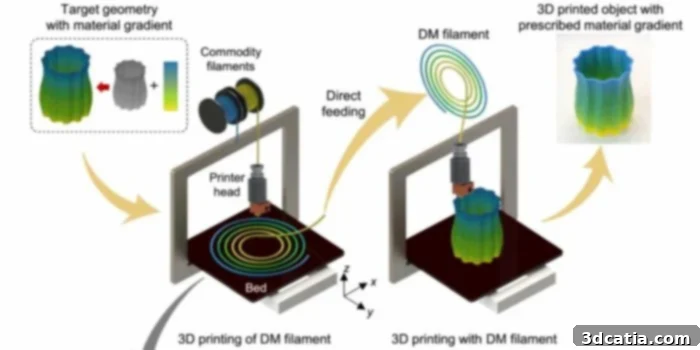
The b-FDM printing process.
Delving into the technical specifics, the research team achieved remarkable precision in crafting their digital material filaments. Each DM filament was printed with an incredibly fine layer thickness of 125 μm, ensuring a smooth and consistent transition between different materials. These filaments typically comprised 14 distinct layers of extruded material, each layer carefully structured to include two to four individual 3D printing lines, each approximately 440 μm wide. The initial creation of the DM filament involved a manual raw material change during the extrusion process, allowing the researchers to precisely control the sequence and quantity of different base materials incorporated. This meticulous layering process is what allows for the combination of a vast array of properties, including not only vibrant color variations but also critical attributes such as enhanced strength, controlled conductivity, and adjustable stretchability within a single filament. To rigorously test their innovative approach, these custom-blended filaments were then used to print a variety of test parts utilizing a standard Prusa i3 MK3S printer from Prusa Research. Excellent adhesion, crucial for successful FDM printing, was consistently achieved by maintaining the 3D printing bed at an optimal temperature of 70°C. A particularly compelling demonstration involved combining conductive, brittle PLA (CPLA) with soft, flexible thermoplastic polyurethane (TPU). This synergistic blend resulted in the creation of conductive parts that retained flexibility, opening exciting avenues for applications in cutting-edge wearable electronics, advanced sensors, and integrated soft robotics. Crucially, the b-FDM generated filaments are meticulously designed to conform to the industry-standard diameter of 1.75 mm, guaranteeing their compatibility with virtually any conventional FDM printer currently available on the market. This universal compatibility is a key factor in the rapid potential adoption and widespread impact of this technology.
To comprehensively demonstrate the transformative capabilities of their b-FDM technology, the Seoul National University researchers undertook an impressive feat: they successfully printed a complex, multifunctional origami gripper using only a simple FDM printer and a single, custom-blended filament. This intricate gripper design masterfully incorporated a variety of functionalities that would typically necessitate multiple materials or advanced multi-axis fabrication techniques. The gripper featured distinct rigid facets, providing structural integrity and precise manipulation capabilities. Alongside these rigid sections, it seamlessly integrated flexible hinges, allowing for articulate movement and adaptation to various object shapes. Even more remarkably, the single filament was capable of producing integrated electrical circuits directly within the structure, paving the way for self-contained, functional electronic components. Furthermore, the gripper included embedded sensors, enabling it to detect and respond to its environment. This groundbreaking demonstration vividly illustrates how their innovative approach can be effortlessly applied to and executed by standard, off-the-shelf FDM printers, effectively transforming them into multi-material fabrication powerhouses. The ability to produce such a functionally diverse component from a single print material marks a significant leap forward in additive manufacturing, moving beyond simple aesthetics to complex, integrated functionality.
The implications of the b-FDM technology are far-reaching, particularly concerning its accessibility and cost-effectiveness. Unlike many advanced multi-material printing systems that require specialized, expensive hardware, b-FDM integrates seamlessly with conventional FDM printers, making it highly accessible to a broad user base, from academic institutions to small businesses and individual hobbyists. The process requires only a few common, readily available filaments as base materials, further driving down operational costs and simplifying supply chain management. This innovation unlocks the full, previously untapped potential of FDM printing for an expansive range of technical applications that were once deemed impractical or impossible with single-material extrusion. The researchers view these pioneering results not merely as an incremental improvement but as a truly significant enhancement to existing FDM 3D printers, presenting an unprecedented opportunity to fundamentally push the boundaries of current 3D printing capabilities. This breakthrough promises to democratize multi-material manufacturing, fostering innovation across various sectors, from custom medical devices and advanced robotics to consumer electronics and bespoke industrial components.
To delve deeper into the intricate details of this fascinating project and explore the scientific methodology behind Blended-FDM, you can access the full research paper by clicking here. The publication provides comprehensive insights into the experimental setup, material characterization, and the profound implications of this game-changing technology for the future of additive manufacturing.
What are your thoughts on this revolutionary b-FDM printing method and its potential impact on the 3D printing landscape? We invite you to share your insights and opinions in a comment below or join the discussion on our LinkedIn, Facebook, and Twitter pages! Don’t forget to sign up for our free weekly newsletter here to receive the very latest 3D printing news and innovations straight to your inbox! You can also find an extensive library of all our informative and engaging videos on our dedicated YouTube channel, showcasing the dynamic world of additive manufacturing.
*All Photo Credits: Nature Communications and Seoul National University