
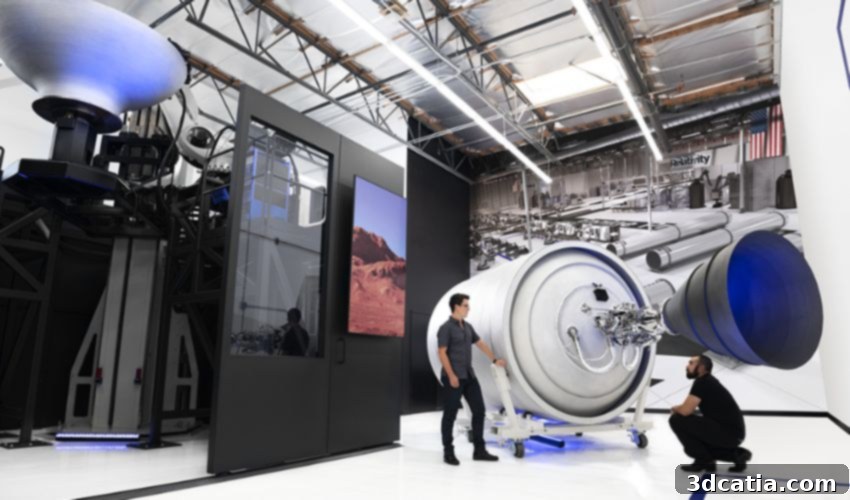
Relativity Space Unveils Stargate 4th Generation Metal 3D Printers: Revolutionizing Large-Scale Rocket Production
The aerospace sector has consistently stood at the forefront of adopting cutting-edge technologies, and among these, additive manufacturing, commonly known as 3D printing, has emerged as a truly transformative force. Its unparalleled ability to craft intricate, high-strength components while drastically reducing their weight is a critical advantage for applications where every gram matters, particularly in airborne and space vehicles. This inherent benefit has positioned 3D printing as an indispensable tool for aerospace innovators seeking enhanced performance and efficiency. Leading this charge in the realm of space exploration and manufacturing is Relativity Space, a company synonymous with pushing the boundaries of what’s possible with large-scale additive manufacturing. They have recently made a groundbreaking announcement, unveiling their Stargate 4th Generation metal 3D printers, which are set to redefine the future of spaceflight. These advanced printers are not just an incremental improvement; they are envisioned as the cornerstone for achieving the mass production of incredibly complex 3D printed rockets, making space more accessible and missions more ambitious.
While the concept of 3D printed rockets is garnering significant attention today, it was Relativity Space that pioneered this audacious endeavor, fundamentally challenging conventional aerospace manufacturing paradigms. From its inception, the company has been committed to a vision of fully 3D printed rockets, setting a precedent in the industry. They continue to hold the distinction of operating the largest metal 3D printers globally, a testament to their ambition and technological prowess. The advantages offered by their advanced 3D printing technology are multifold: it enables the production of lighter, more structurally optimized products, significantly reduces manufacturing costs, and dramatically accelerates production timelines. These benefits are continuously amplified by the relentless pace of innovation in additive manufacturing, making the technology more sophisticated and versatile with each passing year. This profound belief in the transformative power of 3D printing is succinctly captured by Tim Ellis, co-founder and CEO of Relativity Space, who confidently asserts, “all large-scale products that are designed to fly will inevitably be 3D printed.” This bold statement underscores the company’s long-term strategic outlook. The immediate application for this latest iteration of their unique, proprietary manufacturing platform is the creation of Terran R, a fully reusable, 3D printed rocket. This monumental engineering feat from Relativity Space is designed to be capable of launching an impressive 20,000 kg payload to low Earth orbit, marking a significant leap forward in space launch capabilities and cost-efficiency.

The 4th generation Stargate metal 3D printers have significantly improved on their predecessors increasing build volume, speed and print quality, paving the way for advanced rocket components.
Unveiling the Stargate 4th Generation: Enhanced Capabilities for Space Manufacturing
As one would anticipate from a fourth-generation technological advancement, Relativity Space’s newest Stargate metal 3D printers are packed with a suite of significant upgrades, meticulously engineered to propel their 3D printed rocket production capabilities to unprecedented levels. These enhancements address critical aspects of additive manufacturing, focusing on speed, precision, and scalability. Relativity Space proudly highlights that these latest printers boast a staggering 7x increase in printing speed compared to their immediate Stargate predecessors, and an even more remarkable 12x acceleration when benchmarked against Relativity’s overall prior additive solutions. This dramatic boost in speed is crucial for meeting the demanding production timelines required for frequent rocket launches and rapid iteration cycles. Furthermore, the company emphasizes a substantial improvement in print quality, achieved through the integration of powerful perception technology. This advanced in-process monitoring system meticulously scrutinizes every layer as it’s being deposited, ensuring unparalleled accuracy, surface finish, and structural integrity of the printed components. Such real-time feedback and control are vital for aerospace applications where safety and reliability are paramount, minimizing defects and ensuring that each part meets stringent quality standards.
However, what truly distinguishes this new generation of Stargate printers and marks a paradigm shift in large-scale metal additive manufacturing is its entirely novel print orientation and operating environment. Departing from the conventional vertical build approach, the Stargate 4th generation printers ingeniously utilize a horizontal print orientation. This innovation completely nullifies the restrictive ceiling height constraints that have historically limited the size of parts produced by vertical 3D printers. In essence, by “flipping the script” and printing horizontally, Relativity Space has unlocked the capability to create monolithic objects of truly staggering dimensions. These cutting-edge metal 3D printers are now capable of fabricating components that are up to an astounding 120 feet (approximately 36.5 meters) long and 24 feet (approximately 7.3 meters) wide. This translates to an exponential increase in volume capacity, a colossal 55 times greater than its 3rd generation predecessor. This unprecedented build volume allows for the creation of entire rocket sections, such as fuel tanks and fairings, as single, seamless parts, dramatically reducing the need for complex assemblies and welds. Moreover, the company underscores a significant reduction in entropy, leading to more consistent and reliable manufacturing outcomes. This is largely attributable to Stargate’s advanced robotic automation platform, which ensures meticulous control over every aspect of the printing process, from material handling to precise deposition, thereby enhancing repeatability and minimizing human error in the production of flight-critical components.

The horizontal orientation allows the printer to overcome ceiling height constraints for even larger parts, fundamentally changing the scale of 3D printed aerospace components.
The profound impact of these Stargate 4th generation printers extends far beyond mere size and speed; they are engineered to enable a radical reduction in part count. By printing large, complex structures as single integrated units, Relativity Space can consolidate hundreds, or even thousands, of individual components into a handful of robust, optimized parts. This simplification not only slashes manufacturing complexity and associated costs but also inherently enhances the structural integrity and reliability of the final product by eliminating numerous potential points of failure, such as seams, bolts, and welds. Concurrently, the technology facilitates rapid design iteration, allowing engineers to test, refine, and implement design changes with unparalleled agility. This iterative approach is crucial in the fast-paced aerospace industry, enabling continuous improvement and optimization of rocket performance. The ultimate outcome of these innovations is the production of significantly lighter, more cost-effective, and ultimately superior aerospace products. Scott Van Vliet, SVP of Software Engineering at Relativity Space, eloquently summarized this philosophy, stating, “Iteration empowers innovation not only in our rocket design, but also in our own Stargate printers. In its short history, Relativity has made great strides in evolving its core 3D printing technology, but Stargate 4th Generation printers are our most innovative leap yet. We’re fundamentally changing the way our factories are designed and operating, and by flipping the script and going horizontal, we’re radically increasing our capacity for scale. Being a software-driven manufacturing company allows us to achieve unique product features, such as integrated pad-ups and domes, with radical flexibility.” His statement underscores the synergistic relationship between technological advancement, innovative design, and software-driven manufacturing, positioning Relativity Space at the vanguard of the next era of space exploration. For more detailed insights, the official press release offers comprehensive information, available HERE.
The unveiling of Relativity Space’s Stargate 4th Generation metal 3D printers marks a pivotal moment in both additive manufacturing and aerospace. These advancements not only promise to accelerate the production of fully 3D printed rockets like Terran R but also to significantly lower the barriers to space access, opening new frontiers for exploration, commercialization, and scientific discovery. The horizontal printing orientation, combined with enhanced speed, precision, and robotic automation, sets a new benchmark for large-scale industrial 3D printing. What are your thoughts on Relativity Space’s latest generation of Stargate metal 3D printers and their potential impact on space exploration? We encourage you to share your insights and comments below, or engage with us on our LinkedIn,Facebook, andTwitter pages! Don’t miss out on the latest advancements and news in additive manufacturing – be sure to sign up for our free weeklyNewsletter here, delivering the most relevant 3D printing news directly to your inbox! Additionally, you can explore all our compelling videos and content on our dedicatedYouTube channel.
*Cover Photo Credits: Relativity Space