
The 3D Printing Industry Navigates 2024 Headwinds: A Comprehensive Market Analysis and 2025 Recovery Outlook
The year 2024 proved to be a challenging period for the global 3D printing industry. A retrospective look at the prevailing trends revealed a landscape marked by significant turbulence. The sector grappled with a series of setbacks, including failed mergers, widespread layoffs, and notable leadership changes across prominent companies. This period of struggle has been further substantiated by a recent insightful report from CONTEXT, a leading London-based market intelligence and analytics firm. The report meticulously highlights the widespread difficulties experienced throughout the entire additive manufacturing market, with particular emphasis on the industrial 3D printer segment. Despite these headwinds, the analysis cautiously points towards a glimmer of hope, forecasting improved growth prospects for 2025.
Even as early as the previous year, industrial 3D printer shipments had already begun to exhibit distinct signs of deceleration, creating an uneasy undertone for the year to come. Interestingly, this slowdown in the high-end market contrasted sharply with an observable rise in the sales of desktop 3D printers. To accurately interpret these trends, it’s crucial to understand CONTEXT’s classification of 3D printer categories, which are primarily defined by their price points. These categories are segmented as follows: personal (or desktop) printers, priced under $2,500; professional printers, ranging from $2,500 to $20,000; midrange systems, falling between $20,000 and $100,000; and industrial printers, which command prices of $100,000 and above. Therefore, the data unequivocally shows that the most expensive 3D printers, those critical for large-scale manufacturing and advanced applications, experienced a substantial decrease in shipments. Conversely, the more affordable, entry-level solutions demonstrated a year-on-year increase in growth, signaling a clear bifurcation in market performance.
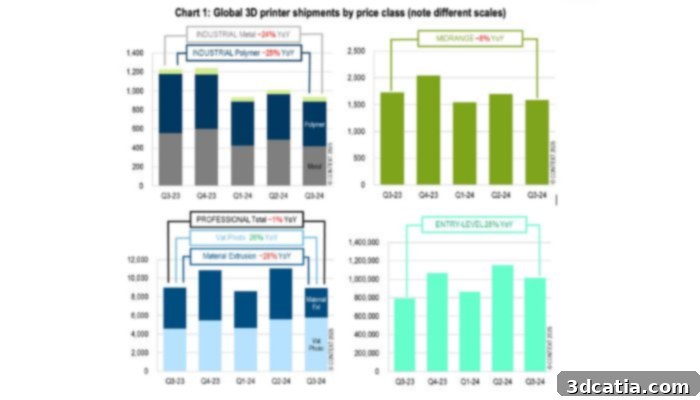
Global 3D printer shipments by price, showing the decrease for all but entry-level solutions (photo credits: CONTEXT)
The visual representation in the graph above starkly illustrates the downward trajectory across various price categories. From the outset of Q1 2024, both polymer and metal industrial 3D printer shipments recorded significant declines. While Q2 offered a brief period of partial recovery, this positive momentum was short-lived, with the downward trend persisting and even accelerating into Q3. The overall decrease for polymer industrial printers reached a substantial 25% compared to Q3 2023, while metal industrial printers saw a 24% reduction in shipments during the same period. CONTEXT further notes that this challenging environment was exacerbated by what they described as a “turbulent and chaotic” conclusion to the year. This period disproportionately affected major industrial 3D printer manufacturers, although it was not identified as the primary catalyst for the overarching shipment decrease. Instead, deeper economic factors were at play, casting a long shadow over the sector’s performance.
Chris Connery, Vice President of Global Analysis at CONTEXT, elaborated on these underlying factors, stating, “While this chaos had significant impacts, newly updated analyses show that 2024 as a whole was even more heavily affected by high interest rates and subsequently muted Capital Expenditure (CapEx) spending.” This economic pressure translated directly into reduced investments by businesses, especially in high-cost industrial machinery. Connery continued, “It therefore seems that full-year figures are likely to be close to the lows seen during the height of pandemic lockdowns in 2020, with at least a 12% fewer industrial printers shipped worldwide in 2024 than in 2023.” This comparison to the unprecedented economic disruption of 2020 underscores the severity of the market downturn in the industrial 3D printing segment, highlighting a significant contraction in global demand for advanced additive manufacturing solutions.
Industrial 3D Printer Sector Suffers While Other Segments Adapt
What do these statistics mean for the diverse landscape of the additive manufacturing industry? Concretely, the substantial drop in industrial 3D printer shipments permeated almost all printer modalities and material types. Furthermore, this negative trend was observed on a global scale, affecting markets that had previously shown resilience. This global impact is particularly noteworthy given that in the preceding year, the overall downward trend in industrial 3D printer shipments had been somewhat offset by pockets of growth, especially within the dynamic Asian market and, more specifically, in China. However, in 2024, even these previously robust regions succumbed to the broader market pressures. China, for instance, experienced a steep decline in sales, plummeting by approximately 37%, a stark contrast to the 25% drop seen in North America and a more contained 13% decrease in Western Europe. This regional disparity highlights the varying degrees of economic sensitivity and investment hesitancy across different global markets.
Delving deeper into specific industrial polymer systems, the report indicates that vat polymerization solutions within this high-price category continued to face considerable challenges. Two global leaders in this space, UnionTech and 3D Systems, were particularly impacted, witnessing sharp declines in their shipment volumes. Both companies attributed these setbacks primarily to a significant decrease in demand from the dental market, a sector that heavily relies on vat polymerization for producing aligners, models, and custom prosthetics. Beyond this specific application, the broader industrial polymer 3D printer segment also recorded an overall decrease in growth, down by 15%. Material extrusion technologies, another critical polymer additive manufacturing method, also saw a substantial 15% reduction in sales. Perhaps the most dramatic decline was observed in material jetting systems, which suffered a staggering 43% drop, indicating a significant contraction in demand for these high-precision polymer printing solutions.
In contrast, the metal 3D printing sector initially demonstrated greater resilience, according to CONTEXT’s analysis through the second quarter of 2024. This stability, however, proved temporary. By Q3, only binder jetting systems managed to maintain flat sales figures, signifying a general softening even in this traditionally robust segment. Powder Bed Fusion (PBF) solutions, which account for a dominant 74% of all new industrial metal systems, experienced a significant decrease in shipments of 24%. The second-largest category, Directed Energy Deposition (DED) 3D printers, also saw a notable drop of 18%. This downturn in metal additive manufacturing is particularly surprising, given the continuous and widespread emphasis on the transformative benefits of industrial additive manufacturing across various sectors, including aerospace, medical, and automotive. DED printers, in particular, often command significant attention at major industry events, such as their prominent presence on the show floor at Formnext 2024, making their sales decline a point of concern for future investment trends.
As depicted in the graph below, the regional disparities that characterized industrial metal PBF 3D printer shipments in 2023 largely diminished throughout 2024. In the previous year, a clear divergence was observed, with China exhibiting robust growth in this segment while Western companies wrestled with various market challenges. However, by Q2 of 2024, these regional performances converged, reflecting a more uniform global slowdown. This trend continued into Q3, where Chinese vendors experienced a 21% decrease in shipments, while their counterparts in Europe faced an even sharper 26% decline. This harmonization of negative trends across major global markets underscores the pervasive nature of the economic pressures impacting the high-end metal additive manufacturing sector.
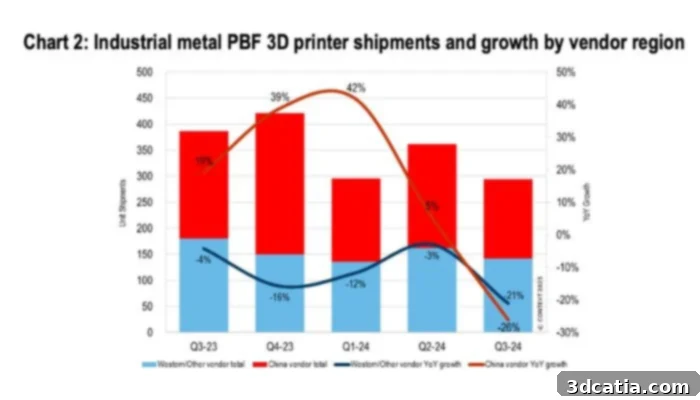
This chart shows industrial Metal PBF 3D printer shipments, showing the general decrease including in China which had originally seen growth in the beginning of the year (photo credits: CONTEXT)
The stagnation was not confined solely to the industrial segment; other price classes also felt the pinch of a tightening market. Among midrange solutions, a year-over-year (YoY) drop of 8% was recorded in Q3 of 2024. Within this category, 3D Systems, a historically significant player, demonstrated a noticeable decrease in market presence, sliding to sixth place and continuing its struggle to maintain previous market share. In stark contrast, Stratasys managed to retain its market-share lead despite experiencing weak sales in its material extrusion 3D printers, demonstrating the strength of its existing customer base and product portfolio. However, a significant highlight in this segment was the remarkable performance of Chinese vendors, including UnionTech, ZRapid Tech, and Flashforge. These companies fared much better than their international competitors, collectively achieving an aggregate shipment increase of 46% while others in the midrange category faced a 24% decrease in sales. This indicates a growing competitive threat and innovation drive from Asian manufacturers in the midrange market.
For professional 3D printer shipments, the overall sales saw a modest decrease of 1%, but a deeper look reveals that material extrusion machines within this segment performed the worst. This decline can be directly attributed to the proliferation and increasing sophistication of entry-level extrusion solutions, which began to cannibalize sales from the professional tier. Consequently, professional FDM/FFF 3D printer sales plummeted by 28%. This trend, which began to emerge last year, has been significantly compounded by the strong, cost-effective offerings from innovative companies like Bambu Lab. These affordable yet high-performance machines have played a crucial role in driving a robust 28% growth in entry-level printer shipments, fundamentally reshaping the market landscape for extrusion-based technologies.
Glimmers of Hope and a Brighter Outlook for 2025?
Considering the comprehensive data from 2024, what overarching conclusions can we draw about the state and future trajectory of the 3D printing industry? While the year was undeniably bleak for many segments, particularly the high-value industrial sector, the CONTEXT report also highlighted crucial signs of hope and areas of unexpected success. In a recent press release, CONTEXT specifically commended vendors such as Eplus3D and Nikon Solutions for their exceptional performance, even amidst the challenging industrial sector. Their success was largely driven by their advanced, multi-laser, high-build-volume metal powder fusion machines, which helped to push growth in an otherwise contracting market. These specialized solutions met specific demands for high-performance, large-scale metal additive manufacturing, demonstrating that innovation and targeted market strategies can still yield positive results.
Indeed, Eplus3D distinguished itself as the global leader in units shipped in Q3 2024, achieving an impressive 41% growth compared to the previous year. This remarkable achievement underscores the company’s strong market position and the effectiveness of its product offerings. Similarly, established players like TRUMPF and Renishaw also reported year-over-year shipment increases, indicating their continued relevance and ability to adapt to market demands. Beyond shipment volumes, several other key industry players, including EOS, Nikon SLM Solutions, and Renishaw, also saw a notable increase in revenue. These successes, while not universal, provide valuable insights into segments of the market that are thriving due to technological advancements and strategic positioning, offering a blueprint for future growth.
This pattern of resilience and growth was not exclusive to specific industrial metal segments; it was also observed across other 3D printer categories. For instance, while CONTEXT had noted low sales of vat photopolymerization solutions in the previous year, this segment experienced a significant resurgence within the professional price class in 2024. Formlabs emerged as the dominant force in this market, largely driving the bounce-back in this category. Their success is primarily attributable to the highly anticipated release of Formlabs’ new Lithography-based Fluidic Dosing (LFD) vat photopolymerization 3D printer. This innovative technology resulted in a substantial overall increase of 26% in sales for professional vat photopolymerization solutions compared to the same period in 2023, showcasing the power of new product introductions to revitalize market segments.
Looking ahead, the economic forecast for 2025 offers a considerably brighter outlook for the additive manufacturing industry. A key factor expected to drive this recovery is the anticipated reduction in interest rates. Lower interest rates typically lead to decreased borrowing costs for businesses, which in turn is expected to stimulate Capital Expenditure (CapEx) spending. This renewed investment in physical assets, including advanced industrial 3D printing systems, is precisely what the market needs to rebound. CONTEXT is projecting a robust full-year growth of 14% in industrial 3D printer system shipments for 2025. Similarly optimistic forecasts predict that midrange printer shipments will rise by 12% and professional systems by 6% in the coming year. The long-term outlook for 2026 is even more promising, with expectations of consistent and stronger double-digit year-over-year growth across all sectors, potentially reaching growth rates upwards of 30-40% over a five-year period, indicating a strong return to pre-pandemic growth trajectories.
Chris Connery eloquently concludes, “To put this in context, note that the market bounced back strongly coming out of COVID [sic] as vendors delivered against pent-up demand: between 2020 and 2021, Industrial 3D printer shipments were up 30% and those of Midrange systems increased by 26%. However, the impact of a change in US government is yet to be determined: while the new administration is generally focused on accelerating business potential, sticky inflation and unknown import restrictions are tempering optimism.” This insightful observation highlights that while historical trends suggest a strong recovery is possible, macroeconomic and geopolitical uncertainties, particularly regarding potential changes in government policies and their impact on inflation and trade, could still influence the pace and stability of the forecasted growth. For more detailed insights, you can find the full report HERE.
What are your thoughts on the continued decrease in industrial 3D printer shipments throughout 2024? Do you believe the additive manufacturing industry will indeed see significant improvement and sustained growth in 2025, or are the existing economic headwinds too strong? We invite you to share your perspective in a comment below or join the discussion on our LinkedIn, Facebook, and Twitter pages! Don’t miss out on the latest 3D printing news and trends – remember to sign up for our free weekly Newsletter here, delivered straight to your inbox! You can also explore all our informative videos and engaging content on our YouTube channel.
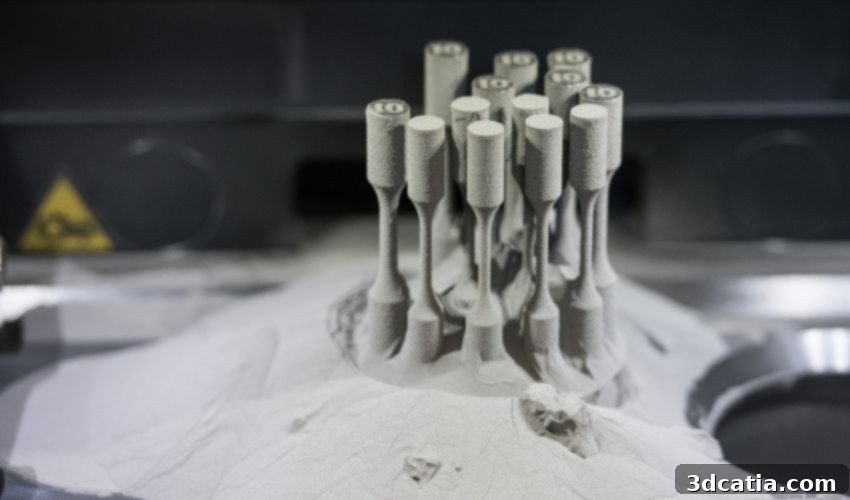
*Cover Photo Credits: René Volfík – Institute of Physics of the Czech Academy of Sciences, CC BY-SA 4.0