
Revolutionizing FDM 3D Printing: Unveiling Joshua Bird’s 4-Axis Core-RΘ Polar System
In the dynamic landscape of Fused Deposition Modeling (FDM) 3D printing, where conventional Cartesian systems have long been the industry standard, groundbreaking innovations are continuously emerging to challenge established norms. One such innovation comes from the brilliant mind of Joshua Bird, who has engineered a remarkable 4-axis core-RΘ 3D printer. This audacious maker has not only pushed the boundaries of traditional FDM design but has fundamentally reimagined the mechanics of additive manufacturing by developing a machine based on a revolutionary polar kinematic system. This departure from conventional approaches promises to unlock new capabilities and overcome some of the persistent limitations faced by existing FDM technologies.
Unlike the vast majority of FDM 3D printers, which rely on a Cartesian coordinate system with three linear axes (X, Y, and Z) to define movement and position, Joshua Bird’s core-RΘ printer embraces a sophisticated polar system. To put it simply, a polar system distinguishes itself through the utilization of a rotating circular build plate, which is complemented by precise angular and radial movements of the print head, rather than the more common linear displacements along horizontal planes. This paradigm shift in motion control enables the printer to generate radial slices for each layer, fundamentally differing from the flat, parallel layers produced by Cartesian machines. This innovative approach is not merely a cosmetic change; it introduces profound advantages in print quality, structural integrity, and geometric freedom, paving the way for a new generation of FDM applications.
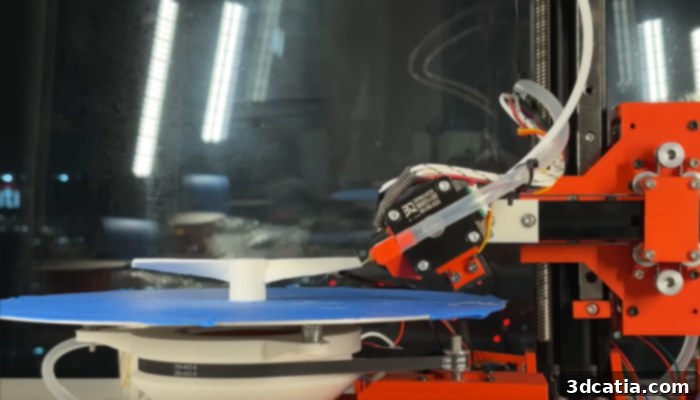
The core-RΘ 3D printer utilizes a rotating circular build plate, a hallmark of its polar kinematic system.
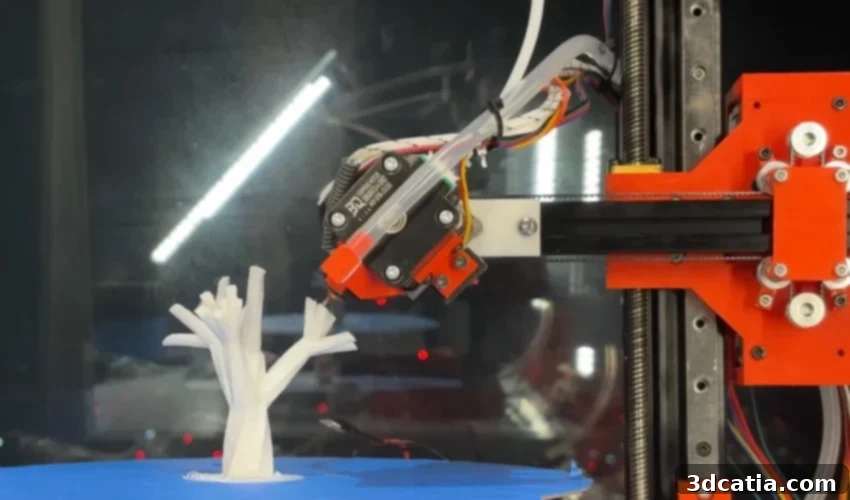
This unique polar approach delivers a significant and often sought-after advantage in the realm of 3D printing: vastly improved overhang management. One of the persistent challenges in traditional FDM is the difficulty of printing complex geometries with steep overhangs or bridges without the extensive use of support structures. These supports often consume extra material, increase post-processing time, and can leave undesirable surface finishes. Joshua Bird’s core-RΘ printer, however, adeptly addresses this issue. Its design allows it to print with a remarkable 90° orientation relative to the build plate without encountering any particular difficulties or requiring conventional supports. This capability is vividly demonstrated in Bird’s video presentation, where he showcases the core-RΘ 3D printer producing an intricate tree-shaped part. The horizontal and inclined branches of this part are printed flawlessly without any supports, primarily because the print head, mounted on a rotating axis, extrudes material inwards, directly onto previously established sections. This ‘self-supporting’ methodology dramatically reduces material waste, streamlines the printing process, and opens up new avenues for designing complex, organic, and architectural forms that were previously impractical or impossible with standard FDM printers.
Unveiling the Ingenious Core-RΘ Kinematic System
The exceptional capabilities of the core-RΘ printer stem from Bird’s innovative kinematic system, meticulously designed to facilitate its unique polar movements. This system, aptly named “core-RΘ,” ingeniously integrates several key components to achieve its multi-axis functionality:
- A Circular, Rotating Build Plate (C-axis): This forms the foundation of the polar system, providing continuous rotation that enables the radial slicing methodology. The controlled rotation of the build plate is critical for building up objects layer by layer in a circular fashion, diverging from the planar layering of Cartesian systems.
- A Vertical Screw for Z-Movement: Similar to many conventional 3D printers, a vertical screw mechanism is employed to precisely control the Z-axis movement. This allows the print head to move up and down, enabling the creation of vertical layers and controlling the overall height of the printed object.
- A Horizontal Rail with Belt for the X-axis: This component facilitates radial movement. The print head assembly moves along this horizontal rail, extending or retracting from the center of the build plate. This radial displacement, combined with the build plate’s rotation, defines the ‘R’ (radius) component of the polar coordinates.
- A Rotating Print Head (B-axis): This is perhaps the most distinctive and crucial element, allowing for complex non-planar extrusion. The print head itself is capable of tilting in the XZ plane, providing an additional degree of freedom. This B-axis rotation is what enables the printer to extrude material at varying angles, including the remarkable 90° orientation to the build plate, directly addressing the challenge of overhangs and facilitating true non-planar printing.
The sophisticated interaction of these axes is orchestrated by a clever mechanical design. Bird’s system employs two motors strategically linked to a pulley system. This arrangement not only controls the horizontal (x-axis) movement of the print head but also simultaneously manages the rotation or tilt of the print head (b-axis). All of these mechanisms are precisely mounted on a z-axis carriage, allowing the entire assembly to move vertically. This intricate design empowers the print head with the unprecedented ability to move, tilt, and articulate to reach virtually any point above the rotating build plate. It is this coordinated movement and articulation that makes the complex process of radial and non-planar printing not just possible, but highly effective, ushering in a new era of geometric complexity for FDM technology.
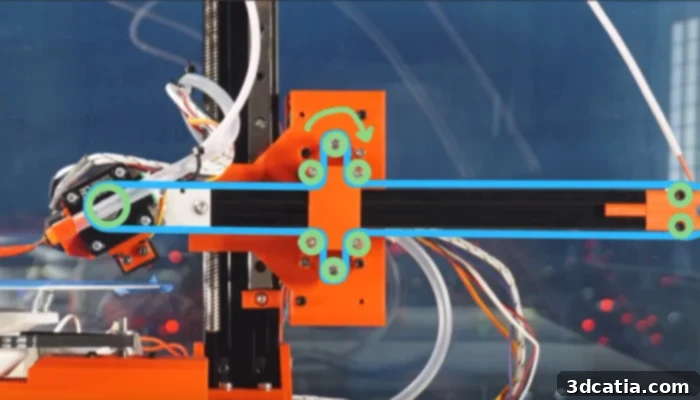
The innovative “core-RΘ” system by Joshua Bird masterfully uses a pulley to synchronize both print head rotation and x-axis movement, highlighting its engineering ingenuity.
An Innovative, Open-Source Project Driving Community Innovation
The brilliance of this machine extends far beyond its mechanical design. One of the most significant challenges in developing a printer with such unique kinematics is the fundamental incompatibility with existing software infrastructure. Standard firmware, which is designed for Cartesian systems, and conventional slicers are simply not equipped to interpret or generate the complex G-code required for polar and 4-axis movements. To circumvent this formidable obstacle, Joshua Bird embarked on an equally impressive software development journey. He meticulously configured and adapted the Reprap firmware, commonly used by Duet3D boards, to accommodate the core-RΘ’s distinctive motion system. Furthermore, he went a step further by developing his own custom slicing software, christened the “Radial Non-Planar Slicer.” This specialized slicer is intricately designed from the ground up to generate G-code that is perfectly tailored to the unique kinematic requirements of his 4-axis polar printer, ensuring precise control over every radial and non-planar extrusion path.
In a true testament to the spirit of collaboration, knowledge sharing, and community innovation that defines the 3D printing world, Joshua Bird has generously made his remarkable creations available as open-source projects on GitHub. This encompasses not only the complete design and build instructions for the core-RΘ printer but also the source code for his bespoke Radial Non-Planar Slicer. This incredible act of generosity aligns perfectly with the ethos of the RepRap project, enabling enthusiasts, engineers, and researchers worldwide to freely access, reproduce, modify, and improve upon his work. By lowering the barrier to entry, Bird fosters an environment of accelerated development and collective problem-solving within the 3D printing community. Moreover, Bird has estimated the cost of manufacturing this innovative printer to be remarkably affordable, ranging between $300 and $400. This relatively low cost makes such a sophisticated and interesting technology accessible to a broader audience, encouraging widespread experimentation and further advancements.
For those inspired to delve deeper into this groundbreaking project, or perhaps even embark on the journey of replicating it, comprehensive resources are readily available. You can explore the intricate details of the core-RΘ printer design and specifications on its dedicated GitHub repository: HERE. Additionally, the source code and documentation for the Radial Non-Planar Slicer, essential for generating compatible print files, can be found HERE. These open-source contributions provide an invaluable toolkit for anyone looking to understand, build, or enhance this revolutionary FDM system.
With his visionary 4-axis polar 3D printer, Joshua Bird is not merely offering an alternative; he is providing a transformative solution for applications that demand superior support-free printing capabilities. This innovation opens up entirely new perspectives for creating highly complex, intricate, and organically shaped objects that were previously cumbersome or impossible to produce with conventional FDM methods. Imagine architectural models with dramatic cantilevers, intricate artistic sculptures, or functional components with optimized internal geometries – all achievable without the headache of support removal. Bird’s project, thoroughly detailed and explained in an engaging YouTube video, has already captivated the interest of a global audience, garnering widespread acclaim and enthusiasm from users who recognize its immense potential. The passion and ingenuity demonstrated by Bird have resonated deeply within the 3D printing community, inspiring many to envision the next frontier of additive manufacturing.
The comments from the community reflect the profound impact of Bird’s work. One user exclaimed, “I feel like this guy is a time traveler. I mean, he’s single-handedly building a completely insane next-generation 3D printer for under $400 and offering it to the community for further development. Amazing! Just incredible!!!” This sentiment highlights the dual astonishment at both the technical prowess and the generous open-source spirit. Another appreciative comment stated, “This man is single-handedly moving the 3D printing community forward. (…) And on top of that, he’s sharing everything open source, what a legend.” These reactions underscore the significance of Bird’s contribution – not just as an engineering marvel, but as a catalyst for collective progress, demonstrating how individual ingenuity, when coupled with an open-source philosophy, can profoundly shape the future of a technology. Joshua Bird’s core-RΘ system stands as a powerful testament to what can be achieved when innovation meets accessibility and community engagement in the evolving world of 3D printing.
What are your thoughts on Joshua Bird’s groundbreaking work with the core-RΘ system and its potential to reshape FDM 3D printing? We invite you to share your insights in a comment below or join the conversation on our LinkedIn, Facebook, and Twitter pages! Don’t forget to sign up for our free weekly Newsletter here to receive the latest 3D printing news directly in your inbox! You can also find all our compelling videos and interviews on our YouTube channel for more in-depth content.
*All Photo Credits: Screenshots from Joshua Bird’s inspiring YouTube Video