
Revolutionizing Shelter: The World’s First 3D Printed Community by New Story, ICON, and Fuseproject
The global housing crisis is a monumental challenge, leaving billions without adequate, safe, or affordable shelter. For far too long, vulnerable populations have been the last to benefit from technological advancements and innovative solutions. However, a groundbreaking collaboration between three pioneering organizations is set to change this narrative dramatically. San Francisco-based design studio Fuseproject, renowned for its human-centered approach to innovation, recently announced its partnership with New Story, a non-profit organization dedicated to ending global homelessness, and ICON, a leader in construction 3D printing technology. Together, they are embarking on an ambitious mission to design, plan, and build the world’s first 3D printed community, heralding a new era for sustainable, rapid, and affordable housing.
This visionary project aims to leverage the power of advanced technology, particularly 3D printing, to bring unprecedented speed and scale to housing design and construction. The partners firmly believe that this innovative approach can fundamentally transform how we address the critical need for affordable homes. By combining cutting-edge design, non-profit drive, and revolutionary construction methods, they are not just building houses; they are building hope and paving the way for a more equitable future where safe housing is accessible to all.
A Visionary Collaboration to Combat Homelessness
The genesis of this extraordinary project lies in the shared commitment of Fuseproject, New Story, and ICON to tackle one of humanity’s most pressing issues. Yves Béhar, founder of Fuseproject, articulated this ethos perfectly: “I believe the most advanced technologies can deliver designed solutions for those most in need, and it is both the new technology from ICON and the vision of New Story that is making it possible today”. This statement encapsulates the synergy at the heart of the partnership. Fuseproject brings its expertise in empathetic design, ensuring that the homes are not just structures but tailored living spaces that truly respond to human needs and cultural contexts. New Story, as a pioneer in developing innovative solutions for homelessness, provides the strategic vision, on-the-ground understanding, and non-profit framework necessary to execute such a large-scale humanitarian effort. ICON, with its advanced construction 3D printers, supplies the revolutionary technology capable of delivering these homes with unmatched efficiency and cost-effectiveness.
The project is specifically headed to Latin America, targeting families most in need of affordable and resilient housing solutions. A crucial aspect of this initiative is its community-centric approach. The partners have worked directly with the communities in the region, engaging residents to design houses that are culturally appropriate, functional, and adaptable to their daily lives and evolving needs. This direct engagement ensures that the solutions are not imposed but co-created, fostering a sense of ownership and relevance among the beneficiaries. Yves Béhar further elaborated on this participatory design process: “As we spoke to the community members, we realized that a single house design doesn’t respond to the needs and expectations. This led to design a system that allows for different programmes, climate factors, and growth for families and spaces”. This insight is vital, highlighting a flexible design system capable of accommodating diverse family sizes, climate conditions, and future expansion possibilities, thus moving beyond a one-size-fits-all model.
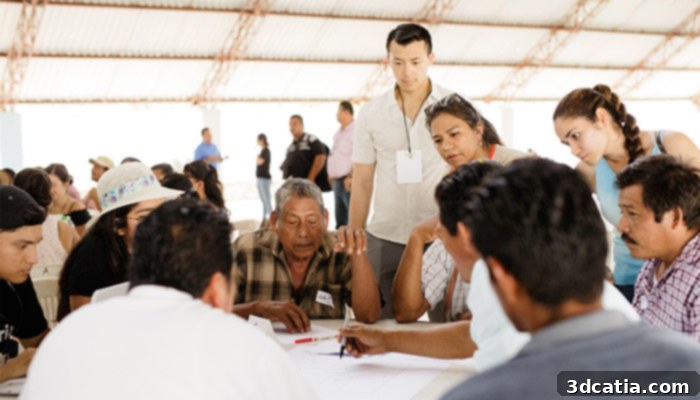
Working hand-in-hand with the community to design truly responsive homes | Photo Credits: Fuseproject
The Power of Construction 3D Printing: Speed, Efficiency, and Affordability
The foundation of this ambitious endeavor is ICON’s innovative construction 3D printing technology. As a proof of concept and a testament to the potential of this method, New Story and ICON had previously partnered to 3D print a house in Austin, Texas. This pilot project, completed in less than 48 hours and costing less than $4000, showcased the remarkable capabilities of ICON’s original Vulcan 3D printer. This successful demonstration laid the groundwork for the more extensive community project in Latin America.
For the Latin American community, the trio aims for even greater efficiency. They anticipate that each house will be printed in as little as 24 hours using ICON’s updated and more advanced construction printer, the Vulcan II. This significant reduction in construction time from days to a single day per house represents a paradigm shift in humanitarian construction, allowing for rapid deployment of housing solutions at an unprecedented scale. The estimated cost of producing each building in Latin America is projected at approximately $6000. While slightly higher than the Austin pilot due to factors like materials, logistics, and localized customization, this figure remains remarkably low compared to traditional construction methods, especially when considering the speed and quality. This affordability is critical for making safe and durable housing accessible to low-income families.
Beyond speed and cost-effectiveness, ICON’s 3D printer boasts several other advantages critical for humanitarian efforts in developing regions. Its design minimizes waste generation, addressing a significant environmental concern in traditional construction. Furthermore, the Vulcan II is engineered to function effectively under challenging circumstances, such as limited access to water, power, and skilled labor infrastructure. This resilience makes it an ideal solution for remote or underserved areas where conventional building methods are often impractical or prohibitively expensive. The ability to operate autonomously with minimal external resources underscores the printer’s potential to revolutionize disaster relief and long-term development projects globally.
Designing for Dignity: A Community-Centric Approach
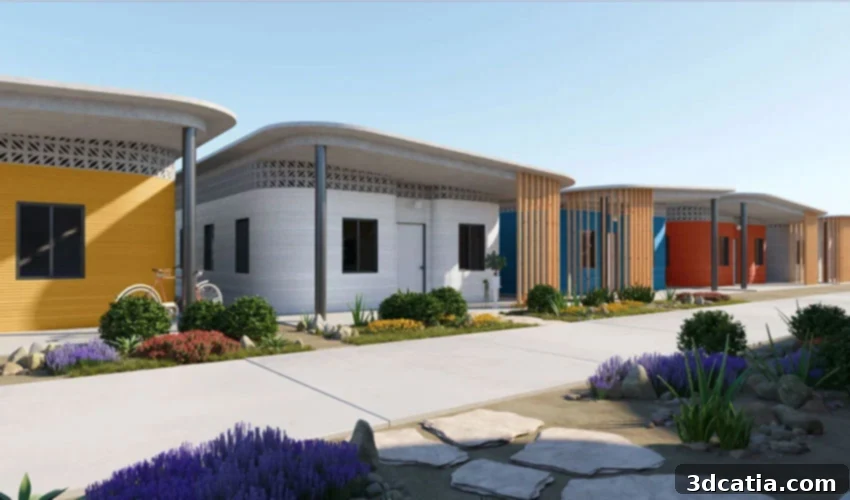
The design of these 3D printed homes goes far beyond mere functionality; it embodies a profound respect for the dignity and cultural identity of the future residents. Each house will feature a spacious internal area of 55m2, providing ample living space for families. Crucially, the design extends beyond the enclosed structure, incorporating covered outdoor areas that are integral to daily life in many Latin American cultures. Families will have access to a covered outdoors kitchen, a dining room, and gardens, expanding their total functional covered space to 120m2. This thoughtful integration of indoor and outdoor living areas reflects the project’s commitment to creating holistic and culturally relevant homes.
A distinctive aesthetic element of these homes is the exposed 3D printed concrete walls, both inside and out. These walls will be decorated with colorful patterns, which are not merely painted but are a direct result of the 3D printing process itself. This technique adds a unique, vibrant, and integrated aesthetic quality that celebrates the innovative construction method. Functionality is also deeply embedded in the design; the walls will incorporate perforated concrete blocks along the top, creating a clerestory for natural ventilation. This ingenious feature promotes consistent airflow, crucial for comfort in warm climates, and reduces reliance on energy-intensive mechanical cooling systems. Furthermore, the interiors will feature an open-plan layout, further encouraging air-flow and creating a spacious, interconnected living environment.
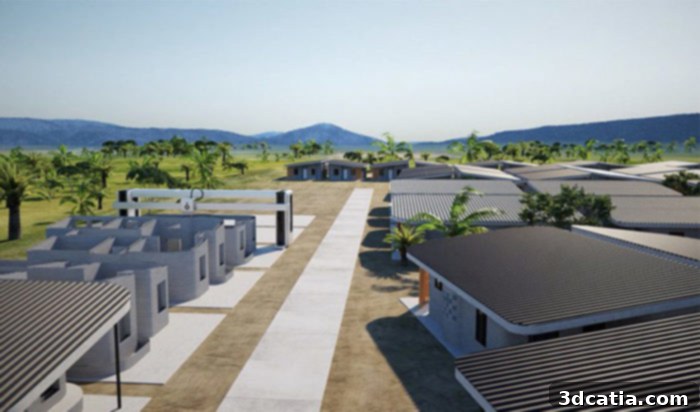
Thoughtful design tailored for community needs and cultural integration | Photo Credits: Fuseproject
Beyond Bricks and Mortar: A New Era for Humanitarian Aid and Sustainable Construction
3D printing of homes offers a transformative potential to address the global housing crisis by providing manufacturing solutions at significantly lower costs and in drastically quicker times. This innovative approach moves beyond the limitations of traditional, linear construction methods, which often prove too slow and expensive to meet the vast and urgent demands of a rapidly growing global population. Brett Hagler, CEO of New Story, eloquently articulated this philosophy: “We feel it’s our responsibility to challenge traditional methods. Linear methods will never reach the billion plus people who need safe homes. Challenging our assumptions, iterating based on data, and taking calculated risks on innovative ideas will allow us to reach more families with the best possible solutions, exponentially faster.”
Hagler’s statement underscores the core ethos of New Story and its partners: a commitment to radical innovation and continuous improvement. The traditional construction industry, while fundamental, is often slow, labor-intensive, and prone to supply chain inefficiencies. By embracing construction 3D printing, New Story, ICON, and Fuseproject are not merely adopting a new tool; they are redefining the entire paradigm of housing development for humanitarian purposes. This exponential acceleration in home delivery is critical for effectively serving the more than one billion people worldwide who lack access to safe and permanent housing. This project is a powerful demonstration of how thoughtful design, cutting-edge technology, and a dedicated humanitarian spirit can converge to create scalable, impactful, and sustainable solutions that genuinely change lives.
The Road Ahead and Broader Implications
The establishment of the world’s first 3D printed community in Latin America is more than just a housing project; it is a blueprint for the future of humanitarian aid and sustainable development. It represents a bold step towards achieving the United Nations’ Sustainable Development Goal 11, which aims to make cities and human settlements inclusive, safe, resilient, and sustainable. The success of this initiative will undoubtedly inspire similar projects globally, demonstrating a viable, efficient, and dignified path forward for communities grappling with housing insecurity.
As this ambitious project unfolds over the summer, the world will be watching keenly. The lessons learned, the innovations refined, and the lives transformed will provide invaluable insights for future endeavors in the field of construction 3D printing and global development. This collaboration stands as a beacon of hope, illustrating how technology, when guided by compassion and thoughtful design, can truly serve humanity’s most pressing needs. How will this pioneering project turn out? We eagerly anticipate the results and the stories of the families whose lives will be positively impacted. For more in-depth information, you can explore the details HERE.
What are your thoughts on this revolutionary project and the potential of 3D printing to end homelessness? We invite you to share your insights in a comment below or join the conversation on our Facebook and Twitter pages! Stay informed about the latest advancements in additive manufacturing by signing up for our free weekly Newsletter here, delivering the most relevant 3D printing news straight to your inbox!