
High-Performance Polymers in Additive Manufacturing: Market Trends, Growth, and Future Opportunities
The landscape of additive manufacturing is continuously evolving, driven by the demand for materials that can withstand increasingly rigorous applications. In this dynamic environment, high-performance polymers (HPPs) are emerging as a transformative force. A recent comprehensive report from Research and Markets, titled ‘The Global 3D Printing High-Performance Plastic Market,’ casts a spotlight on this crucial sector. This in-depth analysis delves into the positioning and anticipated evolution of advanced polymers such as PA (polyamide), PEEK (Polyether Ether Ketone), PEKK (Polyetherketoneketone), PEI (Polyetherimide), and various reinforced high-performance composites. The study’s projections are compelling, forecasting a robust 22.9% compound annual growth rate (CAGR) between 2020 and 2025. This trajectory is expected to elevate the market to an estimated value of $202 million within the next four years.
This anticipated growth signifies a substantial opportunity for the entire 3D printing industry, which is actively seeking thermoplastics offering exceptional added value. These advanced materials are increasingly challenging traditional choices like metals, particularly due to their superior chemical, mechanical, and thermal resistance properties. The report offers a holistic view, encompassing various material forms—filaments, powders, and granules—and provides a detailed analysis across all global regions and the diverse applications that are currently feasible and those on the horizon. From cutting-edge industrial solutions to niche specialized products, high-performance polymers are proving indispensable for pushing the boundaries of what’s possible with additive manufacturing.
The Unrivaled Advantages of High-Performance Polymers in 3D Printing
High-performance polymers have garnered significant attention and popularity within the additive manufacturing market over recent years, and for good reason. They offer an exceptional combination of properties and characteristics that set them apart from conventional plastics. These include remarkably high resistance to heat, making them suitable for demanding high-temperature environments. Furthermore, their inherent resistance to aggressive chemicals and solvents opens up applications in harsh industrial settings where material integrity is paramount. Coupled with their outstanding strength and stiffness, HPPs ensure the creation of durable, long-lasting, and reliable components.
These formidable properties make high-performance polymers indispensable across several critical sectors. Industries such as aeronautics rely on their lightweight yet robust nature for structural components and interior parts. The railway sector benefits from their durability and resistance to wear and tear. In the medical field, their biocompatibility and ability to be sterilized are game-changers for implants and surgical instruments. The automotive industry utilizes them for parts that require high thermal stability and resistance to fluids. However, leveraging these advanced materials in 3D printing often requires sophisticated machinery and demanding printing parameters, particularly concerning extrusion temperatures, which are significantly higher than those for standard thermoplastics. Consequently, HPPs are typically compatible with specialized industrial-grade 3D printers that can handle these extreme conditions, ensuring optimal material performance and print quality.
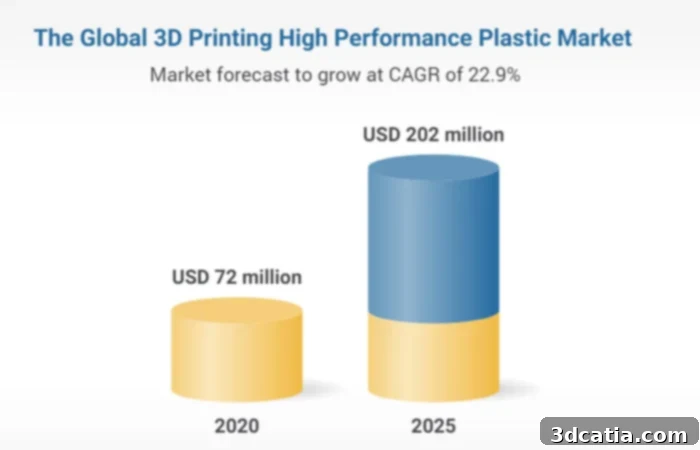
The high-performance polymers market is expected to register an annual growth of 22.9% (Photo Credit: Research and Markets)
Leading Polymers and Evolving Technologies Driving Growth
The Research and Markets report identifies specific polymers that are spearheading the growth in the high-performance additive manufacturing market. Among these, PEEK and PEKK, both belonging to the high-performance PAEK (Polyaryletherketone) family, stand out for their exceptional growth in both volume and value. These materials are highly sought after for their outstanding mechanical properties, thermal stability, and chemical resistance, making them ideal for engineering applications.
Notably, PEEK holds a particularly prominent position within the medical sector. Its excellent biocompatibility, coupled with its ability to withstand sterilization processes, makes it an ideal material for producing personalized implants. Its properties are remarkably similar to those of human bone, which significantly aids in osseointegration—the direct structural and functional connection between living bone and the surface of a load-bearing implant. This characteristic not only enhances patient recovery but also improves the long-term success rate of implants. The report further highlights the potential for certain high-performance polymers to serve as advanced alternatives to traditional metal spinal and orthopedic implants, offering benefits such as reduced stress shielding, improved imaging compatibility, and enhanced patient comfort. This shift underscores the transformative impact these materials are having on modern medical device manufacturing.
Material Forms and Processing Innovations
Regarding the physical forms in which these advanced polymers are utilized, the study indicates that filaments and granules currently dominate the market. In 2019, filaments generated the most revenue, largely attributed to their widespread compatibility with FDM (Fused Deposition Modeling) machines, which are common across various industrial and professional settings. Leading manufacturers such as Arkema, Solvay, Evonik, and Victrex are actively developing and supplying high-performance polymer solutions in the form of plastic granules. This addresses a significant demand in the sector, particularly for large-format 3D printing and pellet extrusion processes, which can offer faster production rates and lower material costs for high-volume applications.
Despite the current dominance of filaments and granules, the report predicts that polymer powders are poised for substantial growth in the coming years. This anticipated evolution is likely to be fueled by increased adoption from demanding industries such as defense and aerospace, where the isotropic properties and design freedom offered by powder bed fusion processes are highly valued. Furthermore, ongoing research and development into new powder compositions and advanced processing techniques for powder bed systems are continually expanding their capabilities and opening up new application areas. This includes innovations in material science that enhance printability and final part performance for these specialized polymer powders.

Powders could see important developments (photo credit: Evonik)
In terms of additive manufacturing technologies, Selective Laser Sintering (SLS) has been identified as the fastest-growing technology within the high-performance polymer market. SLS offers unparalleled design freedom, enabling the creation of complex geometries and intricate internal structures without the need for support materials. This capability is particularly advantageous for high-performance applications where lightweighting and functional integration are critical. Currently, the availability of SLS machines compatible with high-performance polymers is somewhat limited due to the specialized hardware and precise thermal control required. However, ongoing technological advancements and increasing investment in R&D are rapidly expanding the range of compatible machines and processes. This expansion is expected to broaden the applications of HPPs in sectors such as consumer goods, where customization and complex designs are key, as well as in the automotive and aeronautics industries, where the demand for high-performance, lightweight components is ever-present.
Global Market Dynamics and Future Outlook
The study also provides a geographical breakdown, highlighting the most promising regions in terms of market volume and value. North America, and more specifically the United States, is identified as the primary market for high-performance polymers in additive manufacturing. This dominance is driven by a strong innovation ecosystem, significant R&D investments, and the presence of key industry players. Leading companies such as Stratasys, Oxford Performance Materials, 3D Systems, and 3DXTECH are at the forefront of developing and commercializing HPP solutions, contributing to the region’s robust market position.
Europe follows closely behind North America, with a strong manufacturing base and a growing adoption of advanced additive manufacturing technologies across its diverse industrial sectors. The APAC (Asia-Pacific) region is also demonstrating significant growth potential, fueled by expanding manufacturing capabilities, increasing investment in industrial digitalization, and a rising demand for advanced materials in countries like China, Japan, and South Korea. While the global health crisis undoubtedly impacted the broader polymer market, causing a temporary slowdown in growth forecasts from previous years, additive manufacturing demonstrated its inherent resilience and adaptability. The ability of 3D printing to rapidly respond to urgent needs, particularly in the medical sector—such as producing PPE and critical medical device components—showcased its strategic value. This experience strongly suggests that growth in the high-performance polymer market for additive manufacturing can quickly rebound, with 3D technologies having a crucial role to play in future industrial resilience and innovation.
Addressing Challenges and Paving the Way Forward
Despite the immense promise of high-performance polymers in additive manufacturing, several challenges need to be addressed for their widespread adoption. The relatively high cost of these specialty materials compared to conventional plastics can be a barrier for some applications, though the value proposition often justifies the investment for critical parts. Furthermore, the complexity of processing these materials, requiring precise temperature control, specialized machinery, and often a controlled build environment, can increase operational costs and necessitate skilled operators. The limited availability of compatible 3D printing systems for certain HPPs, particularly for newer material formulations or specific technologies like SLS, also presents a bottleneck.
However, ongoing advancements in material science are leading to the development of more affordable and easier-to-process HPPs. Innovations in 3D printer technology are producing more accessible and robust machines capable of handling these demanding materials. Collaborative efforts between material suppliers, printer manufacturers, and end-users are crucial for developing optimized workflows and expanding the application spectrum. As these challenges are systematically overcome through continuous research and development, standardization, and education, the market for high-performance polymers in additive manufacturing is set to unlock its full potential, driving innovation across countless industries.
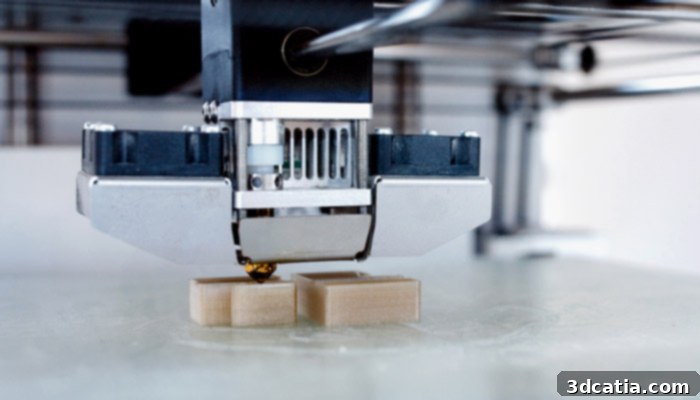
Photo credit: Solvay
The future of manufacturing is intrinsically linked to the evolution of materials, and high-performance polymers are undoubtedly at the forefront of this revolution within additive manufacturing. Their unique properties, coupled with ongoing technological advancements, promise to unlock unprecedented design possibilities, improve component performance, and drive efficiency across a multitude of industries. The market’s significant growth forecast underscores the increasing recognition of these materials’ value and their indispensable role in shaping the next generation of 3D printed parts. You can order the detailed study to gain deeper insights into this burgeoning market HERE.
Do you currently integrate high-performance polymers into your additive manufacturing processes? Share your experiences and insights with us by leaving a comment below or connecting with us on our Facebook, Twitter, and LinkedIn pages! To stay informed about the latest developments and breakthroughs in the 3D printing world, be sure to sign up for our free weekly Newsletter here, delivering all the essential news straight to your inbox!
* Cover photo credit: miniFactory